Picture a farmer in a village an hour from the nearest branch. He has a bank account but no debit card in his pocket today. At the local shop, the shopkeeper holds up a small device, asks for his Aadhaar number, presses a fingerprint reader, and hands over ₹3,000 in cash. That is an Aadhaar cash withdrawal, and it happens millions of times a month through the Aadhaar Enabled Payment System, or AePS.
It is useful where ATMs are scarce, and it is also a service where a cloned fingerprint can empty an account. This guide explains how AePS and micro ATMs work, the limits, the charges and the habits that keep your money safe.
What AePS is and who runs it
AePS is a payment service run by the National Payments Corporation of India (NPCI). It lets a bank customer use Aadhaar as identity to reach an Aadhaar-enabled bank account and do basic transactions. NPCI describes these as balance enquiry, cash deposit and cash withdrawal, and the service has also been used for mini statements and Aadhaar to Aadhaar transfers.
The key difference from a debit card is that you do not need a card, a PIN or even a phone. The bank account is looked up through your Aadhaar number, and your fingerprint or iris scan, checked against the UIDAI database, is the proof that it is you.
The Reserve Bank has noted that AePS is used for digital payments in an assisted mode, with over 37 crore users in 2023. That figure came from the RBI’s own February 2024 policy announcement, which also said the system needed tightening after fraud reports. We come back to that below.
Who does the transaction for you
A person at a shop, kiosk or business correspondent point does it. The RBI calls this person an AePS touchpoint operator, and the operator’s bank, the acquiring bank, must vet and monitor the operator.
How micro ATMs fit in
A micro ATM is a small handheld device that a business correspondent (BC) carries or keeps at a counter. It reads a card or a fingerprint, connects to the bank through a phone network, and lets the BC give cash from his own cash float. Think of it as a very small ATM that a person operates for you.
So the two terms overlap. AePS is the service that uses your Aadhaar and biometrics. A micro ATM is one of the devices on which an AePS withdrawal can be done. A micro ATM can also be used with a debit card and PIN, and a compliance news service reported that NPCI notified in October 2025 that cash withdrawal on a micro ATM through UPI at BC points had been enabled too.
| Feature | AePS | Micro ATM |
|---|---|---|
| What it is | A payment service run by NPCI | A handheld device at a BC point |
| What you give | Aadhaar number and fingerprint or iris | Debit card and PIN, Aadhaar biometrics or, at some points, UPI |
| Who handles cash | The shop or BC | The shop or BC |
| Typical use | Villages, small towns, people without cards | Places with no ATM nearby |
The steps of an Aadhaar cash withdrawal
An Aadhaar cash withdrawal normally runs like this.
- You tell the operator the amount you want and your bank’s name.
- The operator enters your Aadhaar number, or the 16-digit virtual ID if the device accepts it.
- You place your finger on the scanner or give an iris scan.
- The device sends the request to your bank through NPCI, and your bank debits the account.
- The operator pays you the cash, and the device prints or shows a slip.
- Your bank sends an SMS alert for the debit.
Check the SMS before you leave the counter after any Aadhaar cash withdrawal. If the cash did not come out but the SMS shows a debit, tell the operator at once and note the time, the amount and the operator’s name.
Limits on cash withdrawal through AePS
This is the part where most online articles disagree, and you should treat any single number with care. I could not read NPCI’s own pages on limits, so the figures below come from secondary reports and should be checked with your bank.
- Reports commonly cite ₹10,000 as the cap on one AePS withdrawal.
- A summary of an NPCI circular from November 2023 says NPCI recommended that banks allow a cumulative ₹50,000 a month for AePS cash withdrawals, counted on a rolling 30 days.
- Your own bank can set a lower limit than NPCI does. It may also cap the number of transactions.
As an illustration, say you need ₹25,000 in cash for a medical bill. If your bank applies a ₹10,000 limit per withdrawal, you would need three transactions. AePS suits small, everyday cash needs. For larger amounts, a branch withdrawal or a UPI transfer is cleaner.
Our guide on ATM withdrawal charges covers the free limits on a debit card.
Charges on an Aadhaar cash withdrawal
Many readers ask whether AePS costs extra. The honest answer is that I could not find a verified customer fee schedule from NPCI or the RBI for AePS withdrawals, so check your own bank’s schedule of charges before you assume the service is free. Do not pay anything extra to the operator for a standard withdrawal that your bank has not told you about.
The operator is paid by the system. Business Standard reported in March 2025 that pricing on micro ATM transactions continues to be half a per cent of the transaction value or ₹15, whichever is lower, and that the higher ATM interchange fee from May 2025 does not apply to micro ATM transactions. That is a fee between banks and operators, not a charge on you.
How AePS fraud happens
The fraud pattern is simple and has been in the news for several years. Your fingerprint is not secret. You leave it on registers, on property documents, on SIM forms and on door locks. Criminals collect these prints, copy them onto a silicone or similar surface, and use them on an AePS device along with your Aadhaar number, which is also not secret. The device sees a valid print and the money moves.
The RBI’s own statements show the concern. In February 2024 it said it would streamline how AePS touchpoint operators are signed up and consider extra fraud risk measures. In June 2025 it issued formal directions, effective 1 January 2026, noting they were meant to curb AePS fraud caused by identity theft or compromised customer credentials.
What the RBI now requires from banks
The June 2025 directions for acquiring banks include these points.
- Do full due diligence on every operator before onboarding, using the KYC Master Direction, 2016.
- Update operator KYC periodically.
- If an operator has had no transaction for three continuous months, finish KYC again before allowing more.
- Monitor each operator’s activity on an ongoing basis, with parameters set by location, type of operator and the volume and speed of transactions.
- Make sure technology links such as APIs are used only for AePS operations.
These rules fix the operator side, which is why your own settings matter.
Lock your biometrics and other safety steps
UIDAI offers a free facility to lock your biometrics. A February 2026 government statement, as reported in the press, lists the biometric lock feature among the measures taken against identity fraud. Once locked, your fingerprint and iris cannot be used for authentication until you release the lock, which in turn stops an AePS withdrawal that depends on them. Media reports describe it as available through the UIDAI website and the mAadhaar app, with an OTP sent to your registered mobile number.
Two cautions. The detailed steps and timings differ between reports, so follow the current menu on the UIDAI site or the app. And the release of the lock is described as temporary, so if you need biometrics for something else, such as a SIM or a government service, release it only for as long as you need and lock it again.
Here is a short set of habits that works alongside the lock.
- Keep SMS alerts on for the account and use a mobile number your bank has on file.
- Never give your fingerprint to anyone who says it is for a “verification” and does not show a bank reason.
- Read the amount on the device screen before you place your finger.
- Transact only at a known shop.
For the full steps of reporting online fraud, see our guide on how to report online fraud.
If money has been taken from your account
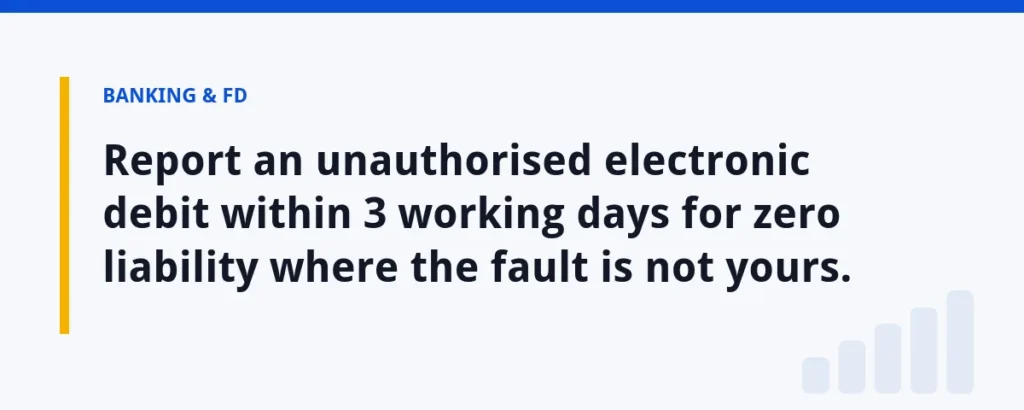
Speed matters. The RBI’s 2017 circular on limiting customer liability covers unauthorised electronic banking transactions, split into remote and face-to-face. It says the customer has zero liability if the fault lies with the bank, or if the fault lies elsewhere in the system and the customer reports within three working days of the bank’s communication. If you report within four to seven working days, your liability is capped at the lower of the transaction value or a set amount, which is ₹5,000 for basic savings accounts and ₹10,000 for other savings accounts. After seven working days, the bank’s board-approved policy applies. The bank must credit the disputed amount to your account within 10 working days of your report, without waiting for an insurance claim.
The circular lists ATM and POS use under face-to-face transactions and does not name AePS. So when you write to your bank, describe the case as an unauthorised electronic transaction, cite the RBI circular, and ask for the bank’s written reply. Do not assume the outcome. If the bank does not respond properly, the RBI Ombudsman route is available, and we have a guide on it.
| When you report | Your liability if the fault is outside you and the bank |
|---|---|
| Within 3 working days | Zero |
| 4 to 7 working days | Lower of the amount or ₹5,000 to ₹10,000, depending on the account |
| After 7 working days | As per the bank’s board-approved policy |
Report the fraud in these steps.
- Call your bank’s 24×7 line and block further use, then ask for a complaint number.
- Lock your Aadhaar biometrics at once so the fraud cannot be repeated.
- Call the national cyber crime helpline, 1930, or file a report on the cybercrime portal, and keep the reference.
- Write to the bank the same day, listing the date, time, amount and operator details.
- Keep every SMS, slip and screenshot.
When to use it and when to skip it
An Aadhaar cash withdrawal through AePS is a fair choice if you live far from an ATM, if you are elderly and cannot manage a card, or if your cash needs are small. It is a poor choice if you have a working debit card and an ATM nearby, since the card needs a PIN that you control, and a fingerprint is something you cannot change.
A good middle path is to keep your Aadhaar biometrics locked by default and release the lock only on the days you plan to use AePS.
Key takeaways
- AePS lets you withdraw cash with Aadhaar and a biometric at a BC point or shop, without a card or PIN.
- A micro ATM is a device on which such withdrawals are done, run by a person you transact with.
- Reported limits are about ₹10,000 per withdrawal and a ₹50,000 rolling monthly cap, but your bank may set lower limits, so confirm with it.
- Fraud usually uses copied fingerprints and Aadhaar numbers, and not your PIN, so keep biometrics locked when you do not need them.
- Report any unauthorised debit within three working days to keep your liability at zero where the fault lies outside you and the bank.
For planning your own cash flow, our FD calculator may help you decide how much to keep in hand and how much to keep invested.