You send ₹45,000 to a plumber at 11 pm on a Sunday, and the money leaves your account but he says nothing has arrived. Or you transfer ₹6 lakh for a flat booking and wonder whether the bank will take it today. Or you key in one wrong digit in an account number and your heart sinks. These are the everyday moments when it matters which rail you used.
India has three main bank-to-bank transfer systems, and NEFT RTGS IMPS are the names every account holder meets. All three now run round the clock, but they differ in minimum amounts, speed, charges and what happens when something fails. This guide compares them side by side using RBI and NPCI material, and then covers how to trace a failed transfer and what to do when money goes to the wrong account. It is general information, not advice for your case.
NEFT RTGS IMPS in one view
NEFT, the National Electronic Funds Transfer, settles in batches. RTGS, Real Time Gross Settlement, settles each transfer one by one and is meant for large amounts. IMPS, Immediate Payment Service, is run by NPCI and credits the receiver within seconds. UPI sits on top of the same instant rail and has its own guide on this site.
| Feature | NEFT | RTGS | IMPS |
|---|---|---|---|
| Availability | 24×7, every day | 24×7, every day (since 14 December 2020) | 24×7, every day |
| How it settles | In half-hourly batches | One by one, in real time | Instant, within seconds |
| Minimum amount | None stated by RBI | ₹2 lakh | None |
| Maximum amount | No RBI limit, bank may set one | No RBI limit | ₹5 lakh per transaction on most channels |
| Run by | RBI | RBI | NPCI |
The simple rule of thumb: IMPS for small urgent payments, NEFT for most routine transfers, RTGS for ₹2 lakh and above where you want the money in the receiver’s account quickly.
Timings and how fast the money arrives
Until 2019 NEFT worked only in office hours. From 16 December 2019 it runs in 48 half-hourly batches through the day and night, and RTGS followed on 14 December 2020. That means a Sunday-night transfer by either route will go through, though your own bank’s app may still show maintenance windows.
For NEFT, RBI says the beneficiary bank should credit the account within two hours of the batch settling. So a transfer you start at 10.50 am joins the 11 am batch and should land by about 1 pm at the outside, often much sooner. For RTGS the rule is tighter. The beneficiary bank should credit within 30 minutes of receiving the message. IMPS is instant, because each payment is processed as it comes.
Limits for each system
RTGS has a floor, not a ceiling. The minimum is ₹2 lakh, with no upper cap from RBI. Anything below that must go by NEFT or IMPS.
NEFT has no RBI-imposed maximum either. Your bank may set its own cap based on its risk assessment, with Board approval, so the real limit is whatever your bank’s app allows. A person without a bank account can also deposit cash at a branch for a NEFT transfer, up to ₹50,000 per transaction.
IMPS carries a cap of ₹5 lakh per transaction. RBI proposed the rise from ₹2 lakh in October 2021, and NPCI now states the ₹5 lakh figure for all channels except SMS and IVR. Banks can set their own limits for each channel, so a mobile app and an ATM may allow different amounts. If you need to send ₹7 lakh in one go, RTGS is the right rail.
Charges you can be asked to pay
Receiving money is free under RBI’s rules for NEFT and RTGS, and IMPS receipts are generally free too, though IMPS pricing is each bank’s call. Sending is where charges can appear, and RBI sets ceilings only for some of them.
- NEFT: there is no charge to the person receiving. RBI stopped charging banks from 1 July 2019, and from 1 January 2020 banks must not charge savings account holders for online NEFT. For other outward NEFT, banks can charge no more than ₹2.50 up to ₹10,000, ₹5 above ₹10,000 up to ₹1 lakh, ₹15 above ₹1 lakh up to ₹2 lakh and ₹25 above ₹2 lakh, plus GST.
- RTGS: inward transfers are free. For outward transfers a bank can charge up to ₹25 plus tax for ₹2 lakh to ₹5 lakh, and up to ₹50 plus tax above ₹5 lakh. RBI has also waived its own RTGS processing charges since 1 July 2019.
- IMPS: we did not find an RBI ceiling for IMPS fees on the pages we read, so the charge is whatever your bank states in its tariff. Check the schedule before a big transfer.
As an illustration, say you send ₹3 lakh by RTGS from a branch. The bank may charge up to ₹25 plus GST. Sending the same amount by online NEFT from a savings account costs nothing, but it arrives in the next batch rather than within minutes.
Which one to use when
Your choice comes down to amount and urgency. Use IMPS when the receiver needs money now and the amount is below ₹5 lakh, such as an emergency payment at night. Use NEFT for rent, fees, EMIs and most family transfers, because it is usually free online from a savings account and reliable. Use RTGS for large payments such as a property advance, a business payment or a fixed deposit funding of ₹2 lakh or more.
If you are moving money into a deposit, our FD calculator will show what the amount earns. If the money is for an EMI, see what you will pay with the EMI calculator before you transfer the first instalment.
What happens when a transfer fails
Failures come in two kinds. In the first the transfer is refused and the money never leaves. In the second the money is debited but the receiver is not credited. The second is the one that worries people, and RBI has set deadlines for it.
| System | If money is debited but not credited | Compensation |
|---|---|---|
| NEFT | Receiving bank must credit, or return the money to the sending branch, within two hours of the batch completing | Penal interest at the RBI repo rate plus 2% if the delay goes beyond that, paid without a claim |
| RTGS | Credit within 30 minutes. If it fails, the money goes back to the sending bank within one hour or before the RTGS day ends, whichever is earlier | Compensation at repo rate plus 2%, credited without a request |
| IMPS | Receiving bank must reverse automatically by T+1, where T is the transaction day | ₹100 for each day of delay beyond T+1, credited to your account without a complaint |
A failed NEFT usually shows up in your statement as a return entry. The IMPS rule comes from RBI’s turnaround time framework of September 2019, which took effect on 15 October 2019.
How to trace a failed transfer
- Check your bank statement and the app’s transaction history. Note the date, time, amount, UTR or reference number and the beneficiary details.
- Wait for the deadline for the system you used, as in the table above. Many reversals arrive on their own.
- If the money has not come back, call or message your bank’s customer care and raise a complaint with the reference number. Ask for a complaint number in writing.
- Ask the bank to confirm whether the beneficiary bank has credited the account, and request the compensation due for the delay.
- If the bank does not reply within 30 days, or you are not satisfied, complain to the RBI Ombudsman.
The RBI Ombudsman scheme now in force, the Reserve Bank – Integrated Ombudsman Scheme, 2026, took effect from 1 July 2026. You must complain to the bank first. You can go to the Ombudsman if the bank does not reply within 30 days or if you are unhappy with the reply. The complaint should reach the Ombudsman within 90 days of the later of the end of the waiting period or the bank’s last reply. Filing is free, at the cms.rbi.org.in portal, by email to crpc@rbi.org.in, or by post to the Centralised Receipt and Processing Centre in Chandigarh. The scheme allows up to ₹30 lakh for consequential loss and up to ₹3 lakh for lost time, expense and harassment.
Money sent to the wrong account
This is the harder case, because the transfer did not fail. It worked, but for the wrong person. Both RBI’s NEFT and RTGS pages say the credit is made on the basis of the account number alone, and that it is the remitter’s responsibility to enter it correctly. The beneficiary name is only a supporting detail, and a mismatch does not automatically stop the credit.
If it happens, act within minutes. Tell your bank at once, in writing, with the transaction reference, the amount and the account you meant to pay. Ask it to contact the beneficiary’s bank. The bank can request the account holder to return the money, but it cannot take the money out of someone else’s account without their consent, so a return is not guaranteed. If the recipient refuses, the next steps are a legal notice or a police complaint.
If you suspect you paid a fraudster rather than made a mistake, call the national cyber fraud helpline 1930 or report at cybercrime.gov.in straight away. The Home Ministry runs 1930 for immediate reporting of financial fraud, and speed improves the chance of freezing the money.
The best protection is prevention. RBI’s RTGS page mentions a free name look-up facility that lets you check the account holder’s name registered with the beneficiary bank before you pay. Many banking apps show the name as a confirmation step. Use it, and send a small test amount to a new payee before a large payment.
Key takeaways
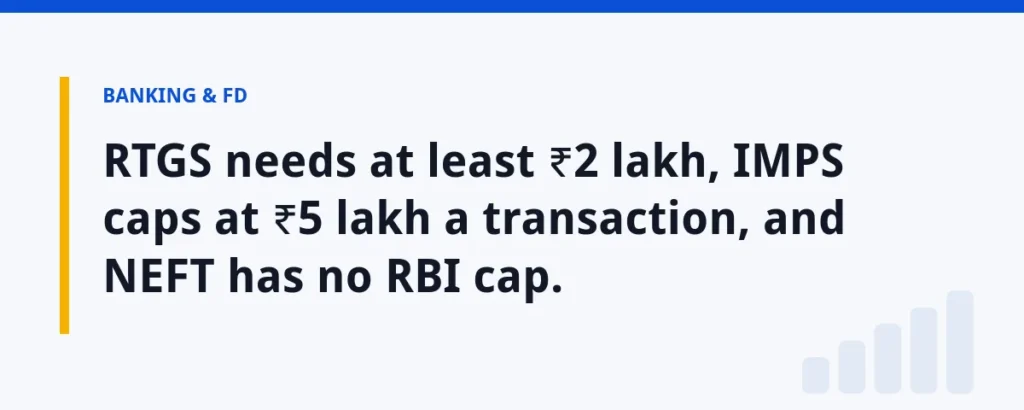
- NEFT RTGS IMPS all run 24×7. RTGS needs at least ₹2 lakh, IMPS caps at ₹5 lakh a transaction, and NEFT has no RBI cap.
- Online NEFT from a savings account is free. RTGS and branch NEFT charges have RBI ceilings, and IMPS charges are set by each bank.
- For a failed transfer, NEFT and RTGS carry repo-plus-2% compensation, and IMPS pays ₹100 a day beyond T+1, all without a claim.
- Credit is by account number only, so a wrong digit can send money to a stranger. Check the name, and test with a small amount first.
- Complain to the bank first, then to the RBI Ombudsman after 30 days, and report fraud to 1930 immediately.