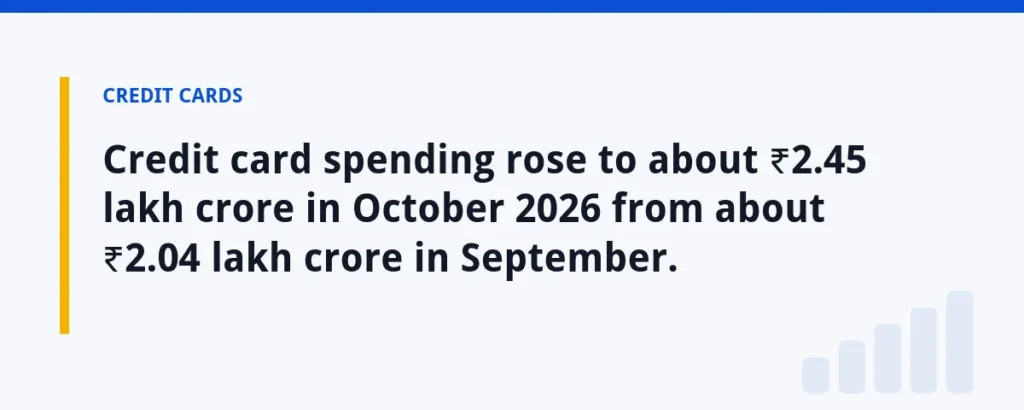
Credit card spending in India rose to about ₹2.45 lakh crore in October 2026, up nearly 20% from about ₹2.04 lakh crore in September, according to RBI data reported by IANS on 25 November 2026. The jump comes after a rare dip: September spends fell 5.9% from a year earlier, the first annual fall since February 2021, CareEdge Ratings said in a report covered by Moneycontrol on 28 October.
So what looked like a slowdown in September turns out to be mostly a calendar story. Festive sales and Navratri moved into October this year, and card swipes moved with them. If you use a card, the numbers say something useful about timing, about how many of us now hold cards, and about what happens when a bill is not cleared in full.
What the RBI data shows on credit card spending
RBI publishes bank-wise ATM, POS and card statistics every month, and its page now lists the October 2026 report. The figures below come from newspaper and research-house readings of that data, so small differences between sources are normal.
| Measure | September 2026 | October 2026 |
|---|---|---|
| Credit card spends | about ₹2.04 lakh crore | about ₹2.45 lakh crore |
| Online (e-commerce) spends | about ₹1.26 lakh crore | about ₹1.54 lakh crore (63% of total) |
| In-store (POS) spends | ₹77,751 crore | ₹90,562 crore |
| Cards in force | about 12.53 crore | about 12.67 crore |
| Cards added in the month | about 12.6 lakh | about 14 lakh |
CareEdge put the October spend at 14.3% higher than a year earlier. For September, a separate Jefferies note put the fall at 6.2% against CareEdge’s 5.9%, because the two use slightly different datasets. Neither reading changes the story.
Why September fell and October bounced back
September 2025 was an unusually strong month. GST rate cuts had just taken effect and the big online festive sales began in late September, so September 2026 was being compared with a very high base. This year Navratri fell in October, and the online sales moved with it. Reports noted that spends were down only marginally from August to September, which suggests the weakness was in the comparison, not in everyday buying.
CareEdge also pointed to a few other factors for September: fewer high-value festive purchases, more people paying through UPI with a card linked to it, and weak air travel. Those are the research house’s reading, not an official finding.
Smaller tickets, more swipes
The October data shows 68.3 crore card transactions, up 32% from a year earlier, while the average transaction fell to about ₹3,585 from ₹4,133. In plain words, people are using cards for more everyday payments of smaller size, not only for big appliances and flights.
More cards, but not necessarily more spending per card
The number of cards keeps growing at roughly 10% a year. In September, average spending per card was ₹16,305, down 14.8% from a year earlier. For October, simple division of ₹2.45 lakh crore by about 12.67 crore cards gives roughly ₹19,300 a card. That is our own illustration, not an RBI figure, and it treats every card as active, which many are not.
The gap between cards held and cards actively used matters. A household that holds four cards and uses one is counted as four cards. Reports on the September data noted that more cards may not mean more active users, and that some spending may have shifted to other payment methods.
What festive timing means for your own budget
Your bill for a spend made in October usually arrives in November or early December, so the festive hangover often lands in the weeks after Diwali. Check your statement dates, not just the swipe date. A purchase made one day after the statement date can push the payment almost two months away, while one made the day before can fall due much sooner.
- Write down your statement date and due date for each card you hold.
- Note the total of festive purchases made on EMI offers and when each instalment starts.
- Set aside the full bill amount in your savings account the day you make a big purchase.
The cost of not paying in full
RBI’s credit card directions for commercial banks, dated 28 November 2025 and updated as on 1 October 2026, set the basic rules. The interest-free period runs from the transaction date to the due date. If you pay only part of the bill or miss the due date, the interest-free period is lost, and interest is charged from the transaction date on the outstanding amount. Late payment charges apply only on the outstanding amount after the due date, and late-payment reporting applies only when the account stays past due for more than three days.
Each statement must carry a warning that paying only the minimum amount each month stretches repayment over months or years. The minimum due must also be set so that it does not lead to negative amortisation, meaning your balance should not keep growing even while you pay the minimum.
A worked example
The directions leave each issuer to set its own rate, and we do not name any. As an illustration, assume 40% a year, or about 3.33% a month, on a ₹50,000 balance left unpaid for three months with compounding monthly. The balance grows to roughly ₹55,170, an extra ₹5,170, before any late fee or tax. A festive bill is far better cleared in full, and if you cannot, compare the cost of a loan first.
What to watch in the next data release
Two readings are worth following when the November figures come out. First, whether spends fall back after the festive burst, as they did in earlier years once festivals ended. Second, whether growth in cards in force keeps outpacing growth in spends per card. If it does, issuers are adding customers faster than customers are using their cards.
You can check the monthly cost of a large purchase on our EMI calculator before choosing how to pay.
Key takeaways
- Credit card spending was about ₹2.45 lakh crore in October 2026, after about ₹2.04 lakh crore in September.
- The September dip reflected a high base and festive sales that moved into October, not a collapse in demand.
- Cards in force reached about 12.67 crore, but spend per card is the number to watch.
- Pay the full bill by the due date; a part payment loses the interest-free period.
- Read your statement date, due date and the minimum-payment warning before any big festive purchase.
This article is general information based on reported data and RBI directions, not personal financial advice.