Anjali applied for a two-wheeler loan last month and was told her application needed “further review” because of something in her credit report. She had never missed an EMI. It turned out a credit card she closed three years ago still showed an unpaid balance of ₹1,800. That single wrong entry was pulling down her credit score, and fixing it took one complaint and about three weeks.
Your credit score is a three-digit number that tells lenders how you have handled loans and credit cards in the past. It affects whether you get a loan, how much you can borrow and, often, the interest rate you are offered. This guide explains who calculates it, what the numbers mean, what moves the score, how to get your free report every year and how to get errors corrected under RBI rules, including the compensation you are owed if the correction is late.
What a credit score is
A credit score is a summary of your credit report. The report lists your loans and credit cards, whether each account is current or past due, your repayment record and recent enquiries made by lenders. A credit information company (CIC) runs your report through its own model and produces a score that estimates how likely you are to repay.
Banks, non-banking finance companies, housing finance companies and other regulated lenders report their borrowers’ data to the CICs. Under RBI’s directions, from 1 July 2026 they must report as on the 9th, 16th, 23rd and last day of each month, sending changed accounts within four days of each date and a full file by the 5th of the next month. So a payment you make today should show up in your report within weeks, not months.
Your score is built from your credit record. A lender may still ask for income proof and bank statements separately when it assesses your application.
The four credit information companies
India has four CICs registered with the Reserve Bank of India under the Credit Information Companies (Regulation) Act, 2005. Each keeps its own database and calculates its own score, so your scores can differ slightly from one to another.
| Credit information company | Regulated by | Score scale |
|---|---|---|
| TransUnion CIBIL Limited | RBI | 300 to 900 |
| Equifax Credit Information Services Private Limited | RBI | 300 to 900 |
| Experian Credit Information Company of India Private Limited | RBI | 300 to 900 |
| CRIF Credit Information Services Private Limited (formerly CRIF High Mark) | RBI | 300 to 900 |
Lenders are required to report to all four CICs, and they may pull your report from one or more of them when you apply. That is why it pays to check your report with each of them at least once a year.
Credit score range and what the numbers mean
RBI requires all CICs to calibrate their credit scores on the same scale of 300 to 900, so that scores can be read in a consistent way. A higher score means lower risk in the CIC’s model. There is no single official cut-off for a “good” score, and each lender sets its own policy. CRIF’s own guidance is that a score above 700 is generally considered good.
Some people have no score at all. If a CIC cannot find enough credit history for you, you may get a “no history” report or an exclusion code rather than a number. That is common for students and first-time borrowers. It is not a black mark; it only means the lender has less to go on.
What affects your credit score
Each CIC uses its own model, but the main factors are similar. CRIF, for example, lists five:
- Payment history: whether you pay EMIs and card dues on time. Late payments lower the score.
- Credit utilisation: how much of your available card limits you are using. A rising card balance signals a growing repayment burden.
- Length of credit history: a longer record of responsible use helps.
- Credit mix: experience with different kinds of credit, such as a home loan, a vehicle loan and a credit card, can help.
- New credit: opening several accounts in a short time can lower the score.
How a late card payment is reported
RBI’s credit card directions say a card issuer can report your card account as past due to the CICs, or levy late payment charges, only when the account has been past due for more than three days. The days are counted from the payment due date on your statement. So paying a day late should not damage your record, but a habit of paying a week or two late will.
As an illustration of utilisation, say you have two cards with a combined limit of ₹2 lakh and you regularly carry ₹1.6 lakh on them. That is 80% of your limit in use. Bringing the balance down to ₹50,000, or 25%, tells lenders you are not stretched, even though your income has not changed.
How lenders use your credit score and report
RBI directs lenders to build credit reports into their loan policies, so that credit decisions are based on the information available in the system. In practice a lender pulls your report when you apply for a loan or a card, looks at the score and then reads the detail: existing EMIs, card balances, any overdue amounts, settled or written-off accounts and how many enquiries you have made recently.
The score can affect three things: whether you are approved, how much you can borrow and the rate or terms you are offered. Card issuers also use CIC data when deciding your credit limit, taking into account limits you already enjoy with other lenders.
Two RBI rules protect you here. First, information about loans you were refused earlier must not be reported by CICs, so one rejection cannot be used by the next lender as a reason to reject you. Second, CICs must send you an SMS or email alert when a lender accesses your report, and lenders must alert you when they report a default or overdue status, wherever your mobile number or email is on record. If you get an alert for an enquiry you never made, take it up at once: it could be a mistake or an attempt at fraud.
Getting your free credit report every year
Every CIC must give you one free full credit report, including your credit score, once in each calendar year (January to December), in electronic form, after verifying your identity. The free report must carry the same detail as the most detailed version lenders receive, and each CIC must display the link to it on its homepage.
Because there are four CICs, you can get four free reports a year. Many people spread them out, one every three months, so that they see their record regularly at no cost. When you get the report, check:
- Your name, date of birth, PAN and address.
- Every loan and card listed: do you recognise all of them?
- Closed accounts: are they shown as closed, with zero balance?
- Days past due: do any months show late payments you did not make?
- Enquiries: did you actually apply to each lender listed?
How to correct errors in your credit report
You can raise a dispute either with the lender that reported the data (the credit institution) or with the CIC. Where the error involves data from more than one lender, register the complaint with the CIC, which then coordinates with all the lenders concerned.
- Note the account number and the exact entry that is wrong.
- Raise the dispute online with the CIC, or write to the lender, attaching proof such as a closure letter or no-dues certificate.
- Give your bank account or UPI details in the complaint form so any compensation can be credited.
- Keep the complaint reference number and track the dates.
RBI timelines and compensation for delay
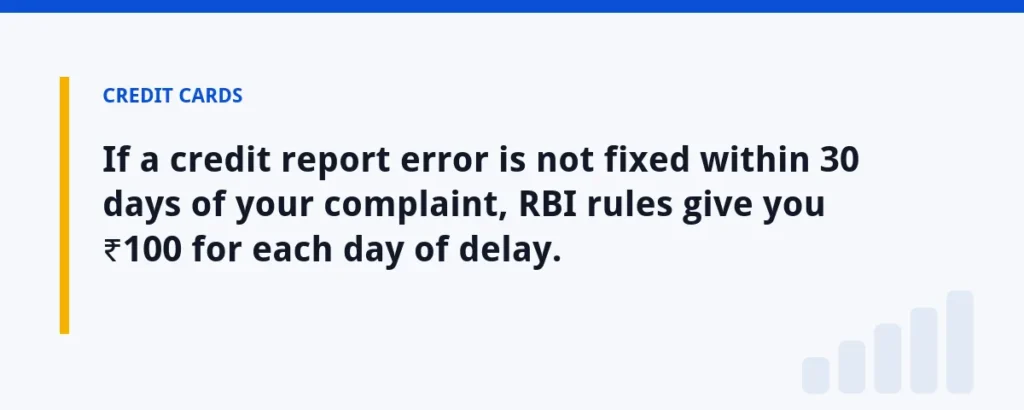
The law gives lenders and CICs together 30 days to resolve a complaint. RBI’s directions split this: the lender gets 21 days to send corrected data to the CIC, and the CIC gets the remaining nine days to complete the correction. If your complaint is not resolved within 30 calendar days of filing, you are entitled to compensation of ₹100 for every calendar day of delay.
The compensation is shared between the lender and the CIC according to who caused the delay, and must be credited to your bank account within five working days of the complaint being resolved. If either side wrongly denies compensation, you can approach the RBI Ombudsman under the Reserve Bank – Integrated Ombudsman Scheme, 2021. Note that the compensation does not cover disputes about how the score itself is computed.
As an illustration, if you filed a complaint on 1 March and the corrected report was sent to you on 10 April, the delay beyond 30 days is 10 days, so the compensation would be ₹1,000. If the lender or CIC rejects your request, it must tell you the reasons. If a correction is made, the CIC must also send a free copy of the corrected report to anyone who received your report in the previous six months. While a dispute is pending, you can ask for your comment to be added to the report.
Habits that build a strong credit score
There are no shortcuts, but the steps are simple:
- Pay every EMI and the full card bill by the due date. Set up auto-debit for at least the minimum due as a safety net.
- Keep card balances well below the limit.
- Apply for new loans and cards only when you need them, and avoid several applications in a short span.
- Keep old, well-run accounts open where there is no cost, because a long history helps.
- When you close a loan, collect a no-dues certificate and check that your report shows it closed.
If you are planning a loan, the EMI calculator helps you pick an EMI you can pay on time every month, which matters more for your score than the size of the loan.
Key takeaways on your credit score
- Four RBI-registered CICs calculate credit scores on a common 300 to 900 scale.
- Payment history, card utilisation, length of history, credit mix and new credit shape the score; card dues are reported past due only after more than three days.
- You can get one free full report with score from each CIC every calendar year.
- Errors must be fixed within 30 days; after that you earn ₹100 a day in compensation.
- Escalate wrongful denial of compensation to the RBI Ombudsman.
Check your report before you apply for credit, not after a rejection. This guide is general information; for a specific dispute, keep your documents ready and follow the steps your lender and CIC set out.