
What happened
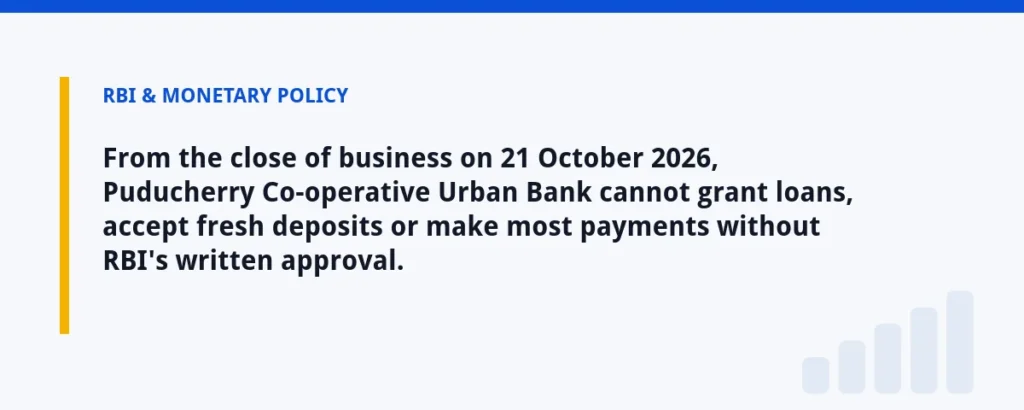
The Reserve Bank of India (RBI) has placed restrictions on Puducherry Co-operative Urban Bank Ltd. The directions, dated 19 October 2026, take effect from the close of business on 21 October 2026 and were announced the same day.
They were issued under Section 35A read with Section 56 of the Banking Regulation Act, 1949, which lets RBI direct a bank in the interest of depositors.
Without RBI’s prior written approval, the bank cannot:
- grant or renew loans and advances
- make any investment
- incur any liability, including borrowing funds or accepting fresh deposits
- pay out money, whether to meet its obligations or otherwise
- enter into any compromise or arrangement
- sell, transfer or otherwise dispose of its properties or assets
These curbs apply except as set out in the RBI direction itself, a copy of which the bank has been told to display on its website and premises.
What it means for you
If you hold an account at the bank, the key limit is cash access. Given the bank’s present liquidity position, it must allow withdrawal of no more than ₹5,000 from a savings, current or any other account of a depositor.
The bank may still let you set off a loan against your deposit, subject to conditions in the directions. It can also spend on essential items such as employee salaries, rent and electricity bills.
Your deposits are also covered by insurance. Eligible depositors can receive up to ₹5,00,000 from the Deposit Insurance and Credit Guarantee Corporation (DICGC), in the same capacity and the same right, under the DICGC Act, 1961. The claim depends on the depositor submitting willingness and on verification. Our guide to deposit insurance (DICGC) explains how the cover works.
For example, if one person held ₹3 lakh in a savings account and ₹1 lakh in a fixed deposit in the same name and capacity, both would count towards the ₹5 lakh ceiling. Depositors can contact bank officials or visit www.dicgc.org.in for details.
Borrowers should note that the restriction covers granting or renewing loans, so fresh credit or renewals need RBI’s approval.
Background
RBI says it had recently engaged with the bank’s board and senior management to improve its functioning. It says the bank made no concrete efforts to address supervisory concerns, and that protecting depositors’ interests made the directions necessary.
RBI states the directions should not by themselves be read as cancelling the bank’s banking licence. The bank continues its business, subject to the restrictions, until its financial position improves.
The directions stay in force for six months from the close of business on 21 October 2026 and are subject to review. RBI says it continues to monitor the bank and may modify the directions depending on circumstances and in depositors’ interest.