
Your employer offers a ₹1 lakh bonus today or ₹1.2 lakh three years from now. Most people feel the bigger number must win. It does not always, and the reason is the time value of money: a rupee in your hand today is worth more than a rupee promised later, because today’s rupee can earn interest, repay a loan or be spent before prices rise.
This guide is about the three ideas behind that sentence: future value, present value and discounting. They sit under every EMI, every fixed deposit and every retirement target. We use round numbers and assumed rates throughout, and each one is an illustration. The site already has a guide on compound interest and the rule of 72, which covers how growth builds up. Here we go the other way and ask what a future amount is worth today.
What the time value of money means
SEBI’s Financial Education Booklet puts it plainly: the value of the money you have now is not the same as it will be in the future. It gives the example of a lunch that cost a certain sum ten years ago and now buys only a portion of that meal for the same sum. Three forces are at work.
- Earning power. Money received today can go into a deposit, a fund or a loan repayment and start earning straight away.
- Falling purchasing power. Prices rise, so the same rupees buy less later. The RBI’s inflation target is 4 per cent with a tolerance band of 2 per cent on either side, so price rises of a few per cent a year are treated as normal, and over many years they add up.
- Uncertainty. A promise to pay you in five years may not be kept in full. Waiting carries risk.
None of this is a trick from finance textbooks. It is why a lender charges interest, why a fixed deposit pays it, and why a flat sold on a pay-later schedule should be priced differently from one sold for full payment today.
Future value: where today’s money ends up
Future value answers a simple question: if I put this sum away now, what will it become? With a yearly rate r and n years, the formula is future value = amount x (1 + r) raised to the power n. As an illustration, say you invest ₹1 lakh and it grows at 7% a year for 10 years. It becomes about ₹1.97 lakh. You can check this kind of arithmetic on the lumpsum calculator or the compound interest calculator.
Note what we assumed: that the interest is added back every year and stays invested. A deposit that pays out its interest instead of reinvesting it behaves differently, and the result changes with how often interest is added. Always check the compounding frequency of your product.
Present value and discounting
Present value runs the formula backwards. Instead of asking what ₹1 lakh becomes, you ask what a future sum is worth today. You divide by the same growth factor, and the rate you use is called the discount rate. The process is called discounting.
Present value = future amount / (1 + r) raised to the power n.
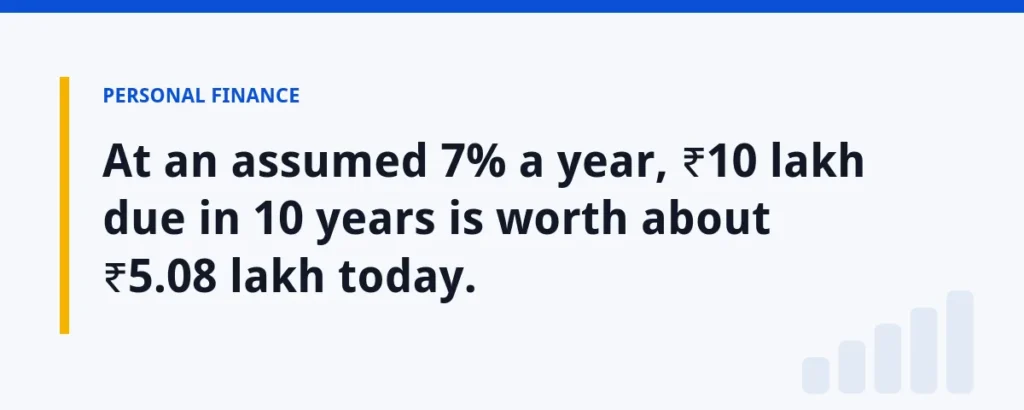
As an illustration, say you will need ₹10 lakh in 10 years for a course fee and you assume your money can earn 7% a year. The present value is about ₹5.08 lakh. If you set aside ₹5.08 lakh today and it really earns 7% a year, it grows to ₹10 lakh. If you would rather save in smaller monthly amounts, the SIP calculator works the same logic across a series of payments.
The discount rate is the whole game. It is the return you could reasonably earn on the money elsewhere, at similar risk. Pick a high discount rate and distant money looks nearly worthless. Pick a low one and it looks almost as good as cash in hand.
A quick look at discount factors
The multiplier you apply to a future rupee is called the discount factor. These figures are calculated for three assumed rates.
| Years away | At 5% a year | At 7% a year | At 9% a year |
|---|---|---|---|
| 5 years | ₹0.78 | ₹0.71 | ₹0.65 |
| 10 years | ₹0.61 | ₹0.51 | ₹0.42 |
| 20 years | ₹0.38 | ₹0.26 | ₹0.18 |
Read it this way: at 7%, a rupee promised 10 years from now is worth about 51 paise today. At 9%, a rupee promised in 20 years is worth about 18 paise. Each figure is an illustration, not a forecast.
Comparing offers that arrive at different times
Back to the bonus. Ask two questions. First, what rate does the later offer imply? Waiting three years to turn ₹1 lakh into ₹1.2 lakh works out to about 6.3% a year. Second, can you earn more than that elsewhere at similar risk? If a safe option pays you more than 6.3%, take the ₹1 lakh now and invest it. If your best safe option pays less, waiting is the better deal.
The same test works for many everyday choices.
- Lump sum versus instalments. A seller offers a ₹10 lakh price for paying everything now, or ₹1.25 lakh a year for ten years (₹12.5 lakh in total). At an assumed 7% discount rate, with payments at each year end, the instalments are worth about ₹8.78 lakh today. At today’s value the instalment plan is the cheaper one, even though its total looks higher.
- Early payment discounts. A supplier offering 2% off for paying a month early is paying you more than 24% a year to hurry. Whether to take it depends on what your cash could earn instead.
- Prepaying a loan. Putting spare cash into a loan earns you a certain return equal to the loan’s interest rate, before any tax effect. That rate is your discount rate for the decision.
Present value inside your loan EMI
Every EMI is a present value calculation. The lender gives you a sum today, and the EMIs you promise, discounted at the loan’s monthly rate, add up to exactly that sum. As an illustration, take a ₹10 lakh loan at an assumed 9% a year for 60 months. The monthly rate is 0.75% and the EMI works out to about ₹20,758. Discount all 60 of those EMIs at 0.75% a month and you get back ₹10 lakh. Try your own numbers on the EMI calculator.
This also explains the zero cost EMI offers on shopping sites. Say a ₹60,000 item is sold as six monthly instalments of ₹10,000 with no interest charged. If you assume your money could earn 12% a year (1% a month), those six instalments are worth about ₹57,955 at today’s value. The free credit is worth roughly ₹2,045 to you, but only if the price equals the cash price. Processing fees or a lost cash discount can wipe that out, so compare the total you pay with the cash price first, then do the discounting.
Inflation and the real value of a future goal
SEBI’s booklet tells investors to work out their real rate of return, meaning the return after allowing for inflation, and to try to invest at a rate equal to or higher than inflation. Discounting is the tool for this. If you assume prices rise 5% a year, ₹1 crore in 20 years has the buying power of about ₹37.7 lakh today. The number looks large on paper and feels much smaller when you spend it.
Go the other way for goals. If your household costs ₹50,000 a month today and you assume 6% inflation a year, the same lifestyle would cost about ₹1.6 lakh a month in 20 years, or around ₹19.2 lakh a year. A target set at today’s prices must be pushed forward by inflation before you work out what to save. The site’s guides on inflation and CPI, on the real rate of return and on how much you need to retire cover those pieces in detail, so we will not repeat them here.
Series of payments: SIPs, recurring deposits and pensions
Real life rarely has a single cash flow. A SIP, a recurring deposit or a pension is a series, and each payment has its own time value. The site’s SIP calculator uses a monthly rate equal to the yearly rate divided by 12, with the instalment at the start of the month. As an illustration, say you invest ₹5,000 a month for 15 years at an assumed 10% a year. You put in ₹9 lakh and the future value comes to about ₹20.9 lakh. For a fixed monthly deposit with a fixed rate, the RD calculator does the same job.
The reverse is a stream you will receive, such as a pension or rent. Its present value is the sum of each payment discounted back. This is how you judge whether a lump sum is a fair swap for a lifetime of monthly income. The answer swings sharply with the discount rate, so ask what rate is implied in any such offer before you accept.
Common mistakes with the time value of money
- Mixing nominal and real rates. If your goal is stated at today’s prices, use a return after inflation. If it is already inflated, use the plain return. Do not mix the two.
- Using an optimistic rate. A discount rate of 12% makes a future goal look cheap to fund. If you only earn 7%, you fall short. Test your plan at a lower rate as well.
- Forgetting tax and costs. Interest, fund charges and tax reduce what you actually keep. Use a rate after these where you can.
- Ignoring timing. Payments at the start of a period are worth more than the same payments at the end. Check the timing assumption.
- Treating a rate as a promise. Market returns are not guaranteed. Every calculation here assumes a steady rate, which real investments do not deliver.
Using the idea in a simple plan
You do not need a spreadsheet degree. A workable routine looks like this.
- Write each goal at today’s prices, with the year you need it.
- Push the amount forward with an assumed inflation rate to get the future cost.
- Pick a cautious, after-cost return for the money you will invest. Use a lower rate for goals within five years and a higher one for goals ten years or more away.
- Discount the future cost back to find the lump sum needed today, or use a calculator to find the monthly amount.
- Recheck once a year and adjust when rates, prices or goals change.
The site’s guide on goal-based financial planning goes through that process goal by goal, so use this guide for the maths and that one for the structure.
Key takeaways
- A rupee today is worth more than a rupee later, because it can earn a return and prices rise.
- Future value grows today’s money forward. Present value discounts a future sum back.
- The discount rate decides the answer. Use a realistic, after-cost rate and test a lower one.
- An EMI is the present value of a loan spread across months.
- Compare offers by their value on the same date, not by the totals printed on them.
- Every figure in this guide is an assumption for illustration, not a promise of returns. This is general information, not personal advice.