
Say you are 34, earn well, spend about ₹50,000 a month and have read that you can “retire at 40 with 25 times your expenses”. The idea is called FIRE, short for financial independence, retire early. FIRE in India is a real goal for a small but growing group of salaried people and professionals, and the arithmetic behind it is simple enough to do on the back of an envelope.
The trouble is that the headline numbers come from the United States, where inflation, returns and retirement systems are very different. This guide explains the idea, the “25 times” and “4% rule” shortcuts, why they need adjusting for Indian inflation, and the risks that the Instagram version of FIRE leaves out. It is general information, not personal advice, and every rupee figure marked as an illustration is an assumption, not a forecast.
What FIRE actually means
Financial independence means your investments can pay for your living costs without you needing a salary. Early retirement is a choice some people make once they get there. Many who reach it keep working part-time or switch to work they like.
Followers usually describe a few flavours. These are informal labels used by the community, not official categories.
- Lean FIRE: a small corpus and a tight lifestyle.
- Fat FIRE: a large corpus that supports a comfortable or expensive lifestyle.
- Coast FIRE: you have saved enough early that growth alone could carry the corpus to a normal retirement age, so you only need to cover current expenses.
- Barista FIRE: a part-time income covers some expenses, and the corpus covers the rest.
Whatever the flavour, FIRE in India rests on three numbers: what you spend, how much you save, and the return you can expect after inflation.
The 25 times rule and the 4% rule of thumb
The most quoted FIRE shortcut is that you need about 25 times your annual expenses. It is the same thing as saying you can withdraw 4% of the corpus in the first year (1 divided by 0.04 is 25), then raise that amount each year with inflation.
The 4% figure comes from US research. A financial planner, William Bengen, studied American market history from 1926 and reported in 1994 that a 4% first-year withdrawal, raised yearly for inflation, had not run out of money over any 30-year period he tested. A later study by three professors at Trinity University in 1998 looked at 15 to 30 year periods and found that 3% to 4% rates, adjusted for inflation, had a good chance of lasting 30 years. Later work using lower expected returns has suggested lower starting rates in some cases.
Treat this as a contested rule of thumb, not a rule and certainly not a rule for India. It rests on US stock and bond history, a 30-year retirement and a specific mix of assets. A person retiring at 40 may need the money for 50 years or more. India has different inflation, different asset returns and different tax and pension rules. Nobody knows what future returns will be, and a study period is not a promise.
The research also looks backwards, and it has critics on both sides: some say US data flatters the result, others say 4% is too cautious. Pick the rate as an assumption you will test.
How Indian inflation changes your FIRE in India numbers
The 25 times figure is only as good as the expense number you multiply. Your expenses a decade or two from now will be higher, and the corpus must be sized on those future expenses, not today’s. Here is an illustration with round numbers.
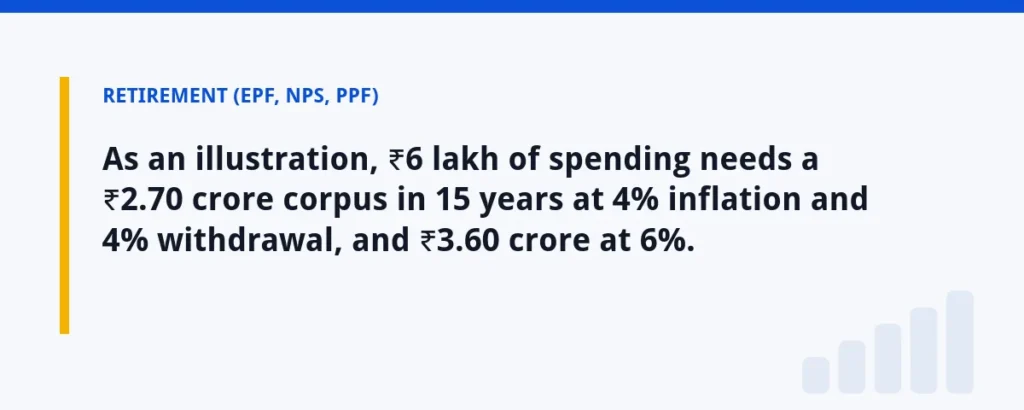
Say you spend ₹6 lakh a year today and want to stop working in 15 years. The table shows what that spending becomes, and the corpus needed at a 4% and a 3% first-year withdrawal. Inflation rates of 4%, 5% and 6% are assumptions chosen to show the effect.
| Assumed inflation | Yearly spending in year 15 | Corpus at 4% withdrawal | Corpus at 3% withdrawal |
|---|---|---|---|
| 4% a year | ₹10.8 lakh | ₹2.70 crore | ₹3.60 crore |
| 5% a year | ₹12.5 lakh | ₹3.12 crore | ₹4.16 crore |
| 6% a year | ₹14.4 lakh | ₹3.60 crore | ₹4.79 crore |
Two extra percentage points of inflation add about ₹90 lakh to the 4% target. Over a longer horizon the gap widens: ₹6 lakh of spending grows to roughly ₹28.8 lakh in 40 years at 4% inflation and about ₹61.7 lakh at 6%, more than double.
For context, the Reserve Bank of India works to a CPI inflation target of 4% with a tolerance band of 2% to 6%. That is the policy aim for the headline consumer price index, not a prediction of your own family’s inflation. Your spending basket, with school fees, medical costs and travel, can rise faster than the headline figure. Our guide on inflation and CPI explains how the index is built, and the guide on the real rate of return shows how to read returns after inflation.
Corpus size: a worked example
Take the same ₹6 lakh of annual spending today, a 15-year horizon and 5% assumed inflation. Spending in year 15 would be about ₹12.5 lakh. If you choose a more cautious 3.5% starting withdrawal, the corpus comes to about ₹3.56 crore.
How much must you invest each month? As an illustration, assume 12% a year on a monthly SIP, with the instalment at the start of each month and the monthly rate as 12% divided by 12, the method our SIP calculator uses. A ₹1,000 monthly SIP would grow to about ₹5.05 lakh in 15 years, so reaching ₹3.56 crore needs roughly ₹70,600 a month. The 12% is an assumption, not a promise, and equity returns can be far lower, or negative, for years. At a lower assumed return the same target would need a much larger SIP.
You can test your own numbers with the SIP calculator and the lumpsum calculator. For a broader approach to the target itself, see our guide on how much you need to retire.
The corpus target is dominated by your spending and the withdrawal rate you choose. Cutting yearly spending by ₹1 lakh lowers the target by ₹25 lakh at a 4% withdrawal, and also leaves more to save. This is why followers of FIRE often focus on the savings rate more than the return.
Why returns after inflation matter more than the headline
What carries your corpus is the real return, the return left after inflation. A 10% return with 6% inflation is about 3.8% in real terms, not 4%, because the two multiply (1.10 divided by 1.06). A small gap in assumptions changes how long the money lasts.
As an illustration, suppose you retire with ₹1.5 crore and withdraw ₹6 lakh in year one (4%), raising it with inflation each year. The table shows roughly how long the money lasts under different assumed combinations of yearly return and inflation.
| Assumed inflation | Assumed return | Real return | Money lasts about |
|---|---|---|---|
| 4% | 8% | 3.9% | 69 years |
| 4% | 10% | 5.8% | More than 80 years |
| 6% | 8% | 1.9% | 34 years |
| 6% | 10% | 3.8% | 65 years |
| 6% | 12% | 5.7% | More than 80 years |
In the 6% inflation and 8% return row the same ₹1.5 crore and same ₹6 lakh withdrawal lasts about 34 years, which would be short for someone who retires at 40. The same inflation with a 10% return lasts about 65 years. The lesson is not which row will happen, but how sharply the answer moves.
These runs assume a steady return every year. Real markets do not behave that way.
Sequence risk, the early-years problem
Sequence of returns risk means the order of returns matters when you are withdrawing. If markets fall sharply in your first few years of retirement, you sell units at low prices to fund spending, and the corpus has less left to recover. The same average return arriving in a different order can leave you with a very different balance.
Ways followers manage this include holding a cash and debt buffer of a few years of spending, being willing to cut spending in a bad year, or earning some income in the early years. Our guide on the bucket strategy for retirement income explains one way to organise this, and the guide on SWP in mutual funds covers how regular withdrawals from a fund work in practice.
Risks the neat formula leaves out
A long early retirement raises costs and risks that a spreadsheet can hide. Go through each of these before you set a date.
- Health costs: medical inflation can outrun general inflation, and cover bought late may be pricier or restricted. Keep health insurance separate from your corpus.
- Longevity: retiring at 40 or 45 may mean 50 years or more of withdrawals, far longer than the 30-year US test periods.
- Taxes: gains and interest are taxed, and rules change. Work with post-tax returns and check current rules.
- Lifestyle creep and one-off costs: children’s education, ageing parents, a house repair or a wedding can break a plan built on flat spending.
- Retirement benefits you cannot reach yet: pension and provident money often has age conditions, discussed below.
The Indian pension system and early retirement
If you stop working at 40 or 45, most formal pension money is not available in the usual way. Under the NPS, the regulator’s FAQ for All Citizen subscribers says exit is at age 60, and at least 40% of the corpus must then buy an annuity, with the rest paid as a lump sum. Voluntary exit before 60 is allowed after the required period of subscription, but a larger share, at least 80% according to that FAQ, must go into an annuity, with the balance as lump sum. Full withdrawal without an annuity is allowed only if the corpus is below a small limit set by the regulator. PFRDA has been revising its exit rules, so always check the current rules before relying on any of this. Our guides on NPS exit and withdrawal rules and on annuities explain the detail.
The practical point is that early retirees usually live off money held outside pension accounts for the first stretch, the bridge years, and treat pension accounts as a later layer. Pension money you cannot touch until 60 should not be counted as available at 45.
A step-by-step way to test FIRE in India for yourself
- Know your spending. Track a year of real expenses, then split essentials from optional. Our guide on the monthly budget helps.
- Project spending to your retirement date. Use two inflation assumptions, one near the RBI target and one a couple of points higher.
- Choose a withdrawal range. Look at 3% to 4% and see how the corpus changes, as the first table did.
- Check the bridge. List which assets you can use before 60 and which are locked until then.
- Stress test. Run returns two or three points lower, inflation higher, and a bad first three years.
- Add health, insurance and emergency cover. Build these outside the corpus. See our guides on the emergency fund and on asset allocation.
- Decide the flexibility. Could you earn something, cut spending or delay by two years if needed?
Key takeaways
- FIRE means your investments pay your costs; the “25 times” and “4%” shortcuts are US-based rules of thumb, not rules for India.
- Size the corpus on future, inflated spending. In the illustration, 6% inflation instead of 4% raised the target by about ₹90 lakh.
- Real return, not the headline return, decides how long money lasts; a two-point gap can halve the years.
- Sequence risk, health costs, a longer life and tax matter more for a 40-year-old retiree than for a 60-year-old.
- Pension money is often locked until 60, so plan the bridge years separately.
- Run your own numbers for FIRE in India with two or three assumptions and keep a flexible fallback.
This guide is general information, not personal financial advice.