What it is
The Unified Pension Scheme (UPS) is a pension option for central government employees, introduced by the Government of India with effect from 1 April 2025. It sits inside the National Pension System (NPS) and is regulated by the Pension Fund Regulatory and Development Authority (PFRDA).
Under plain NPS, your pension depends on how much your investments grow. UPS adds a promised level of payout, so retirement income is more predictable. PFRDA describes it as assured, inflation-indexed and adequate.
UPS is open to three groups:
- Central government employees already under NPS as on 1 April 2025.
- New recruits joining central service on or after 1 April 2025.
- NPS subscribers who retired on or before 31 March 2025, with at least 10 years of qualifying service, retirement under FR 56(j) (not as a penalty), and a legally wedded spouse on the date of retirement if the subscriber dies.
How it works
Contributions
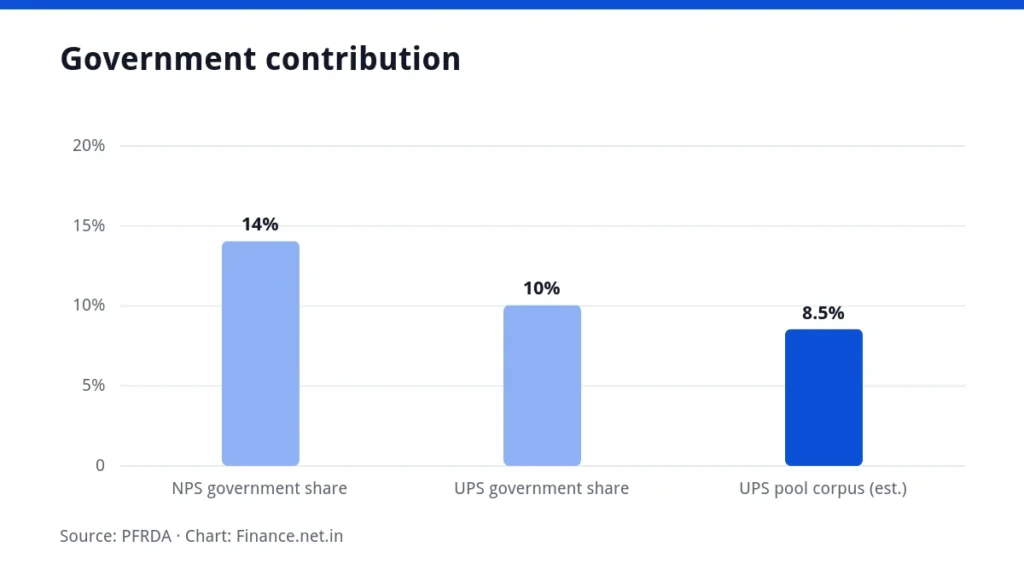
Under UPS the employee pays 10% of basic pay plus dearness allowance (DA, a cost-of-living top-up). The government matches 10%, and adds an estimated 8.5% of basic pay plus DA to a common pool corpus. Under NPS the employee pays 10% and the government pays 14%.
Two corpuses
The Individual Corpus is what the employee and the matching government share build up. The Benchmark Corpus is a notional figure worked out using the default investment pattern, regular and timely contributions, and no partial withdrawals or voluntary contributions.
Payout
The assured payout is 50% of the average basic pay over the last 12 months before superannuation, payable after at least 25 years of qualifying service. With fewer years, the payout is proportionate. A minimum of ₹10,000 a month applies after 10 years of service.
For example, if the 12-month average basic pay were ₹1,00,000 (an illustrative figure), a full-service employee would get an assured ₹50,000 a month.
Dearness relief, which is meant to offset rising prices (see inflation), is payable on the payout as notified by the government. NPS carries no dearness relief.
Lump sum, withdrawals and family benefits
- Lump sum at exit: one-tenth of the last drawn basic pay plus DA for every completed six months of qualifying service. For 30 years of service, that is 60 six-month blocks, or six times monthly pay (illustrative).
- Final withdrawal: up to 60% of the Individual Corpus or Benchmark Corpus, whichever is lower. This reduces the assured payout proportionately, though the shortfall can be replenished to restore the full payout.
- Partial withdrawals: up to 25% of your own contributions, excluding returns, allowed three times (counting NPS withdrawals), for purposes such as education, marriage, housing, medical needs, disability and skill development.
- Family payout: the legally wedded spouse receives 60% of the payout the subscriber was drawing before death. Under NPS, family benefits depend on the annuity bought.
- Gratuity: UPS subscribers also get the lump-sum retirement and death gratuity that applies to NPS staff, under the CCS (Payment of Gratuity under NPS) Rules, 2021.
Investments and tax
Investment choice remains. The default pattern applies if you choose nothing; other options are 100% government securities (Scheme G) and two life cycle funds, with equity falling as you age. You can change pension fund once a financial year and investment pattern twice a year.
Per a CBDT Office Memorandum dated 2 July 2025, Sections 80CCD(1), 80CCD(1B), 80CCD(2), 80CCD(3) and 80CCD(4) of the Income Tax Act, 1961 (deductions for contributions) and Sections 10(12A) and 10(12B) (exemptions on withdrawals and annuities) apply to UPS, subject to prescribed limits. PFRDA lists tax benefits as the same as NPS. You can test your own numbers with the income tax calculator.
Common mistakes to avoid
- Assuming UPS applies automatically. If no option is exercised, the employee continues under NPS.
- Missing the window. New recruits must opt within 30 days of joining. For existing employees and earlier retirees, PFRDA’s page gives 30 November 2025, or any extended timeline allowed by the Central Government.
- Expecting the full 50% with short service. The full assured payout needs 25 years of qualifying service; between 10 and 25 years it is proportionate.
- Ignoring the cost of a large withdrawal. Taking the final withdrawal reduces the assured payout unless you replenish the shortfall.
- Treating the switch as reversible. The option to revert to NPS is one-time and one-way.
What it means for you
If you are a central government employee, the main trade-off is predictability versus the market-linked route. UPS gives an assured payout, a minimum pension, dearness relief and a defined family benefit. NPS has none of these but carries a higher government contribution of 14%.
Retirees who qualify can get UPS benefits with arrears and interest at PPF rates. Forms differ by status: A1 for new recruits, A2 for existing NPS subscribers opting in, and B1 to B6 for claims. Check the official PFRDA and NPS Trust comparison pages and your department’s guidance before deciding.