Skip to content
  • USD/INR ₹94.97 ▲ 0.19%
  • EUR/INR ₹106.27 0.00%
  • GBP/INR ₹126.90 0.00%
  • AED/INR ₹25.86 ▲ 0.19%
  • Brent crude $115.22 ▼ 3.03%
  • Bitcoin ₹76,44,265 ▼ 1.27%
Data: ECB · CoinGecko · EIA
Finance.net.in
  • Markets
  • Economy
  • Personal Finance
  • Business
  • NRI
  • World
  • Knowledge Base
  • Tools
  • Learn
  1. Home
  2. Personal Finance
  3. Retirement (EPF, NPS, PPF)
  4. EPF withdrawals and advances: when and how members can take money

Retirement (EPF, NPS, PPF)

EPF withdrawals and advances: when and how members can take money

A plain guide to when EPF members can take a full withdrawal or a partial advance, what EPFO says about eligibility, and how to check your balance online.

Published 24 Oct 2026, 1:22 pm 2 min read
Finance.net.in title card: EPF withdrawals and advances: when and how members can take money

Key points

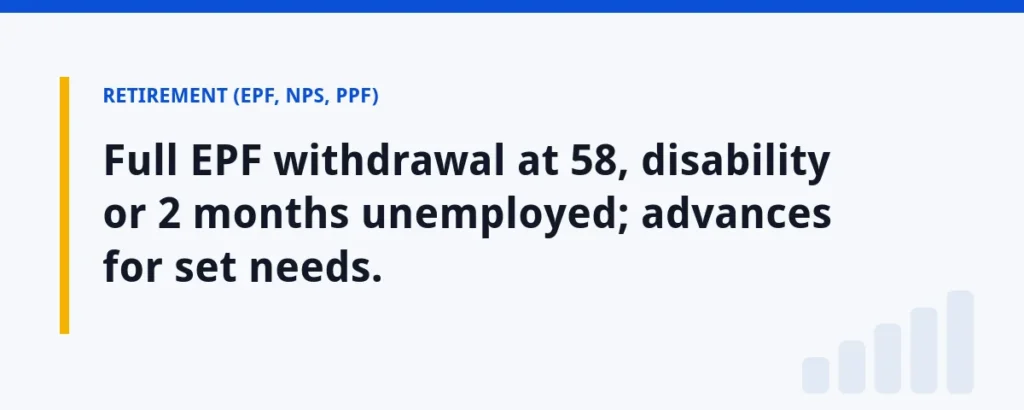
  • EPFO says full withdrawal is allowed at retirement (58 years), on permanent disability, or after 2 months of unemployment.
  • Partial advances are permitted for housing, medical treatment, children's education or marriage.
  • Emergency provisions exist for natural calamities, job loss or abnormal situations.
  • EPFO says the interest earned on the fund is tax-free, and the balance can be checked online with your UAN.

What it is

The Employees’ Provident Fund (EPF) is a retirement savings scheme for salaried workers in India. It is overseen by the Employees’ Provident Fund Organisation (EPFO), which reports to the Ministry of Labour and Employment. The rules come from the Employees’ Provident Funds Scheme, 1952, framed under the Employees’ Provident Funds and Miscellaneous Provisions Act, 1952. You can read the basics in our EPF explainer.

A withdrawal means taking out money, usually when your membership ends. An advance is a partial amount you draw for a specific need while the account stays alive.

How it works

Both you and your employer contribute 12% of basic wages plus dearness allowance (the cost-of-living pay component). Your entire share goes to EPF. The employer’s share is split between EPF, the Employees’ Pension Scheme (EPS) and Employees’ Deposit Linked Insurance (EDLI).

Every member gets a Universal Account Number (UAN), which stays with you across jobs. EPFO says Aadhaar-linked accounts allow faster verification and settlement.

Full withdrawal

According to EPFO, you can withdraw the full amount in these situations:

  • retirement, at 58 years
  • permanent disability
  • unemployment, after 2 months

Partial withdrawals and advances

EPFO says partial withdrawals or advances are permitted for housing, medical treatment, children’s education or marriage. Emergency provisions also exist for natural calamities, job loss or abnormal situations.

EPFO’s pages do not give the amount limits, service requirements or processing times for each purpose. Check those on the EPFO site before you apply.

Choosing the claim form

EPFO’s documents page asks members to find the correct claim form based on their employment status and what they need the money for. Picking the right form matters because full settlement, advances and transfers are handled differently.
Full EPF withdrawal at 58, disability or 2 months unemployed; advances for set needs.

What it means for you

EPFO describes the fund as meant for long-term retirement savings, and says the interest it earns is tax-free. Taking an advance reduces the balance that keeps growing, so it is worth weighing the need against the lost build-up.

You can check your balance online through the EPFO portal using your UAN, through the mobile app, by SMS alerts, or by requesting the annual passbook. Doing this before a claim helps you know how much is available.

EPFO also notes that contributions cannot be made after you leave service, because there are no wages and no employer share to match. It adds that the provident fund is protected from attachment by any court under Section 10 of the EPF and Miscellaneous Provisions Act, 1952.

If you are comparing retirement options, our compound interest calculator can show how a balance grows over time.

Background

EPF membership is mandatory for employees with basic wages and dearness allowance up to ₹15,000 a month in covered establishments. Higher earners can join voluntarily by giving an option under para 26(6) of the EPF Scheme within 6 months of joining.

A member whose pay later exceeds ₹15,000 stays a member, but the contribution is then restricted to ₹15,000, with the employer matching up to that figure. Apprentices cannot be members but must be enrolled as soon as they stop being apprentices.
What it means for you

If you are an EPF member, the money is meant for retirement, but EPFO allows full withdrawal in defined situations and partial advances for housing, medical care, education or marriage. Using an advance lowers the balance that keeps earning tax-free interest. Check your balance and the right claim form before applying.

Compound Interest Calculator PPF Calculator Lumpsum Calculator

Frequently asked questions

When can I withdraw my full EPF balance?

EPFO says full withdrawal is allowed at retirement (58 years), on permanent disability, or after 2 months of unemployment.

Can I take part of my EPF money while still employed?

Yes. EPFO says partial withdrawals or advances are permitted for housing, medical treatment, children's education or marriage, with emergency provisions for natural calamities, job loss or abnormal situations.

How do I check my EPF balance?

You can check it on the EPFO portal using your UAN, through the mobile app, by SMS alerts, or by requesting the annual passbook.

Can I keep contributing to EPF after I leave a job?

No. EPFO says contributions cannot be made after leaving service, because without wages and an employer there is no matching share.

Sources

  1. Employees' Provident Fund Organisation — EPFO
  2. Employees' Provident Fund Organisation — EPFO
Share WhatsApp X LinkedIn Telegram
Topics
  • Employees' Pension Scheme
  • Employees' Provident Fund
  • Employees' Provident Funds Scheme, 1952
  • EPFO
  • Ministry of Labour and Employment
  • Universal Account Number
Tags
  • EPF
  • provident fund
  • retirement
  • UAN
  • withdrawal

Related

Finance.net.in title card: Employees’ Pension Scheme (EPS): who is covered and how it works
Retirement (EPF, NPS, PPF)

Employees’ Pension Scheme (EPS): who is covered and how it works

22 Oct 2026

Finance.net.in title card: EPF explained: contributions, interest and your account
Retirement (EPF, NPS, PPF)

EPF explained: contributions, interest and your account

22 Oct 2026

Finance.net.in title card: EDLI: the life cover that comes with your EPF account
Retirement (EPF, NPS, PPF)

EDLI: the life cover that comes with your EPF account

23 Oct 2026

Finance.net.in title card: How NPS works and who pays your pension at exit
Retirement (EPF, NPS, PPF)

How NPS works and who pays your pension at exit

21 Oct 2026

More in Retirement (EPF, NPS, PPF)

More
  1. 4 hours agoUnified Pension Scheme vs NPS: how they differ for central staff
  2. 4 hours agoHow the Atal Pension Yojana works for informal workers
  3. 4 hours agoHow NPS Vatsalya, the pension account for children, works
  4. 4 hours agoNPS charges explained: what you pay and to whom
  5. 4 hours agoNPS investment choices: active choice vs auto choice

This article is for information only and is not investment, tax or legal advice. Figures are from the sources linked above as of the publish or update time. Please verify with official sources or a qualified adviser before making financial decisions.

Most read

  1. 1 Illustration of a central bank building with an upward arrow, representing RBI's October 2026 rate hike
    RBI rules out near-term rate cut after 25 bps hike: Malhotra

    14 Oct 2026

  2. 2 Regulatory document and laptop on an office desk, representing new portfolio manager rules
    SEBI notifies Portfolio Managers Regulations, 2026, effective 1 April 2027

    14 Oct 2026

  3. 3 Desk with currency notes, calculator and globe representing the forex market
    RBI cuts no-proof forex hedging limit to $5 million from $100 million

    14 Oct 2026

  4. 4 Bank vault with rupee notes and a balance scale, illustrating a cash reserve on forex derivatives
    RBI limits rupee NDDCs for non-residents to hedging, adds 20% FERR

    14 Oct 2026

  5. 5 Stone institutional building with coins and books, representing a central bank committee publishing minutes
    Bank of England publishes September 2026 securities lending minutes

    3 hours ago

Latest

  1. 3 hours ago Bank of England publishes September 2026 securities lending minutes
  2. 3 hours ago SEBI posts public notice for Rose Valley depositors
  3. 3 hours ago SEBI reviews call-record rule for research analysts’ institutional clients
  4. 3 hours ago UAE tax authority holds second Emirates Majalis session in Dubai
  5. 3 hours ago Euro area consumers expect 3.1% inflation in a year, ECB survey shows
  6. 3 hours ago RBI amends bank leverage ratio rules to match Basel 2017 standard
  7. 3 hours ago RBI lets regional offices compound overseas investment FEMA breaches
  8. 3 hours ago RBI finalises Leverage Ratio 2017 Standard rules, effective 1 April 2027

Money tools

  • Income Tax Calculator FY 2026-27
  • EMI Calculator
  • SIP Calculator
  • FD Calculator
  • PPF Calculator
  • GST Calculator
All calculators

Developing stories

  • Minutes of the Securities Lending Committee meeting – September 2026
  • General Public Notice to Rose Valley Depositors
  • Review of regulatory requirement for maintenance of call records of institutional clients by Research Analysts or Resear
  • Building on the Authority’s efforts to foster a culture of constructive community dialogue and enhance tax awareness
  • ECB Consumer Expectations Survey results – September 2026
  • Reserve Bank of India (Commercial Banks – Prudential Norms on Capital Adequacy) Eleventh Amendment Directions, 2026

News by country

  • India
  • UAE
  • Global
  • Qatar
  • Saudi Arabia
  • Oman
  • Bahrain
  • United States
  • United Kingdom
  • Canada
Finance.net.in

Money news, made clear. Daily finance news, explainers and free calculators for India, NRIs and global readers.

Sections

  • Business
  • Economy
  • Markets
  • NRI
  • Personal Finance
  • World

About

  • Editorial policy
  • How we use AI
  • Corrections and fact-checking policy
  • Disclaimer
  • About us
  • Contact us
  • Privacy policy
  • Terms of use

Information only. Nothing on this site is investment, tax or legal advice.

© 2026 Finance.net.in

We use cookies from Google Analytics to count visits and improve this site, and, when advertising is enabled, to show ads. Choose "Accept" to allow them or "Reject" to continue without them. You can change your choice any time from "Cookie settings" at the bottom of the page. Privacy policy