Skip to content
  • USD/INR ₹94.97 ▲ 0.19%
  • EUR/INR ₹106.27 0.00%
  • GBP/INR ₹126.90 0.00%
  • AED/INR ₹25.86 ▲ 0.19%
  • Brent crude $115.22 ▼ 3.03%
  • Bitcoin ₹76,44,265 ▼ 1.27%
Data: ECB · CoinGecko · EIA
Finance.net.in
  • Markets
  • Economy
  • Personal Finance
  • Business
  • NRI
  • World
  • Knowledge Base
  • Tools
  • Learn
  1. Home
  2. Personal Finance
  3. Retirement (EPF, NPS, PPF)
  4. How NPS Vatsalya, the pension account for children, works

Retirement (EPF, NPS, PPF)

How NPS Vatsalya, the pension account for children, works

A plain guide to NPS Vatsalya: who can open it, minimum contributions, withdrawal limits, tax treatment and what happens when the child turns 18.

Published 24 Oct 2026, 1:30 pm 3 min read
Finance.net.in title card: How NPS Vatsalya, the pension account for children, works

Key points

  • NPS Vatsalya is a voluntary, market-linked pension account for Indian citizens below 18, opened and run by a parent or legal guardian.
  • The minimum is ₹250 at opening and ₹250 in each financial year, with no upper limit.
  • Partial withdrawals are capped at 25% of own contributions, after a 3-year lock-in, for education, specified illnesses or disability above 75%.
  • At 18 the subscriber can continue to 21, move to regular NPS or exit, and the tax deduction applies only under the old tax regime.

What it is

NPS Vatsalya is a voluntary savings and pension scheme built only for children under 18. It is part of the National Pension System (NPS), and the pension sector regulator, PFRDA, oversees it.

The child is the subscriber and sole beneficiary. A parent or legal guardian opens the account and runs it until the child turns 18. A Permanent Retirement Account Number (PRAN), the unique number that identifies an NPS account, is issued in the child’s name.

Any Indian citizen below 18 can have one, including eligible NRIs and OCIs (Overseas Citizens of India). The scheme is open regardless of gender. PFRDA says the government announced it in the Union Budget for 2024-25 and brought it into operation on 18 September 2024.

How it works

Opening and contributing

You can apply in person at a registered Point of Presence (PoP), the intermediaries that handle NPS accounts, or go online through a PoP’s facility or the eNPS platform. The guardian picks a Central Recordkeeping Agency and a Pension Fund.

The minimum is ₹250 at opening and ₹250 in each financial year. Later top-ups can be as low as ₹10. There is no maximum, and no limit on the number of contributions in a year. Parents, relatives and friends can all contribute, including through UPI apps. A grandparent can open the account only if they are the legal guardian.

Missing a year’s contribution does not automatically close the account.

Documents

  • For the child: proof of date of birth, such as a birth certificate or school leaving certificate.
  • For the parent or guardian: a KYC document such as Aadhaar or passport, plus PAN or Form 60.
  • A bank account is optional for resident Indians at opening but mandatory for NRIs and OCIs.

Investment and returns

The chosen Pension Fund invests the money. Returns are market-linked and not guaranteed, and there is no fixed interest rate. Funds may allocate up to 100% to equity, or follow an indicative pattern with limits of 75% equity, 20% government securities, 30% debt instruments and 10% money market instruments. Charges match those under the NPS All Citizen Model. The Pension Fund can be changed once in a financial year.

Compare this with a fixed-return scheme such as Sukanya Samriddhi Yojana. PFRDA says the two can be held together.

Withdrawals

After a minimum 3-year lock-in from opening, up to 25% of the child’s own contributions (excluding returns) can be withdrawn for education, treatment of specified illnesses, or disability of more than 75%. Before 18, a maximum of two withdrawals is allowed. Between 18 and 21, two more are allowed, subject to KYC.
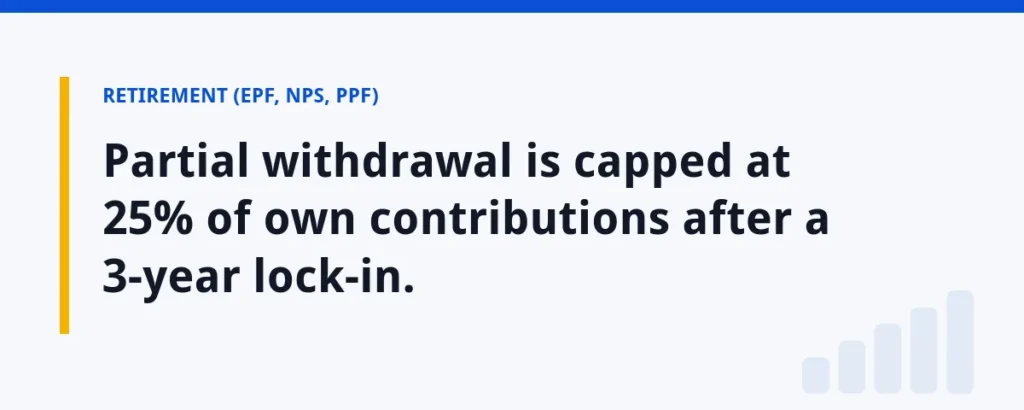
Partial withdrawal is capped at 25% of own contributions after a 3-year lock-in.

At 18

The subscriber must complete fresh KYC and give nominee details, and the account then passes to them. There are three paths:

  • Stay in NPS Vatsalya until 21.
  • Move the full balance into regular NPS, either under the All Citizen Model or another model that applies, once KYC is done.
  • Exit. If the balance is under ₹8 lakh, it can all be taken as cash. At ₹8 lakh or more, up to 80% can be taken as cash and at least 20% must go towards an annuity (a regular pension income).

If the subscriber picks nothing between 18 and 21, the account is moved on its own into a scheme with a larger equity share, run by the same Pension Fund under its Multiple Schemes Framework.

What it means for you

Tax treatment depends on the regime you file under. See our guide to the old and new tax regimes.

Stage Old regime New regime
Contribution Deduction up to ₹50,000 under Section 124(4) of the Income-tax Act, 2025 No deduction
Partial withdrawal Up to 25% of own contributions exempt Same exemption
Exit Lump sum up to 60% of corpus exempt; annuity purchase exempt Same exemption

If the child dies, the entire accumulated wealth is payable to the guardian, nominee or legal heir, and the amount is not treated as their income. If the guardian dies, a new guardian must be registered with KYC documents.

Because returns are market-linked and money is largely locked in until adulthood, the scheme suits a long horizon. You can estimate growth under assumed returns with the Compound Interest Calculator, though actual results will vary.

Common mistakes to avoid

  • Assuming returns are guaranteed. They are not.
  • Expecting a tax deduction under the new regime. None is available for this contribution.
  • Forgetting that the child needs fresh KYC and nominee details at 18.
  • Counting on withdrawals before the 3-year lock-in ends, or for purposes outside the permitted list.

Grievances can be lodged at PFRDA’s Pension Sahayak portal. Intermediaries must resolve them within 30 days.

What it means for you

NPS Vatsalya lets families start a market-linked pension account for a child with as little as ₹250 a year. The money is mostly locked until adulthood, and returns are not guaranteed. The ₹50,000 deduction is available only under the old tax regime.

Compound Interest Calculator Lumpsum Calculator SIP Calculator

Frequently asked questions

Who can open an NPS Vatsalya account?

A parent or legal guardian can open it for an Indian citizen below 18, including eligible NRIs and OCIs. The parent does not need an existing NPS account or to be a government employee.

Can NPS Vatsalya be held with Sukanya Samriddhi Yojana?

Yes. PFRDA says an NPS Vatsalya account may be opened whether or not the child has a Sukanya Samriddhi Yojana account, subject to each scheme's rules.

How many accounts can be opened for one child?

A single NPS Vatsalya account may be opened for a minor, subject to applicable scheme and operational provisions.

What happens when the child turns 18?

The subscriber can continue up to 21, move the balance into NPS, or exit under the rules. If no option is chosen by 21, the account is moved automatically to a scheme with a higher equity share.

Sources

  1. NPS Vatsalya | Offical PFRDA guide to NPS Vatsalya for minors - PFRDA — PFRDA
  2. About NPS Vatsalya | NATIONAL PENSION SYSTEM TRUST — NPS Trust
Share WhatsApp X LinkedIn Telegram
Topics
  • eNPS
  • National Pension System
  • NPS Trust
  • NPS Vatsalya
  • PFRDA
  • PRAN
Tags
  • children savings
  • minor account
  • NPS
  • pension

Related

Finance.net.in title card: Unified Pension Scheme vs NPS: how they differ for central staff
Retirement (EPF, NPS, PPF)

Unified Pension Scheme vs NPS: how they differ for central staff

4 hours ago

Finance.net.in title card: How NPS works and who pays your pension at exit
Retirement (EPF, NPS, PPF)

How NPS works and who pays your pension at exit

21 Oct 2026

Finance.net.in title card: How much you need to retire: a step-by-step planning guide
Retirement (EPF, NPS, PPF)

How much you need to retire: a step-by-step planning guide

23 Oct 2026

Finance.net.in title card: What is NPS and how does the National Pension System work
Retirement (EPF, NPS, PPF)

What is NPS and how does the National Pension System work

21 Oct 2026

More in Retirement (EPF, NPS, PPF)

More
  1. 4 hours agoHow the Atal Pension Yojana works for informal workers
  2. 4 hours agoNPS charges explained: what you pay and to whom
  3. 4 hours agoNPS investment choices: active choice vs auto choice
  4. 4 hours agoEPF withdrawals and advances: when and how members can take money
  5. 23 Oct 2026EDLI: the life cover that comes with your EPF account

This article is for information only and is not investment, tax or legal advice. Figures are from the sources linked above as of the publish or update time. Please verify with official sources or a qualified adviser before making financial decisions.

Most read

  1. 1 Illustration of a central bank building with an upward arrow, representing RBI's October 2026 rate hike
    RBI rules out near-term rate cut after 25 bps hike: Malhotra

    14 Oct 2026

  2. 2 Regulatory document and laptop on an office desk, representing new portfolio manager rules
    SEBI notifies Portfolio Managers Regulations, 2026, effective 1 April 2027

    14 Oct 2026

  3. 3 Desk with currency notes, calculator and globe representing the forex market
    RBI cuts no-proof forex hedging limit to $5 million from $100 million

    14 Oct 2026

  4. 4 Bank vault with rupee notes and a balance scale, illustrating a cash reserve on forex derivatives
    RBI limits rupee NDDCs for non-residents to hedging, adds 20% FERR

    14 Oct 2026

  5. 5 Stone institutional building with coins and books, representing a central bank committee publishing minutes
    Bank of England publishes September 2026 securities lending minutes

    3 hours ago

Latest

  1. 3 hours ago Bank of England publishes September 2026 securities lending minutes
  2. 3 hours ago SEBI posts public notice for Rose Valley depositors
  3. 3 hours ago SEBI reviews call-record rule for research analysts’ institutional clients
  4. 3 hours ago UAE tax authority holds second Emirates Majalis session in Dubai
  5. 3 hours ago Euro area consumers expect 3.1% inflation in a year, ECB survey shows
  6. 3 hours ago RBI amends bank leverage ratio rules to match Basel 2017 standard
  7. 3 hours ago RBI lets regional offices compound overseas investment FEMA breaches
  8. 3 hours ago RBI finalises Leverage Ratio 2017 Standard rules, effective 1 April 2027

Money tools

  • Income Tax Calculator FY 2026-27
  • EMI Calculator
  • SIP Calculator
  • FD Calculator
  • PPF Calculator
  • GST Calculator
All calculators

Developing stories

  • Minutes of the Securities Lending Committee meeting – September 2026
  • General Public Notice to Rose Valley Depositors
  • Review of regulatory requirement for maintenance of call records of institutional clients by Research Analysts or Resear
  • Building on the Authority’s efforts to foster a culture of constructive community dialogue and enhance tax awareness
  • ECB Consumer Expectations Survey results – September 2026
  • Reserve Bank of India (Commercial Banks – Prudential Norms on Capital Adequacy) Eleventh Amendment Directions, 2026

News by country

  • India
  • UAE
  • Global
  • Qatar
  • Saudi Arabia
  • Oman
  • Bahrain
  • United States
  • United Kingdom
  • Canada
Finance.net.in

Money news, made clear. Daily finance news, explainers and free calculators for India, NRIs and global readers.

Sections

  • Business
  • Economy
  • Markets
  • NRI
  • Personal Finance
  • World

About

  • Editorial policy
  • How we use AI
  • Corrections and fact-checking policy
  • Disclaimer
  • About us
  • Contact us
  • Privacy policy
  • Terms of use

Information only. Nothing on this site is investment, tax or legal advice.

© 2026 Finance.net.in

We use cookies from Google Analytics to count visits and improve this site, and, when advertising is enabled, to show ads. Choose "Accept" to allow them or "Reject" to continue without them. You can change your choice any time from "Cookie settings" at the bottom of the page. Privacy policy