
What happened
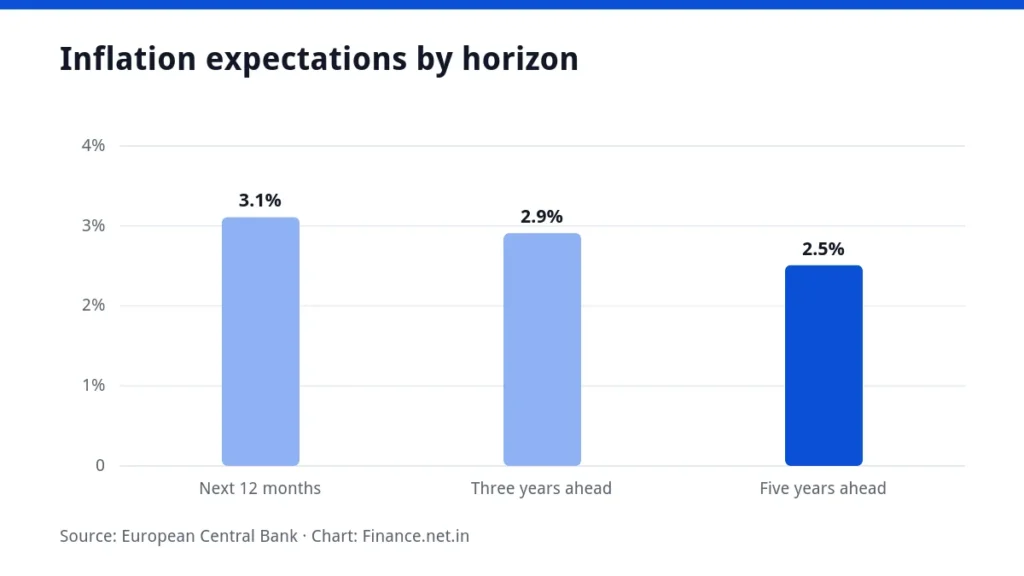
Euro area consumers expect inflation of 3.1% over the next 12 months, up from 3.0% in August, according to the European Central Bank’s (ECB) Consumer Expectations Survey for September 2026, published on 23 October 2026.
Perceived inflation over the previous 12 months rose to 3.6% from 3.5%. Expectations for inflation three years ahead stayed at 2.9%, and five years ahead at 2.5%.
The ECB said uncertainty about 12-month inflation expectations rose slightly and remains higher than before the start of the conflict in the Middle East.
Income and spending
- Expected nominal income growth over the next 12 months: 1.1%, from 1.0%.
- Perceived nominal spending growth over the past 12 months: 5.3%, from 5.2%.
- Expected nominal spending growth over the next 12 months: 3.7%, from 3.6%.
Nominal means the figures are not adjusted for inflation.
Growth and jobs
Consumers expect the economy to shrink by 1.5% over the next 12 months, a weaker outlook than the -1.2% seen in August. The expected unemployment rate in 12 months rose to 11.3% from 11.0%.
That is only slightly above the 10.6% that respondents think is the current rate. The ECB said this points to a broadly stable labour market outlook.
Housing and credit
Consumers expect their home’s price to rise 3.5% over the next 12 months, against 3.4% in August. Expected mortgage rates in 12 months stayed at 4.9%, unchanged from July.
More households than in August reported tighter access to credit over the past year, and more expect it to tighten over the next 12 months, on a net basis.
What it means for you
The survey records what households believe, not official inflation or growth data. The ECB points out that the findings are not a statement of position by its policymakers or staff, and that it uses them alongside other data sources when analysing policy.
Differences by income stand out. Households in the bottom income fifth (quintile) reported higher inflation perceptions and expectations than those in the top fifth. They also expect higher unemployment (13.6% against 9.7%) and higher mortgage rates (5.7% against 4.4%). Younger respondents aged 18-34 reported lower inflation perceptions and expectations than those aged 35-54 and 55-70.
For Indians living in or sending money to the euro area, the survey is a gauge of household mood there. It does not state anything about exchange rates or Indian rules. You can check conversions with the Currency Converter.
Background
The survey is a monthly online poll of around 19,000 adults, all aged 18 or over, spread across 11 euro area members. These include Germany, France, Italy and Spain, along with seven smaller economies. Fieldwork for this wave ran from 27 August to 28 September 2026. Unless stated otherwise, the figures are 2% winsorised means, a method that limits the effect of extreme answers.
For the ECB’s own view on prices, see our coverage of Lagarde’s remarks on euro area inflation and the rate path.
What to watch next
The ECB will release the October survey results on 27 November 2026.