
Frank Elderson, a member of the European Central Bank’s (ECB) Executive Board and Vice-Chair of its Supervisory Board, has said Europe can make bank supervision simpler without lowering core standards. He made the case in an interview with Austria’s Die Presse, conducted on 14 October 2026 and published by the ECB on 20 October 2026.
What happened
Asked whether banks have a point when they complain about the cost of regulation, Elderson pointed to the 2008 financial crisis. In his view, the costs of that crisis for households, firms and taxpayers far outweigh the cost of regulation. He said European banks are now well capitalised, hold high liquidity and are more profitable on average than for many years.
He accepted that rules have become more complex, partly because banks differ widely and the risks have grown, from geopolitical tensions and cyber risk to climate and nature risks and artificial intelligence. The ECB has already cut reporting obligations and sped up processes. But, he said, simplification is not deregulation.
Fragmentation as the main obstacle
Elderson called fragmentation the biggest obstacle to European banks’ competitiveness. Cross-border banking remains limited, so banks cannot fully gain from scale or spread capital and liquidity efficiently. His answer is deeper integration rather than looser rules. He wants Europe to finish building its Single Market, its savings and investments union and its banking union, the latter including a shared European deposit insurance scheme. (Deposit insurance protects savers’ money if a bank fails; see our explainer on deposit insurance for India’s version.)
Basel III and proportionality
On Basel III, the international bank capital standards, he argued that a common minimum benchmark stops banks competing on who has the weakest rules. Loosening Pillar 1 requirements, the basic capital rules, could in his words simply shift the burden from regulation to supervision.
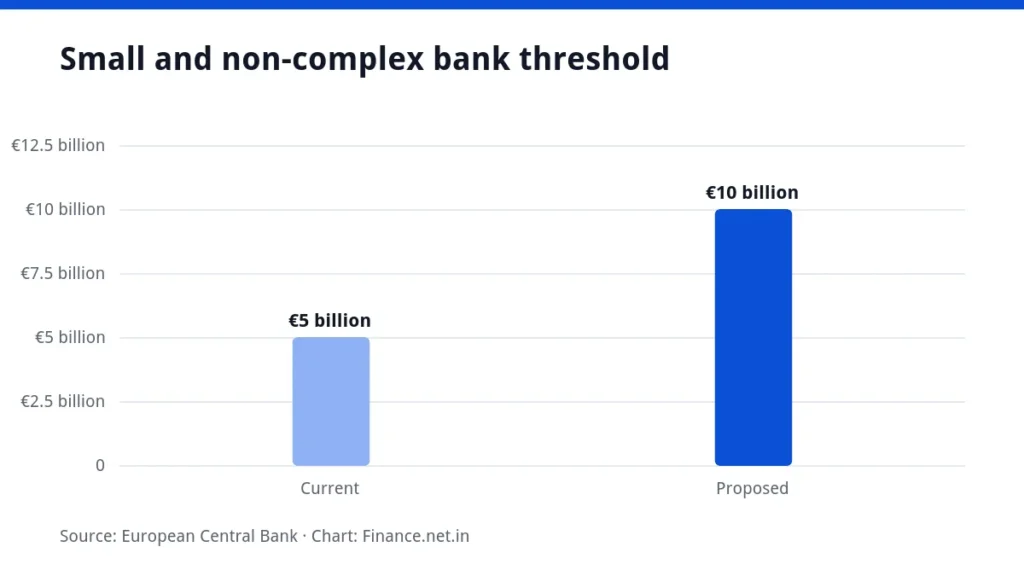
He backed more proportionate supervision, meaning rules tailored to a bank’s size, complexity and risk. Small and non-complex banks already report up to 30% of the data large banks must provide. The current threshold for that category is €5 billion in total assets. Raising it to €10 billion would bring roughly 150 more banks into the simplified regime. Other options he mentioned were longer gaps between regulatory reviews where risk allows, and wider use of data the ECB already holds for stress tests.
He said proportionality can go only as far as a bank’s risk profile allows, with no change to core prudential standards.
Risks from AI and private credit
Elderson said AI can improve risk management, fraud detection and efficiency, but advanced models can find and exploit software weaknesses faster. In July the ECB asked banks to reassess cybersecurity and review IT budgets and staffing. Concrete action plans on AI-related cyber risks are due by the end of October.
He also named over-reliance on AI models, biases, data quality and concentration risk from dependence on a limited number of cloud providers.
On private credit, which means loans made outside the banking sector, he said risks do not necessarily leave the banking system when lending does. A bank might lend to a private credit provider while also funding firms that the same provider lends to, creating hidden concentrations.
What it means for you
The interview is a statement of supervisory thinking, not a new rule. For depositors and borrowers in the euro area, it signals that the ECB wants lighter reporting for smaller banks while keeping capital and liquidity requirements intact. Indians with euro-area bank accounts or exposure to European lenders can read it as context on how the region’s supervisor views bank safety.
Background
The ECB supervises the largest banks in the euro area. Elderson referred to the European Commission’s banking reform package and said it should keep simplification and integration together. For the ECB’s latest view on rates, see our coverage of Lagarde’s statement on inflation and the rate path.