
The Reserve Bank of India on 23 October 2026 issued the Eleventh Amendment Directions to its capital adequacy rules for commercial banks, revising the leverage ratio framework. The central bank said the change was needed to align the rules with the Basel Committee on Banking Supervision’s latest leverage ratio framework, known as the 2017 standard.
What happened
The leverage ratio is a simple safety measure. It divides a bank’s capital (the numerator) by its total exposure (the denominator), and the result is shown as a percentage. Unlike risk-based capital ratios, it does not weigh assets by how risky they are.
The RBI issued the amendments under Section 35A of the Banking Regulation Act, 1949. They replace paragraph 262 of Chapter VII of the 2025 Directions and change several related paragraphs. The key points:
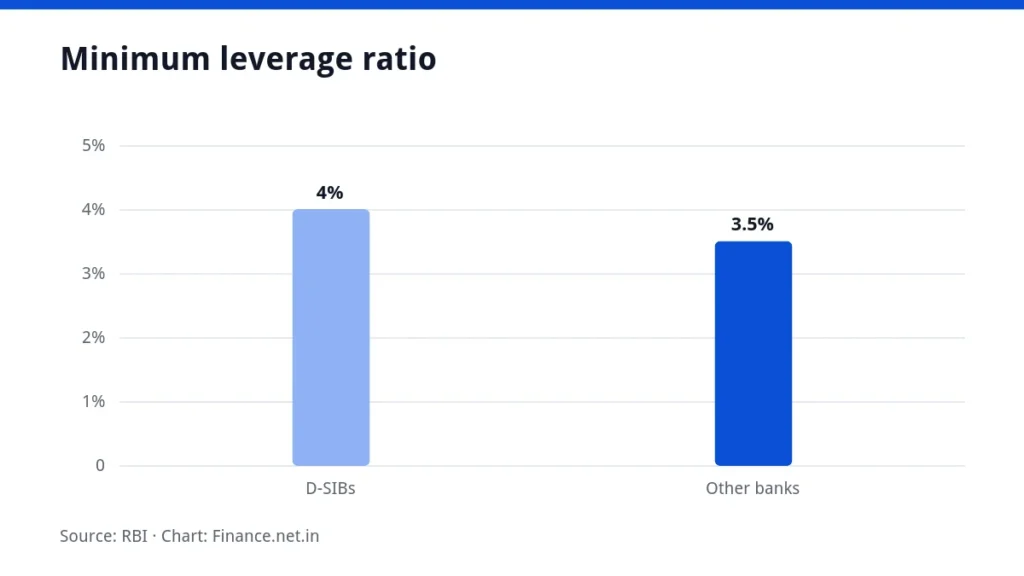
- Minimum ratio: 4% for a domestic systemically important bank (D-SIB), meaning a bank whose failure could shake the system, and 3.5% for other banks.
- Branches of global banks: a branch in India of a global systemically important bank (G-SIB) must keep 3.5% plus the leverage buffer that applies to it as a G-SIB, including any extra buffer set by its home regulator.
- Timing: a bank must meet the minimum at all times. Capital and exposure are calculated at quarter-end, though a bank may use more frequent averaging, such as daily or monthly, with RBI approval, if it does so consistently.
- Scope: the leverage ratio follows the same scope of regulatory consolidation as the risk-based capital framework.
Limits on payouts for G-SIB branches
A G-SIB branch that falls short of its leverage buffer faces capital distribution constraints, meaning limits on paying out earnings. These depend on both its common equity tier 1 (CET1) ratio and its leverage ratio. A branch meeting both requirements faces no minimum capital conservation standards. One that misses either is subject to the matching standard, and one that misses both faces the higher of the two.
For a branch in the first bucket of the higher loss-absorbency requirements, where a 1% risk-based G-SIB buffer applies, the table sets the share of earnings that must be conserved.
| CET1 risk-based ratio | Tier 1 leverage ratio | Earnings to be conserved |
|---|---|---|
| 5.5%–6.375% | 3.5%–3.625% | 100% |
| Above 6.375%–7.25% | Above 3.625%–3.75% | 80% |
| Above 7.25%–8.125% | Above 3.75%–3.875% | 60% |
| Above 8.125%–9% | Above 3.875%–4.0% | 40% |
| Above 9.0% | Above 4.0% | 0% |
How exposure is measured
The exposure measure generally follows gross accounting values. Banks usually cannot reduce it by counting collateral, guarantees or other credit risk mitigation, and cannot net assets against liabilities. The total is the sum of on-balance sheet exposures, derivative exposures, securities financing transaction (SFT) exposures and off-balance sheet items.
Items deducted from Tier 1 capital, other than those linked to liabilities, are also deducted from the exposure measure. Liability items are not deducted. Banks must also watch for transactions or structures that understate their true leverage, such as moving assets off the balance sheet. The RBI may respond with measures that include extra reporting or a Pillar 2 capital charge.
In exceptional macroeconomic circumstances, the RBI may temporarily exempt balances held with it from the exposure measure. In that case it would raise the minimum ratio to offset the effect, and banks would have to disclose the impact of the exemption.
What it means for you
As a depositor or borrower, you will not see a direct change in your account or loan terms from this notification. The rules apply to how banks measure and hold capital. A leverage ratio acts as a backstop against banks building up large balance sheets on thin capital.
The sources do not state a start date or any change in lending or deposit rates. If you want to follow how banks report such ratios, our guide to reading bank results covers the common terms.
Background
The amendment refers to Chapter VII of the RBI’s Commercial Banks Prudential Norms on Capital Adequacy Directions, 2025, which holds the leverage ratio framework. The RBI described the update as needed to align with the Basel Committee’s 2017 leverage ratio standard. The notification is numbered RBI/2026-27/297.