Suresh is leaving his job of 12 years and eight months at a mid-sized engineering firm. His last monthly basic pay plus dearness allowance was ₹52,000, and he wants to know how much gratuity he will get, whether he will pay tax on it, and whether the new labour codes change anything. The short answer: about ₹3.9 lakh, most likely tax-free, and yes, the rules did change in November 2025.
Gratuity is a lump sum your employer pays when you leave after long service, as a thank-you for years worked. This guide covers who is eligible, the formula, the tax exemption limit, what the Code on Social Security, 2020 changed, the new one-year rule for fixed-term employees, and how to claim your money.
Gratuity under the new labour codes: what changed
For decades, gratuity was governed by the Payment of Gratuity Act, 1972. The government made the four labour codes effective from 21 November 2025, replacing 29 older labour laws. Gratuity now sits in Chapter V of the Code on Social Security, 2020.
Much of the old structure carries over: the 15-days-per-year formula, the five-year service condition for most employees and the ceiling notified by the Centre. Three things are new and matter for your wallet:
- Fixed-term employees become eligible after one year of continuous service instead of five, on a proportionate basis.
- A single definition of wages applies across the codes. If allowances exceed 50% of total pay, the excess is added back to wages, which can raise the gratuity figure.
- The date of exit decides the rules. The Labour Ministry’s FAQs say gratuity under the Code applies from 21 November 2025, and an employee leaving on or after that date is paid on the wages last drawn under the Code.
Who is eligible for gratuity
The Code’s gratuity chapter applies to every factory, mine, oilfield, plantation, port and railway company, and to every shop or establishment that employs, or employed on any day in the previous 12 months, ten or more people. The government can also notify other establishments. Employees of the Central or State Government who are covered by their own gratuity rules are outside this chapter.
Gratuity is payable when employment ends after at least five years of continuous service, on:
- superannuation, retirement or resignation;
- death or disablement due to accident or disease;
- the end of a fixed-term contract; or
- any other event the Central Government notifies.
The five-year condition does not apply on death, disablement or expiry of a fixed-term contract. For working journalists, the Code reads five years as three.
What counts as continuous service
Continuous service includes breaks for sickness, accident, leave, lay-off, a strike or a lockout that is not your fault. If your service was not unbroken, you are still treated as having completed a year if you actually worked at least 240 days in the preceding 12 months, or 190 days for work below ground in a mine or in an establishment working less than six days a week. Paid leave, maternity leave of up to 26 weeks and certain lay-offs count as days worked.
The gratuity formula, with a worked example
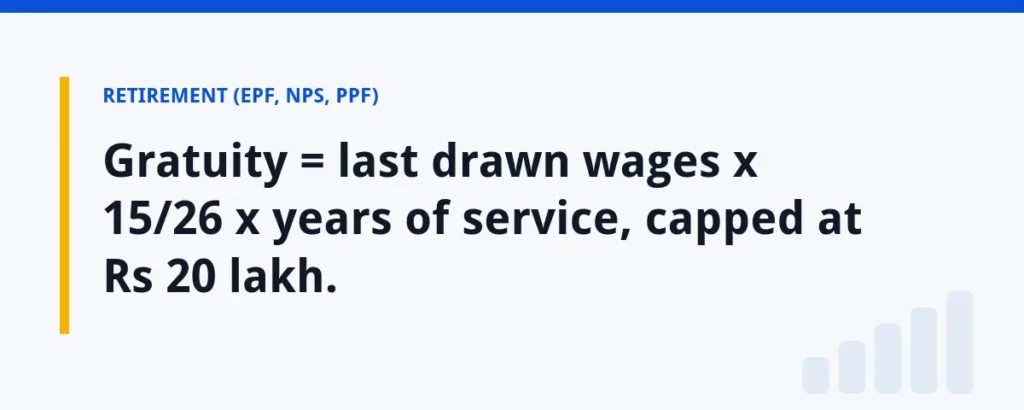
For every completed year of service, or part of a year beyond six months, your employer pays 15 days’ wages based on the wages last drawn. For a monthly paid employee, 15 days’ wages means monthly wages divided by 26, multiplied by 15. So:
Gratuity = last drawn monthly wages × 15 ÷ 26 × years of service
Back to Suresh. His 12 years and eight months round up to 13 years, because the extra eight months exceed six. ₹52,000 × 15 ÷ 26 is ₹30,000 a year. Multiply by 13 and he gets ₹3,90,000. Had he left at 12 years and five months, the five months would be ignored and he would get ₹3,60,000. Timing your exit around that six-month mark is worth knowing about.
| Last drawn wages (₹ a month) | Years counted | Gratuity (₹) |
|---|---|---|
| 26,000 | 5 | 75,000 |
| 39,000 | 8 | 1,80,000 |
| 52,000 | 13 | 3,90,000 |
| 78,000 | 20 | 9,00,000 |
| 1,04,000 | 30 | 18,00,000 |
These are illustrations using the 15/26 formula. Seasonal employees get seven days’ wages for each season, and for piece-rated workers daily wages are averaged over the three months before exit, leaving out overtime. The total is capped at the amount notified by the Central Government, which the Labour Ministry’s FAQ puts at ₹20 lakh. Your employer can always pay more under a better contract, agreement or award.
The new wage definition and why it may raise your payout
Many salary structures keep basic pay low and allowances high. Since gratuity is linked to wages, that kept payouts down. The codes now define wages as basic pay, dearness allowance and retaining allowance, and add a rule: if the other allowances together exceed 50% of total remuneration, the excess is added back to wages.
The Labour Ministry’s own illustration: total pay of ₹76,000 a month, with basic plus DA of ₹20,000. Of the other ₹56,000, ₹16,000 is gratuity and retrenchment compensation, which the rule leaves out, so the remaining allowances of ₹40,000 exceed the 50% limit of ₹38,000 by ₹2,000. Wages for statutory purposes become ₹22,000, not ₹20,000. Performance incentives, stock options and reimbursements are not part of wages. If your basic is a small slice of your pay, your gratuity may now be calculated on a larger base.
Fixed-term employees: gratuity after one year
Fixed-term employment means a contract for a set period, common in projects, export units and seasonal work. Earlier, such employees rarely completed five years with one employer and lost out. The government’s release on the labour codes says fixed-term employees become eligible after one year of continuous service, and PIB’s explainer on the Code says the benefit is on a proportionate basis.
The Labour Ministry’s March 2026 FAQs add two clarifications. First, the one-year rule covers employees directly engaged by the employer, not contract labour supplied through a contractor; for contract labour, the contractor pays gratuity after five years of continuous service. Second, a fixed-term employee becomes eligible after rendering one year of service under the contract, counted from the start of the contract. An 11-month contract therefore does not qualify.
As an illustration, a fixed-term employee on wages of ₹39,000 a month who completes a one-year contract would get ₹39,000 × 15 ÷ 26 × 1, or ₹22,500.
Is gratuity taxable? The ₹20 lakh exemption
For private sector employees, gratuity is tax-free up to a limit. The Finance Ministry raised the exemption for employees not covered by the gratuity law to ₹20 lakh in 2019, and the ceiling under the gratuity law itself went from ₹10 lakh to ₹20 lakh from 29 March 2018.
The Income Tax Department’s table of threshold limits sets out the test. For employees covered by the gratuity law, the exempt amount is the least of:
- 15/26 × last drawn salary × completed years of service (part above six months counted as a year);
- ₹20 lakh; and
- gratuity actually received.
Here “salary” means last drawn salary including DA, but excluding bonus, commission, HRA, overtime and other allowances. For employees not covered by the gratuity law, the formula is half of the average salary of the last 10 months for each completed year, again subject to ₹20 lakh. Anything above the exempt amount is taxed as salary.
One practical point follows. The tax formula uses salary including DA but excluding allowances, while the labour codes may now add part of your allowances back to wages. If your employer’s payout is based on the wider wage figure, a slice of it could fall outside the formula limit and become taxable, even if the total is well under ₹20 lakh. Your Form 16 will show the split. From tax year 2026-27 the Income-tax Act, 2025 applies, so confirm the current notified limit and rules before filing. The income tax calculator helps you see the effect of any taxable portion.
How to claim gratuity and what to do if it is late
The Code sets out a simple process:
- You, or someone authorised in writing, send a written application to the employer in the prescribed form and time.
- As soon as gratuity becomes payable, the employer must work out the amount and give written notice to you and to the competent authority, whether or not you have applied.
- The employer must pay within 30 days from the date it becomes payable.
- If it pays late, it owes simple interest from the due date, at a rate not above the government’s notified rate for long-term deposits, unless the delay was your fault and the competent authority allowed it.
- If there is a dispute over the amount or who should get it, the employer deposits the admitted amount with the competent authority, which can hold an inquiry and order payment. Either side can appeal within 60 days of the order.
Gratuity can be forfeited to the extent of damage you caused to the employer’s property through a wilful act or negligence, and wholly or partly if you were dismissed for riotous or violent conduct or an offence involving moral turpitude committed in the course of employment.
Nomination for gratuity
Every employee who has completed one year of service must file a nomination with the employer. If you have a family, the nominee must be a family member; a nomination in favour of an outsider is void. You can split the amount among several nominees and change the nomination later by written notice. On death, gratuity goes to the nominee, or to the heirs if there is none, and a minor’s share is deposited with the competent authority until the child attains majority.
Key takeaways and checklist
- Gratuity is 15 days’ wages per completed year (wages × 15 ÷ 26 × years), capped at the notified ₹20 lakh.
- Most employees need five years of continuous service; fixed-term employees qualify after one year, and the condition is waived on death or disablement.
- Under the codes, allowances above 50% of pay are added back to wages, which can increase the payout.
- Tax exemption is the least of the formula amount, ₹20 lakh and the amount received.
- Your employer must pay within 30 days, or pay interest.
Before you resign, check your joining date, last drawn basic and DA, any break in service, and whether your nomination form is on file. If you plan to invest the payout, the FD calculator and lumpsum calculator can help you compare options. This is general information, not legal or tax advice.