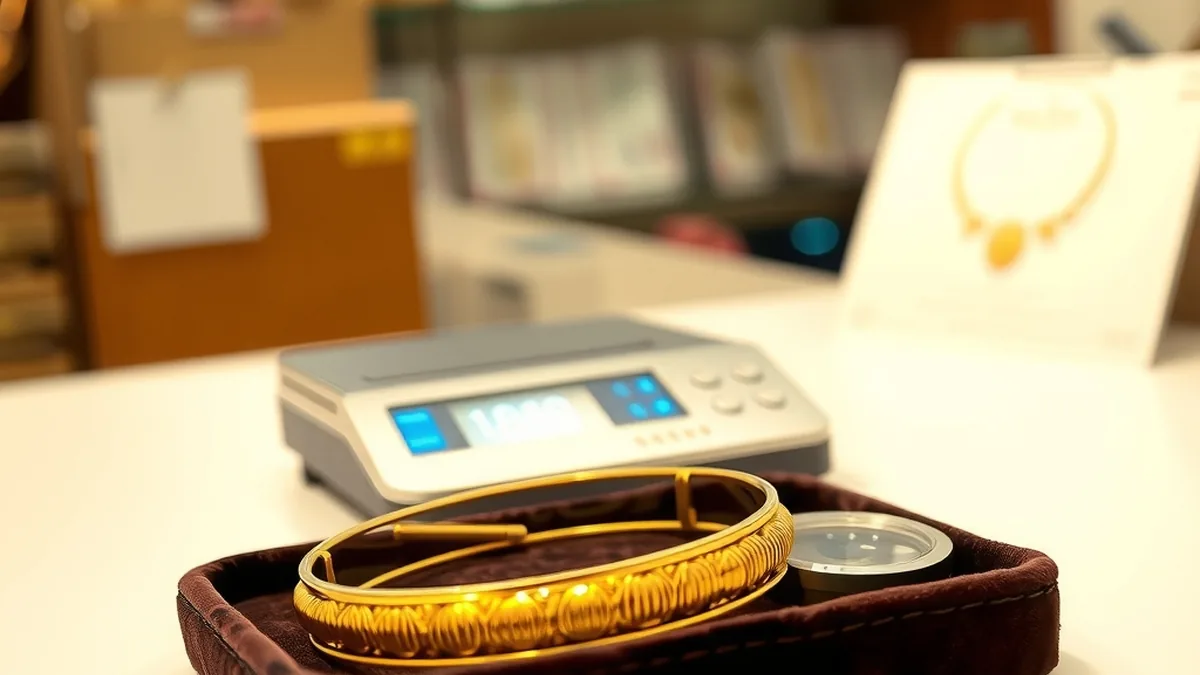
You have picked a pair of earrings, the jeweller says “22 carat, hallmarked”, and the bill is being typed. Before you pay, take thirty seconds with a magnifying glass and your phone. Gold hallmarking is the official record of how much pure gold a piece contains, and in most of India a registered jeweller is not allowed to sell gold jewellery without it.
This guide explains what the hallmark looks like, which purity grades exist, how to verify a piece on the BIS CARE app, what your jeweller must show and write on the bill, and what you can do if the gold turns out to be impure or lighter than promised. The rules come from the Bureau of Indian Standards (BIS); rupee figures in the examples are illustrations.
What gold hallmarking means
Gold is too soft to wear on its own, so jewellery is always an alloy. That is fine, as long as you know the mix. BIS describes hallmarking as the accurate determination and official recording of the proportionate content of precious metal in an article. In practice, a BIS-registered jeweller sends pieces to a BIS-recognised Assaying and Hallmarking Centre (AHC), which weighs and tests them and laser-marks those that meet the standard.
BIS was chosen in 2000 as the sole agency to run the scheme. Hallmarking became mandatory for gold jewellery and artefacts on 23 June 2021 in 256 districts. Six phases later, BIS says coverage stands at 392 districts, as per the latest amendment dated 3 August 2026. By mid-October 2026 there were over 2.1 lakh BIS-registered jewellers selling gold and over 65 crore gold articles marked with a unique ID.
The three marks on every hallmarked piece
Since 1 July 2021, gold hallmarking has three components. Look for all three, using the 10X magnifying glass the jeweller must keep at the counter.
- The BIS standard mark: the BIS logo, which certifies the piece was tested under the scheme.
- Purity in carats and fineness: for example 22K916, which means 22 carat, 916 parts of pure gold per thousand.
- A six-digit HUID: the Hallmark Unique Identification, an alphanumeric code given to that single piece.
Older hallmarked jewellery carried four marks instead: the BIS mark, purity, the assaying centre’s mark and the jeweller’s mark. Those pieces remain validly hallmarked; BIS says the hallmark is valid for the lifetime of the jewellery. From 1 April 2023, registered jewellers may sell only HUID-hallmarked gold jewellery.
If a set has detachable parts, or you are buying a pair, BIS advises that each article and each detachable part should carry its own hallmark. Otherwise a lower-purity piece could be swapped in later.
Gold purity grades and what they mean
The Indian Standard for gold hallmarking, IS 1417:2016, sets the grades. BIS’s current brief lists seven caratages under the hallmarking scheme, each with a minimum fineness in parts per thousand (ppt):
| Grade on the mark | Minimum fineness (ppt) | Pure gold, roughly |
|---|---|---|
| 24KS (24K995) | 995 | 99.5% |
| 23K (23K958) | 958 | 95.8% |
| 22K (22K916) | 916 | 91.6% |
| 20K (20K833) | 833 | 83.3% |
| 18K (18K750) | 750 | 75.0% |
| 14K (14K585) | 585 | 58.5% |
| 9K (9K375) | 375 | 37.5% |
A note on 9K: as recently as March 2026, PIB described mandatory hallmarking as covering six grades from 14K to 24KS, with 9K a voluntary grade. BIS’s October 2026 brief includes 9K in the current framework. Whatever the list, the rule for you is the same: the price per gram should match the grade stamped on the piece, and a 22K price for 18K gold is a straight loss of about 18% of the gold value.

Where gold hallmarking is mandatory, and what is exempt
Mandatory hallmarking applies district by district. The sixth phase, in force from 2 March 2026, took coverage to 380 districts, and BIS now reports 392. The district list is on the BIS website, www.bis.gov.in.
Some items and sellers sit outside the mandatory rule, subject to conditions in the Quality Control Orders. BIS lists exemptions including:
- gold articles weighing less than 2 grams;
- Kundan, Polki and Jadau jewellery;
- gold bullion and gold thread;
- jewellers with annual turnover up to ₹40 lakh, who may still register voluntarily;
- certain export, exhibition, medical, dental and industrial articles.
Old jewellery you already own cannot be hallmarked now, but BIS confirms you can still sell old hallmarked or unhallmarked jewellery to a jeweller. For a purity check on old gold, see the testing section below.
How to verify a HUID on the BIS CARE app
The BIS CARE app is the official BIS mobile app, available on Android and iOS. Its “Verify HUID” feature lets you check a piece before you buy. The steps are simple:
- Install BIS CARE and open “Verify HUID”.
- Read the six-digit code off the piece under the magnifier and type it in.
- Compare the result with the piece and the price tag.
According to BIS and PIB, the app shows the jeweller’s registration number, the AHC’s recognition number and address, the article type (ring, necklace, coin and so on), the date of hallmarking and the purity. Since 8 June 2026, BIS has also captured photographs and the weight of hallmarked gold articles, and these are available on the app for verification before sale. If the app shows a different article type, a different purity, or no record at all, do not buy. Fake hallmarks do exist; BIS has raided centres that put marks on without authority.
What the jeweller must display and write on your bill
BIS’s guidelines for registered jewellers, revised in July 2026, require a shop selling hallmarked jewellery to display:
- the BIS logo with “Hallmarked Jewellery available for sale” outside the shop;
- the BIS certificate of registration, prominently inside;
- the components of the hallmark, and the relation of fineness to caratage;
- a magnifying glass of at least 10X;
- a suitable weighing balance, preferably of 0.01 g accuracy, so you can check the weight;
- BIS contact details, the hallmarking charges and a BIS CARE “Verify HUID” poster.
The bill matters even more. It must give a separate description of each article, the net weight of precious metal, the purity in carat and fineness, and the hallmarking charges. It must also say that you can get the purity verified at any BIS-recognised AHC. Hallmarking charges do not include making or wastage charges, so those should appear separately. On the GST side, the CBIC’s FAQ says GST is 3% of the total transaction value of jewellery, making charges included.
Insist on a proper bill even for small purchases. BIS says an authentic invoice is necessary for any dispute or complaint.
Getting your gold tested
You do not have to take the jeweller’s word, or even the stamp’s. BIS says any consumer can get jewellery tested, hallmarked or not, at any BIS-recognised AHC, on priority and for a charge, and the centre must issue an assay report. PIB releases in 2023 and 2024 put the testing charge for hallmarked jewellery at ₹200; check the current fee with the centre. The list of recognised centres is on the BIS website.
Weight is a separate check. Ask the jeweller to weigh the piece on the shop balance in front of you and compare it with the net weight on the bill and, for newly hallmarked items, the weight shown on the BIS CARE app.
If your gold is impure or underweight
Purity short of the hallmark
Here the law is clear. Under Rule 49 of the BIS Rules, 2018, if hallmarked jewellery is found to be of lower purity than marked, the buyer is entitled to compensation of two times the difference, calculated on the shortage of purity for the weight of the article sold, plus the testing charges. The jeweller who made the sale is liable to pay.
As an illustration, say you bought a 20 gram chain marked 22K916, and an AHC finds 875 fineness. The shortage is 41 parts per thousand, or 0.82 grams of pure gold. Assume pure gold at ₹10,000 a gram for this example: the difference is ₹8,200, so compensation would be ₹16,400 plus the testing charges.
Weight short of the bill
Raise it with the jeweller first, with your bill and the shop’s own balance reading. If that fails, file a complaint.
Where to complain
- BIS: through the BIS CARE app, the online complaint portal on www.bis.gov.in, or by email to complaints@bis.gov.in. BIS can begin cancelling the registration of a jeweller who does not redress a substandard sale.
- National Consumer Helpline: call 1915 or 1800 11 4000, or use consumerhelpline.gov.in, for pre-litigation help.
- Consumer commission: if the jeweller still refuses, you can file a consumer complaint online.
Silver, coins and bars: how the rules differ
Silver now has a HUID system too. From 1 September 2025, HUID-based hallmarking for silver jewellery and artefacts started on a voluntary basis, but any silver article that is submitted for hallmarking must carry the HUID mark. The silver hallmark has the BIS standard mark with the word “SILVER”, a purity grade and a six-digit HUID. The current silver standard, IS 2112:2025, lists eight grades: 800, 835, 900, 925, 958, 970, 990 and 999. For silver, the BIS CARE app shows the purity, the type of article and the jeweller who sent it for hallmarking.
Gold bullion and coins follow a different route. Instead of jewellers sending them to an AHC, BIS licenses eligible refineries and mints, which mark bars and coins at the manufacturing stage. Gold bullion is also on the list of articles exempt from mandatory jewellery hallmarking. So for a coin or bar, look for the refinery or mint’s BIS marking and keep the purchase invoice, exactly as you would for jewellery.
One more practical point: hallmarking charges are levied per article, not per gram. BIS’s brief puts the charge payable by jewellers to AHCs at ₹75 per gold article, plus taxes, which is small next to making charges.
Key takeaways
- Check for all three marks: BIS logo, purity such as 22K916, and a six-digit HUID.
- Verify the HUID on the BIS CARE app before paying; the details must match the piece.
- Make sure the bill lists each article, net gold weight, purity and hallmarking charges.
- Weigh the piece on the shop’s balance and keep the bill safely.
- If purity is short, the jeweller owes twice the difference plus testing charges under BIS rules.
- Complain to BIS through the app or complaints@bis.gov.in, and to the National Consumer Helpline on 1915.
Gold hallmarking protects you only if you use it. The checks above take a couple of minutes and can save you thousands of rupees. This guide is general information; for the latest district list and grades, check the BIS website.