What is MCX
The Multi Commodity Exchange of India (MCX) is the country’s main exchange for commodity derivatives. It is where contracts on gold, silver, crude oil, natural gas, copper and other commodities are bought and sold electronically, and where the “MCX gold price” you hear about in market reports is set, second by second, while trading is open.
So what is MCX in practical terms? It is a marketplace for contracts, not for physical goods on a counter. Most of what trades there is futures contracts. A futures contract is an agreement to buy or sell a set quantity of a commodity, such as gold or silver, at a price fixed today for a set future date. Its price moves constantly as buyers and sellers react to news, global prices and the rupee.
MCX received permanent recognition from the Government of India in September 2003 to run nationwide online trading in commodity derivatives, and it is itself a listed company. It is regulated by the Securities and Exchange Board of India (SEBI), the same regulator that oversees the stock market.
Who regulates it
Commodity exchanges were once supervised by a separate body, the Forward Markets Commission (FMC). SEBI’s press release records that the FMC was merged into SEBI on 28 September 2015, bringing commodity derivatives under the same rulebook as shares and other securities. Since then, rules on brokers, margins, position limits and investor protection in commodities have been set by SEBI.
What trades on MCX
MCX organises its contracts into four broad groups:
- Bullion: gold and silver, the most widely followed contracts for Indian households.
- Base metals: industrial metals such as copper, zinc, aluminium and lead.
- Energy: crude oil and natural gas, whose prices track international benchmarks.
- Agricultural commodities: a smaller set of farm products, such as cotton.
Besides futures, MCX offers options contracts, which give the buyer the right, but not the obligation, to buy or sell at a set price. It was the first exchange in India to introduce commodity options. It also publishes commodity indices under the iCOMDEX name, which track groups of commodities together.
How a commodity futures contract works
Every MCX contract has a fixed size, called the lot, and a price quoted per standard unit. You do not pay the full value of the contract when you trade. Instead, you deposit a margin, a fraction of the contract value set by the exchange, and gains or losses are settled every day as the price moves. This daily settlement is called mark-to-market.
Here is an illustration using round numbers. Suppose the gold mini contract, with a lot of 100 grams, is quoted at ₹1,48,000 per 10 grams. One lot is then worth ten times that, or ₹14,80,000. If the price rises by ₹1,000 per 10 grams, the value of one lot goes up by ₹10,000. If it falls by ₹1,000, you lose ₹10,000. Because you put up only a margin, not the full ₹14.8 lakh, a modest move in price is a large move relative to the money you deposited. That is leverage, and it cuts both ways.
Each contract has an expiry date. Before it, a trader can close the position by doing the opposite trade. Some contracts, including certain bullion contracts, can end in physical delivery of the metal through the exchange’s delivery system if the position is held to expiry; others are settled in cash. The contract specifications published by MCX say which applies.

Gold and silver contract sizes
MCX lists bullion contracts in several sizes so that both large hedgers and smaller traders can take part. Broker listings of MCX specifications give these sizes for the main contracts:
| Contract | Lot size | Price quoted per |
|---|---|---|
| Gold | 1 kg | 10 grams |
| Gold Mini | 100 grams | 10 grams |
| Gold Guinea | 8 grams | 8 grams |
| Gold Petal | 1 gram | 1 gram |
| Silver | 30 kg | 1 kg |
| Silver Mini | 5 kg | 1 kg |
| Silver Micro | 1 kg | 1 kg |
This is why market reports quote MCX gold “per 10 grams” and MCX silver “per kg”: those are the quotation units of the main contracts. MCX revises lot sizes and launches new variants from time to time, so check the current specifications on the exchange website or your broker’s platform before trading.
Who uses MCX and how
Two broad groups trade on the exchange. Hedgers are businesses exposed to commodity prices: jewellers and bullion dealers protecting the value of their stock, refiners and importers, or companies that use copper or crude oil. They use futures to lock in prices and reduce uncertainty. Traders and investors, on the other side, take positions to profit from price moves, and in doing so provide the liquidity hedgers need.
Individuals can trade on MCX through a broker registered with SEBI for the commodity derivatives segment, after opening a trading account and completing the usual know-your-customer checks. Orders are placed electronically, just as with shares.
Who stands behind each trade
Every trade on MCX is cleared through MCX Clearing Corporation Ltd (MCXCCL), a wholly owned subsidiary of the exchange that SEBI recognises as a clearing corporation. It acts as the central counterparty: it collects margins, handles payments and deliveries, and guarantees settlement through a settlement guarantee fund, so a trader does not depend on the person on the other side of the trade paying up. Reports in July 2025 said SEBI had renewed its recognition for three years, to July 2028.
How MCX prices are set
Part of understanding what is MCX is knowing where its prices come from. No one at the exchange sets them. They are the result of orders from buyers and sellers across the country, matched electronically. But traders do not decide in a vacuum: for gold, silver, crude oil and base metals, they watch international prices closely, because India imports most of what it consumes of these commodities.
In broad terms, the MCX price of an imported commodity tends to track the international price converted into rupees, plus the costs of bringing it into India, such as import duty. That is why the rupee-dollar rate matters so much. If world gold prices are flat but the rupee weakens, MCX gold usually rises, because the same ounce costs more rupees. A change in import duty in the Union Budget can also shift MCX prices overnight.
Futures prices also reflect time. A contract expiring in two months can trade at a slightly different price from one expiring next month, because it includes the cost of holding the commodity, or of the money tied up, until the later date.
MCX and the stock exchanges
MCX is the best-known commodity exchange, but it is not the only place commodity derivatives trade in India. Since commodity regulation moved to SEBI, the big stock exchanges, NSE and BSE, have also been able to run commodity derivatives segments, and NCDEX specialises in farm commodities. For most bullion and energy contracts, though, MCX is where the bulk of the trading happens, which is why its prices are the ones quoted in the news.
Trading hours
MCX trades from Monday to Friday, with long hours so that Indian prices can follow international markets. Metals and energy contracts generally trade from 9 am to 11:30 pm, and the session is extended to 11:55 pm for part of the year to line up with US market hours when daylight saving time changes. Most agricultural contracts trade from 9 am to 5 pm, with a few, such as cotton, open until 9 pm. The exchange publishes its own holiday calendar, which does not always match the stock market’s.
MCX prices and the price at the jeweller
In daily bullion reports, MCX is the number most often quoted alongside shop rates. It is a market price for contracts, not the price on a jeweller’s board.
Retail rates are built on base bullion prices, with more added on top. According to Business Today, retail gold purchases in India attract a standard 3% GST (Goods and Services Tax) on the value of the metal and a separate 5% GST on making charges. Import duties and local transport costs also cause price differences between states. The same report says Indian prices are anchored by international spot bullion trends, USD/INR movements and festive demand, and noted that higher interest rates are a headwind for gold, which pays no interest.
Purity matters too. Retail gold is mainly sold as 24-karat, the purest form, and 22-karat, which is mixed with other metals and preferred for jewellery because it is more durable.
Why MCX is in the news
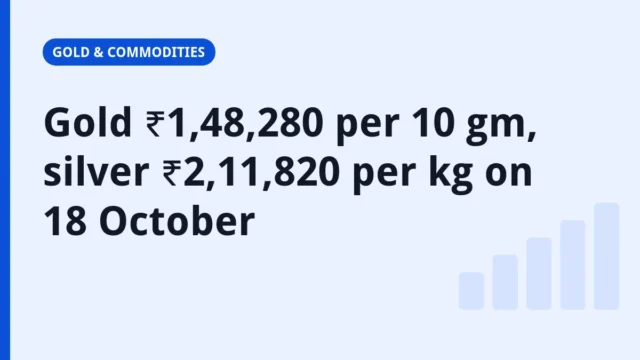
MCX quotes featured in bullion reports in the past week. On 18 October 2026, Business Today reported MCX gold futures down 0.35% at ₹1,48,000 per 10 gm and silver futures down 0.36% at around ₹2,11,418 per kg. Benchmark retail gold that day was ₹1,48,280 per 10 gm and silver ₹2,11,820 per kg, as covered in our city-wise rates report.
On Monday, 19 October, Mint reported that gold on MCX was up 0.20% at ₹1,48,580 per 10 grams in morning trade. Silver futures had gained roughly 0.44% to ₹2,12,770 per kg at about 9:13 AM. Mint tied the gains to rising US-Iran tensions, after a senior Iranian security official said Tehran had prepared a new response plan for any renewed US-Israeli attack.
The stock market was shut on Tuesday, 20 October for Dussehra, according to CNBC-TV18; details are in our market holiday report. Because MCX keeps its own calendar, check the exchange’s holiday list rather than assuming it follows NSE and BSE.
The risks to understand
Commodity futures are not a savings product. Prices of gold, silver and especially crude oil can swing sharply on news from the other side of the world, often overnight while India sleeps. Because positions are leveraged, losses can be large compared with the margin deposited, and a trader may have to add money at short notice to keep a position open. Contracts also expire, so holding a view for months means rolling from one contract to the next.
If you simply want exposure to gold as an investment, there are simpler routes that do not involve margins or expiry dates, such as a gold exchange-traded fund (ETF).
A checklist before your first trade
If you are curious about what is MCX because you are thinking of trading there, run through these questions first:
- Which exact contract, and what is its lot size and quotation unit?
- How much margin will your broker block, and how much more could you need if the price moves against you?
- When does the contract expire, and does it settle in cash or by delivery?
- Can you watch the position during evening hours, when international markets move most?
- Is your broker registered with SEBI for commodity derivatives?
If any answer is unclear, wait until it is not.
What it means for you
If you buy jewellery, the MCX quote is a signal of direction, not your final price. Add GST on the metal, GST on making charges and any local costs. Jewellers also quote slightly different rates: on 18 October, Business Today reported 22K gold at ₹13,535 per gram at Joyalukkas and Malabar Gold & Diamonds, and ₹13,575 at Tanishq. Our Gold Jewellery Price Calculator can help you estimate the total.
Quotes also differ between publishers. On 18 October, BusinessLine listed 22-carat gold at ₹13,615 per gram nationally, while Business Today’s jeweller tables differed, so compare the same source and date when you track prices.
If you are thinking of trading on MCX, start by understanding the lot size, the margin and the daily mark-to-market for the exact contract, and trade only through a SEBI-registered broker. This article is explanatory and does not suggest buying or selling anything.