What gross NPA is
Gross NPA is the portion of a bank’s loans that borrowers have stopped servicing properly. It is usually shown as a percentage of gross advances, which is the total amount the bank has lent before setting aside any money for bad loans.
A loan that has turned bad is called a non-performing asset (NPA). A lower gross NPA ratio generally means a cleaner loan book. Across the banking system the ratio is low by historical standards: the Reserve Bank of India’s (RBI) Financial Stability Report of December 2025 put it at 2.1% for scheduled commercial banks in September 2025, a multi-decade low, as widely reported at the time.
When a loan becomes an NPA
The RBI’s master circular on income recognition, asset classification and provisioning sets the rules every commercial bank follows. In plain terms, a loan becomes an NPA when:
- Term loans (such as a home, car or business term loan): interest or a principal instalment stays overdue for more than 90 days.
- Overdraft and cash credit accounts: the account stays “out of order” for 90 days, for example when the balance remains above the sanctioned limit or drawing power for that long.
- Bills purchased and discounted: the bill stays overdue for more than 90 days.
- Agricultural loans: an instalment stays overdue for two crop seasons for short-duration crops, or one crop season for long-duration crops.
Banks check this every day. The circular says the classification is done as part of the bank’s day-end process, and the date of default is the calendar date for which that process ran.
Warning stages before an NPA
Before a term loan turns into an NPA, the bank tags it as a special mention account (SMA), an early-warning label:
| Category | Principal or interest overdue for |
|---|---|
| SMA-0 | Up to 30 days |
| SMA-1 | More than 30 days and up to 60 days |
| SMA-2 | More than 60 days and up to 90 days |
| NPA | More than 90 days |
Three grades of bad loan
Once a loan is an NPA, the circular grades it by how long it has stayed bad:
- Substandard: an NPA for 12 months or less.
- Doubtful: a loan that has stayed in the substandard category for 12 months.
- Loss: a loan where loss has been identified by the bank, its auditors or the RBI’s inspection, but the amount has not been fully written off.
The longer a loan stays in these grades, the more money the bank must set aside against it. Gross NPA adds up all three grades.
How the ratios are worked out
The gross NPA ratio divides the total of all loans classed as NPAs by the bank’s gross advances. Gross NPA does not take into account the money a bank has already put aside for those bad loans. That is where related measures come in:
- Net NPA: bad loans left after subtracting provisions, which are funds the bank sets aside to absorb expected losses.
- Provision coverage ratio (PCR): the share of bad loans covered by those provisions. A higher PCR means a bigger cushion.
- Capital to risk-weighted assets ratio (CRAR): how much capital the bank holds against the risk in its assets.
Here is how they fit together, using made-up round numbers. Say a bank has gross advances of ₹1,000 crore and ₹30 crore of them are NPAs. Its gross NPA ratio is 3%. If it has set aside ₹24 crore in provisions against those loans, the net NPA is ₹6 crore. Net advances are ₹976 crore (₹1,000 crore minus the ₹24 crore), so the net NPA ratio is about 0.6%. The PCR is ₹24 crore divided by ₹30 crore, or 80%.
A loan can also leave the NPA list. Under the circular, an NPA is upgraded to standard only when the borrower pays the entire arrears of interest and principal. If the borrower has more than one loan with the bank, all of them must be cleared first. Write-offs also bring the gross figure down, which is why analysts watch recoveries and write-offs alongside the ratio.
Why gross NPA is in the news
Banks and lenders have been reporting September-quarter results, and asset quality is one of the first things analysts check. Central Bank of India reported on Saturday, 17 October 2026, that its net profit rose 21% to ₹1,469 crore for the quarter ended 30 September 2026, helped by better core income and a reduction in bad assets. Our earlier report on the results has more detail.
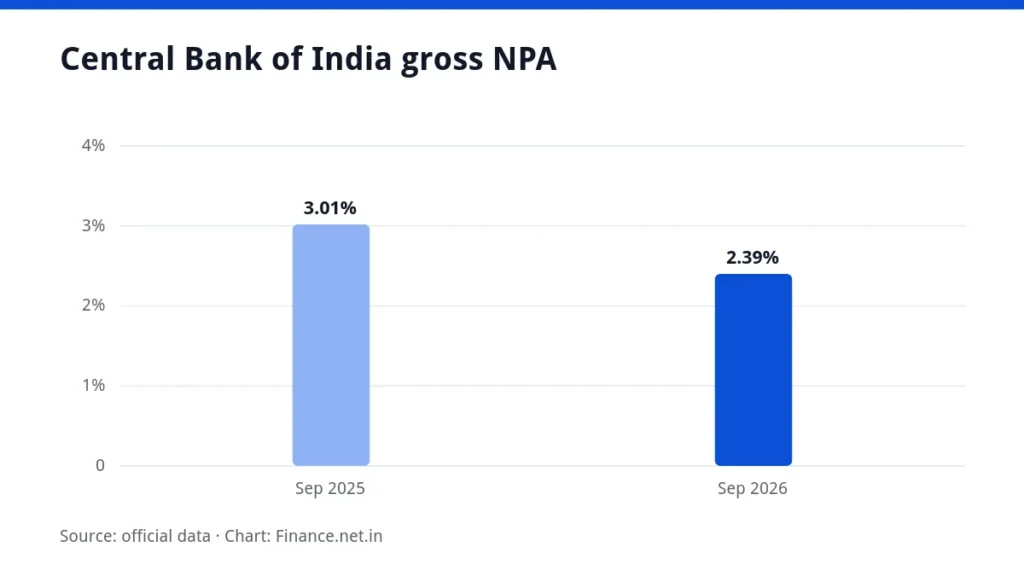
According to BusinessLine and The Hindu, the bank’s gross NPA eased to 2.39% of gross advances at the end of September 2026, from 3.01% a year earlier. Net NPA fell to 0.31% from 0.48%.
The same reports said provisioning rose to ₹490 crore in the quarter from ₹144 crore in July-September last year. The PCR was 97.16% on 30 September 2026, up 28 basis points (a basis point is one-hundredth of a percentage point) from 96.88% a year earlier. CRAR improved to 17.68% from 17.48%.
Lenders outside the banking sector report similar numbers. Bajaj Finance, which posted a 29% rise in Q2 profit to ₹6,367 crore, is covered in our results story.
What it means for you
If you hold a deposit or shares in a bank, gross NPA is one indicator of how well the lender is recovering its loans. It is not a verdict on its own. A bank with a falling gross NPA but thin provisioning may look different from one with the same ratio and a high PCR. Compare the ratio with the bank’s own past figures, as the quarterly reports above do, and with other lenders. Look at gross NPA, net NPA, PCR and CRAR together rather than any single number.
If you are a borrower, the same rules apply to your own loan. Once an EMI is overdue, the account moves through the SMA stages, and after more than 90 days it becomes an NPA in the bank’s books. Clearing only part of the arrears does not bring it back to standard; all overdue interest and principal must be paid. If money is tight, speak to the bank early, while the account is still in the SMA stages.
If you plan to borrow, you can estimate your repayments with the EMI calculator. This article is explanatory and is not advice to buy, sell or hold any security.