What the dollar index is
The dollar index, often written as DXY or USDX, measures how strong the US dollar is against a basket of six other major currencies. It boils that comparison down to a single number. If the number rises, the dollar is gaining against the group as a whole. If it falls, the dollar is weakening.
The index is run by Intercontinental Exchange (ICE), the exchange group that also lists futures contracts on it. ICE says the index was launched in March 1973, soon after the world moved away from fixed exchange rates, and that it is recalculated every second during trading using live prices of its component currencies.
It is different from the rupee-dollar rate you see in the news each evening. The rupee rate compares just two currencies. The dollar index shows the dollar’s broad strength against a group of rich-country currencies, and the rupee is not one of them. That difference matters, and it is the reason the index sometimes moves one way while the rupee moves another.
The six currencies and their weights
Each currency in the basket carries a fixed weight. According to ICE’s own brochure on the index, the weights are:
| Currency | Weight in the dollar index |
|---|---|
| Euro | 57.6% |
| Japanese yen | 13.6% |
| British pound | 11.9% |
| Canadian dollar | 9.1% |
| Swedish krona | 4.2% |
| Swiss franc | 3.6% |
Two things stand out. First, the euro makes up more than half the basket, so the dollar index is, to a large extent, a measure of the dollar against the euro. A big move in the euro alone can push the index sharply even if the dollar is flat against everything else.
Second, the basket has barely changed in half a century. ICE says the composition was changed only once, in January 1999, when the euro replaced the German mark, French franc and other single European currencies, and the combined weight of those old currencies was kept at 57.6%. China’s yuan, the Indian rupee and other emerging-market currencies are not in it at all, even though they now matter far more to world trade than when the index began.
How the dollar index is calculated
ICE describes the index as a geometrically averaged calculation of the six currencies. In plain terms, it multiplies together each exchange rate raised to the power of its weight, and scales the result so the level can be tracked over time. You do not need the formula to use the index. What matters is how to read its moves:
- Direction: a rising index means the dollar is buying more of the basket currencies; a falling index means it is buying less.
- Size: moves are usually quoted in per cent. A daily change of 0.1% or 0.2% is routine. A move of 1% or more in a day is large and usually tied to a big event, such as a surprise from the US Federal Reserve.
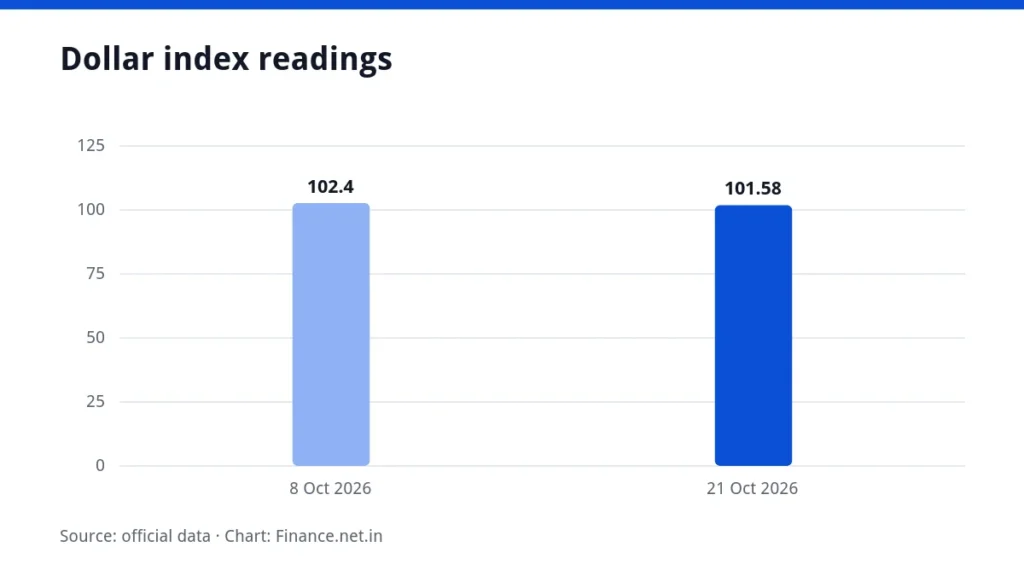
- Level: the number itself, say 101 or 102, is mainly useful for comparing one date with another. A reading of 102.40 against 101.58 tells you the dollar was a little stronger on the first date.
As an illustration of scale, a fall in the index from 102.40 to 101.58 is a decline of about 0.8%. That is a noticeable but not dramatic weakening of the dollar against the basket over the period.
What moves the dollar index
Because the index is mostly the dollar against the euro and a few other major currencies, it tends to respond to the same forces that drive those exchange rates. The common ones are:
- US interest rates: when the Federal Reserve raises rates, or markets expect it to keep them high, dollar deposits and US bonds become more attractive, which tends to lift the dollar. Expectations of rate cuts tend to weaken it.
- Interest rates elsewhere: the gap matters. If the European Central Bank or the Bank of Japan raise rates while the Fed holds, the euro or yen can strengthen and the index can fall.
- Risk appetite: in times of fear, such as wars, banking scares or sharp market falls, investors often move money into the dollar as a safe place to park it. This can push the index up even when the trouble starts outside the US.
- Growth and trade: a stronger US economy compared with Europe and Japan tends to support the dollar.
None of these work like a switch. Markets often move on what they expect to happen rather than on the event itself, which is why the index can fall on a day the Fed raises rates if the rise was smaller than traders had expected.
The dollar index and the rupee
The rupee is not in the basket, so the dollar index never measures the rupee directly. It still matters to India for three reasons.
First, a broadly stronger dollar usually puts pressure on many currencies at the same time, including emerging-market currencies like the rupee. When the index is climbing, foreign investors often pull money out of emerging markets, which means selling rupees for dollars.
Second, India pays for most of its imports, and crude oil in particular, in dollars. When the dollar is firm and oil is expensive at the same time, importers need more dollars, which adds to the pressure on the rupee.
Third, the Reserve Bank of India (RBI) watches these pressures and can step in by buying or selling dollars, or by changing rules that affect currency trading. Its actions can make the rupee move against the trend of the dollar index.
So the rupee reacts to the dollar index, but also to its own drivers: oil prices, foreign investor flows, India’s trade balance and RBI action. The index alone does not decide where the rupee goes.
Why the dollar index is in the news
The index featured repeatedly in reports on the rupee in October 2026. On 8 October, The Hindu reported that forex traders pointed to global dollar strength, with the DXY near multi-month highs, alongside Brent crude near $104 a barrel. The index traded at 102.40, up 0.16%, and the rupee closed at 96.88, down 13 paise.
The rupee then recovered. It closed at 95.17 on 14 October, with traders citing RBI measures to curb speculative bets. We covered that in rupee rebounds to 95.17 from 96.88 in a week.
On 21 October, the index was at 101.58, up 0.06%, and the rupee gained 29 paise to 94.62 in early trade, according to PTI via BusinessLine. Analysts attributed the gain to foreign dollar inflows tied to the Jio IPO and support from the RBI. Elevated crude oil prices and a firm dollar capped the rise. See our report on the rupee’s early trade on 21 October.
So the index moved from 102.40 to 101.58 between those two dates, a softer dollar, while the rupee strengthened from 96.88 to 94.62 in early trade. The rupee’s gain was much larger than the dollar’s dip, which shows how much of the move came from India-specific factors: RBI action and IPO-related inflows.
Other ways to measure the dollar and the rupee
Because the dollar index covers only six rich-country currencies, economists also use broader measures:
- The Federal Reserve’s broad dollar index: the US central bank publishes a weighted average of the dollar against the currencies of a broad group of major US trading partners, including emerging economies. It has daily values, published every week in the Fed’s H.10 release, alongside separate indexes for advanced and emerging economies. Because it is based on trade, it gives a fuller picture of the dollar’s value for the US economy.
- The RBI’s effective exchange rates: for the rupee itself, the RBI publishes the nominal effective exchange rate (NEER) and real effective exchange rate (REER) in its monthly Bulletin, against baskets of 40 currencies and of 6 currencies. The NEER shows the rupee’s average value against India’s trading partners; the REER also adjusts for differences in inflation. These are better guides to the rupee’s overall strength than any single rate.
When you read that “the dollar is strong”, it helps to ask which measure is meant. A strong dollar index can coexist with a stable rupee if the RBI is active or if the euro is weak for reasons of its own.
How traders use it
The index is not only a news statistic. ICE lists futures contracts on it, which let banks, funds and companies take a position on the dollar against all six currencies in one trade. ICE says its main futures contract trades on ICE Futures U.S. for almost the whole day, from 8 pm to 5 pm New York time, expires on the third Wednesday of the contract month and is settled in the six underlying currencies. A smaller, cash-settled “mini” contract trades on ICE Futures Singapore, during Asian hours.
For a company with costs in several currencies, one contract can be simpler than six separate trades. For most individuals, the index is mainly a quick way to read the global mood around the dollar.
Common misreadings
A few mistakes come up again and again:
- Treating it as the rupee rate. The basket has no Asian emerging-market currency at all. A report that the greenback is “strong” may say nothing about how it is doing against the rupee that day.
- Treating it as the whole world. With the euro at 57.6%, a weak euro can make the dollar look strong across the board when it is not.
- Reading too much into tiny moves. Changes of a few hundredths of a per cent happen all the time and rarely mean anything on their own.
- Assuming the past repeats. The link between a firm US currency and a weak rupee holds often, not always. In October 2026 the rupee rose sharply while the greenback barely softened.
How to read dollar index news
Market reports on the rupee often include a line such as “the dollar index, which measures the greenback against a basket of six currencies, was up 0.16% at 102.40”. Here is a short checklist for making sense of it:
- Check the direction. Up means a firmer dollar against the basket, down means a softer one.
- Check the size. A change under 0.3% in a day is ordinary background movement.
- Look for the other drivers in the same report: crude oil, foreign investor flows and any mention of RBI intervention.
- Compare dates using the level, not just the daily change, if you want to see a trend over a week or a month.
- Do not expect a one-for-one link. A 1% move in the index does not mean a 1% move in the rupee.
What it means for you
If you send money to India from abroad, pay for foreign education or travel, or hold dollar assets, the dollar’s strength changes the rupee value of your transactions. A firmer dollar generally means each dollar buys more rupees, which helps people sending money home but makes dollar bills such as foreign tuition costlier in rupee terms. Our currency converter and money transfer calculator help you work out amounts at a given rate.
If you are planning a large dollar payment, such as a university fee, the dollar index is one useful signal of the global backdrop, but the rupee rate on the day you pay is what counts. Watching RBI announcements and oil prices is just as important.
For a broader view of what moves the rupee and what the RBI does about it, read why the rupee swings and what RBI is doing about it.
Treat the dollar index as one signal among several. A rising index does not guarantee a weaker rupee, and a falling one does not guarantee a stronger rupee. This article is explanatory and is not a forecast or advice on currency trading.