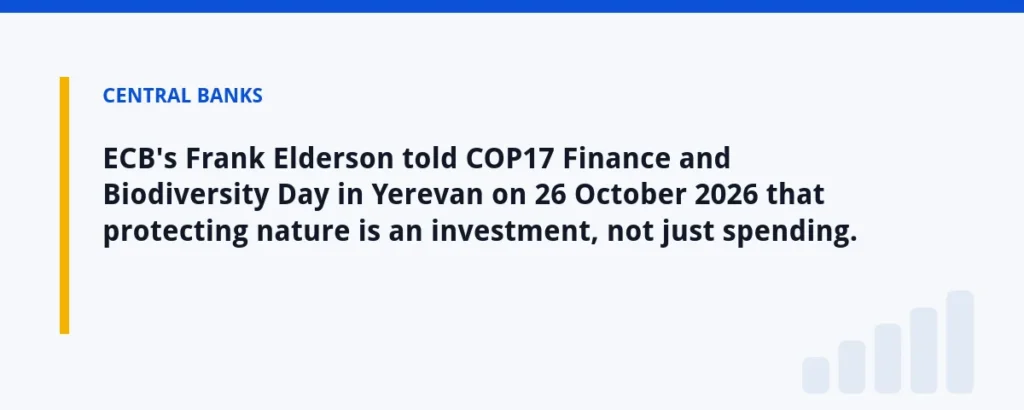
Frank Elderson, a member of the European Central Bank’s (ECB) Executive Board and Vice-Chair of its Supervisory Board, said on 26 October 2026 that degrading nature is an economic and financial risk, and that protecting it should be treated as investment. He was giving the keynote at the COP17 Finance and Biodiversity Day in Yerevan.
What happened
Elderson argued that nature works like economic infrastructure. Water, soils, forests, wetlands and oceans support farms, factories and food systems. He said the economy has long counted production and income but not the natural resources used up to create them.
He cited several figures:
- The World Bank estimates that as much as half of world GDP relies on biodiversity, natural capital and ecosystem services.
- ECB analysis shows 72% of euro area companies depend on at least one ecosystem service, and 75% of euro area corporate lending goes to companies highly dependent on at least one.
- A study by the ECB, the London School of Economics and Oxford University found that a drought of the severity expected once in a century could threaten as much as 24% of euro area economic output.
- Nearly 12% of euro area output faces risks from insufficient flood protection.
- The European Commission estimates that if current PFAS pollution continues until 2050, the cost to society in Europe could reach €440 billion. PFAS are long-lasting chemicals, known as "forever chemicals".
He pointed to this summer’s drought in Europe, when rivers such as the Rhine, Loire, Po and Danube fell to exceptionally low levels. That forced the shutdown of critical nuclear power plants and hit hydropower and supply chains.
What it means for central banks and banks
Elderson said nature degradation can affect price stability, financial stability and the safety of banks. In supervision, the ECB expects banks to identify and manage nature-related risks as well as material climate risks. He said around one-third of the practices in the ECB’s updated compendium of good practices relate specifically to nature.
On prices, he said the ECB has found that food price rises after extreme heatwaves and droughts are an upside risk to inflation, and that nature risks have featured in its monetary policy assessment and communication in recent quarters. When water or other shocks are widespread or persistent, he said, they can ultimately affect growth and inflation.
He also highlighted the Network for Greening the Financial System (NGFS), which brings together 152 central banks and supervisors across more than 95 countries, plus 24 observers. A recent compendium covers 35 examples of how members assess physical and transition risks from nature, with six detailed case studies. He said nature-related risks should stay on the agenda of the Basel Committee, the Financial Stability Board and the IMF.
What it means for you
This is a speech, not a policy change, so nothing changes for savers or borrowers immediately. It does show how euro area authorities are linking environmental loss to bank lending, prices and growth. For readers following the euro area, it signals that supervisors want banks to look at nature-related risks in their loan books. See also the earlier coverage of Elderson on bank supervision.
Background
The Kunming-Montreal Global Biodiversity Framework was adopted four years ago and sets a pathway to living in harmony with nature by 2050. Elderson said progress has been limited and nature has continued to deteriorate, so action needs to move from targets to implementation and investment.
He added that Europe is the fastest-warming continent. Since the mid-1990s its temperatures have climbed by roughly 0.56°C every decade, over twice the global pace. He also said seven of the nine planetary boundaries have already been transgressed.