ECB Executive Board member Piero Cipollone said the European Central Bank will launch a digital euro pilot in 2027, based on real transactions by staff of the ECB and the national central banks. He made the remarks in an interview with Milano Finanza, conducted on 21 October 2026 and published by the ECB on 24 October.
What happened
The digital euro is a planned electronic form of central bank money. Today, people can use central bank money only as cash, which does not work online. Cipollone said the digital euro would fill that gap, offering features similar to cash, such as privacy, and working in shops, online and person to person.
He said 36 market operators, seven of them Italian, already work on the preparations, and the ECB is now asking e-commerce and mobile commerce operators to join.
Timing
The final decision depends on the legislative talks in Brussels. Cipollone said the ECB hopes the regulation is adopted by the end of the year, so the Governing Council can issue a formal decision on issuance. The interviewer noted that adoption this year could allow a rollout as early as 2029. Banks, payment operators and merchants will need time to adapt their systems, he added.
How it would work
- Holding limit: there would be a cap on how much digital euro a person can hold in a digital wallet, but no cap on payments. If a payment exceeds the balance, the remainder can be taken automatically from the linked current account.
- Offline use: two devices brought together can complete a payment without the internet, as with a contactless card. Transaction details stay between payer and payee.
- Access: banks can build it into their own apps, and the Eurosystem will offer a standard app with basic functions. The ECB will not open accounts for people.
- Issuance: as with cash, demand from citizens and firms, not an annual ECB limit, will determine how much is used.
Why the ECB says it is needed
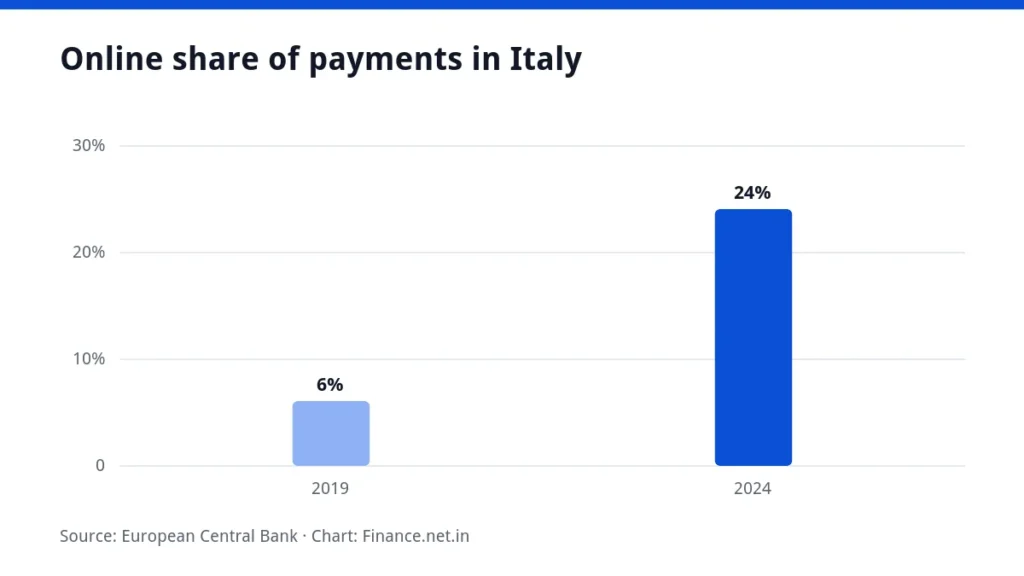
Cipollone said online payments in Italy grew from 6% of the total in 2019 to 24% in 2024, according to the latest available data. He said two thirds of online card payments use non-European card schemes. Many euro area countries have no domestic equivalent of Italy’s Bancomat, so the dependence extends to physical shops.
He also said small shops can pay fees up to four times higher than large operators, and that legal cost caps and added competition should help reduce them.
What it means for you
If you live or travel in the euro area, the digital euro would be an additional way to pay, not a replacement for cash or bank services. Cipollone said he does not expect it to be the only option. Nothing changes yet: the regulation is not adopted and no issuance decision has been made.
For context on other ECB work, see our coverage of euro liquidity lines and the ECB’s inflation outlook. If you send money between currencies, the Currency Converter can help.
Background
Cipollone said the digital euro is not meant to replace banks. Banks and other authorised intermediaries would distribute it, manage customer relationships and build services on a common European infrastructure developed by European providers. He said security would rely on encryption, data segregation, regular simulated-attack testing and distribution across several European regions.
He also pointed to the Pontes project, which started operating on 21 September 2026. Pontes lets trades on platforms built on distributed ledger technology (DLT, a shared digital record-keeping system) be settled with central bank money. A companion project, Appia, is meant to build a fully joined-up European financial ecosystem. More than 70 operators have worked with the ECB on innovation, and a second call for ideas has just been launched.