
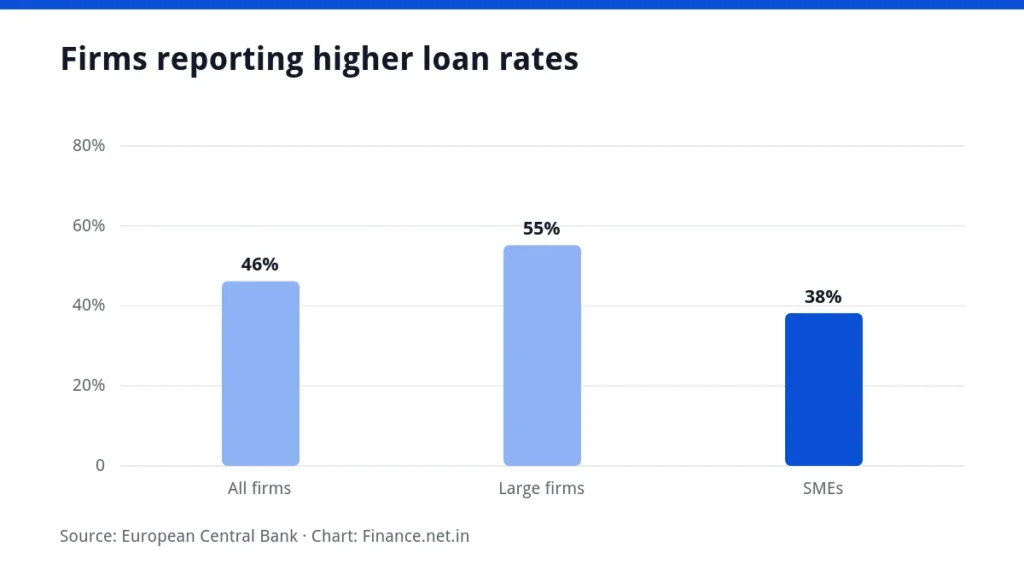
Euro area firms reported a further tightening in bank lending in the third quarter of 2026, according to the European Central Bank’s (ECB) Survey on the Access to Finance of Enterprises (SAFE), published on 26 October 2026. A net 46% of firms said interest rates on bank loans had risen, compared with 42% in the previous quarter.
“Net” here means the share of firms reporting an increase minus the share reporting a decrease.
What happened
The rise in loan rates was felt differently by firm size. Among large firms, a net 55% reported higher rates, up from 41% in the prior quarter. Among small and medium-sized enterprises (SMEs), the figure was a net 38%, down from 43%.
Other costs of borrowing, such as charges, fees and commissions, rose for a net 27% of firms, compared with 31% before. Collateral requirements went up for a net 14%, from 10%.
Availability of bank loans fell (net -5%, against net -1% in the second quarter). SMEs reported net -5% and large firms net -6%.
Loan needs moved less. A net 2% of firms reported lower needs, whereas a net 2% had reported higher needs in the previous quarter. SMEs saw broadly unchanged needs (net 1%), while large firms reported a decrease (net -6%).
The ECB’s financing gap indicator compares changes in the need for loans with changes in their availability. It was positive at net 2%, against 3% before. A positive reading points to a widening gap. Looking ahead, more firms expect external financing availability to decrease over the next three months.
What firms said is holding back finance
The general economic outlook remained the main constraint on availability of external financing (net 31%, up from 29%). Large firms were more pessimistic (net 35%) than SMEs (net 29%). A net 9% said their own sales and profit outlook weighed on availability, after 10% earlier, while their capital position and creditworthiness still had a positive effect.
Inflation and price expectations: a caution
The sample changed substantially this round, with first-time respondents making up the majority. The ECB says this makes the numerical answers, such as those on selling prices, input costs and inflation, harder to read at this stage.
Among firms that took part in both this and the previous round, the rise in selling price expectations was contained and median inflation expectations were broadly unchanged. In the full sample, both rose significantly. The risk assessment for the five-year-ahead inflation outlook was broadly unchanged.
What it means for you
The survey covers euro area businesses, not households. It shows that firms there are finding credit costlier and somewhat harder to get. The ECB release does not draw conclusions for other economies, and it does not say what this means for interest rates.
For readers following European conditions, a related gauge of households is covered in our report on euro area consumers’ inflation expectations.
Background
This is the 40th round of SAFE. The survey ran from 26 August to 2 October 2026. Around half the firms were asked about changes between July and September 2026, and the rest about April to September 2026. The sample had 12,822 euro area enterprises, of which 11,917 (93%) had fewer than 250 employees.