
What the Basel Committee on Banking Supervision is
The Basel Committee on Banking Supervision (BCBS) is the main global body that sets standards for how banks are regulated, above all how much capital they must hold. Capital here means the bank’s own funds, as opposed to the deposits it owes to customers. It works as a cushion that absorbs losses, so that a bad year does not wipe out depositors’ money.
According to the Bank for International Settlements (BIS), which hosts it in Basel, Switzerland, the Committee’s 45 members are central banks and bank supervisors from 28 jurisdictions. The Reserve Bank of India (RBI) is one of them. The Committee reports to an oversight body of central bank governors and heads of supervision, which endorses its major decisions.
Its own charter is clear about one important point: the Basel Committee on Banking Supervision has no formal supranational authority, and its decisions do not have legal force. Its standards, such as the Basel III framework, take effect in a country only when the national regulator turns them into rules. Members commit to doing that within agreed timeframes. In India, that regulator is the RBI.
Why it was set up
The Committee was created by the central bank governors of the Group of Ten (G10) countries at the end of 1974, after serious turmoil in international currency and banking markets. The BIS history page points in particular to the failure of Bankhaus Herstatt in West Germany, a small bank whose collapse in 1974 left counterparties around the world with unsettled foreign exchange trades.
The lesson was that banks operating across borders needed common ground rules and supervisors who talked to each other. The Committee has met regularly ever since, three or four times a year, and has grown from the original G10 to its current membership. Its first major output, the Basel Concordat of 1975, set out how supervisors in different countries should share responsibility for international banks.
How the Committee works
The Committee is run by a chair appointed by its oversight body, the Group of Central Bank Governors and Heads of Supervision. Its secretariat sits at the BIS. The work itself is split among four groups covering risk assessment, supervisory cooperation, policy development and engagement with countries that are not members.
New standards are not handed down overnight. The Committee publishes consultation papers, invites comments from banks, regulators and the public, and revises its proposals before finalising them. Its charter also commits it to consulting central banks and supervisors outside its membership, so that the rules work beyond the countries at the table.
Once a standard is agreed, the Committee follows up on how members put it into practice, because a rule that is adopted unevenly can give some banks an unfair advantage. Promoting a level playing field among internationally active banks is one of the aims written into its mandate.
Basel I, II and III
The Committee’s best-known work is a series of capital accords, usually called Basel I, II and III.
| Framework | When | Main idea |
|---|---|---|
| Basel I (Basel Capital Accord) | Released July 1988 | Minimum capital of 8% of risk-weighted assets, to be met by the end of 1992 |
| Basel II | June 2004 | Three pillars: minimum capital rules, supervisory review, and disclosure to strengthen market discipline |
| Basel III | From 2010, with final reforms in 2017 | Response to the 2007-09 financial crisis: more and better capital, liquidity rules, a leverage ratio and limits on internal models |
Basel I introduced the idea that not all assets are equally risky. A loan to a government was treated differently from a loan to a company, and a bank had to hold capital in proportion to the risk-weighted total. The BIS notes it was adopted not only in member countries but in virtually every country with internationally active banks.
Basel II tried to make capital reflect risk more precisely, including by letting large banks use their own risk models, and added supervisory review and public disclosure as the second and third pillars.
Basel III came after the 2007-09 crisis exposed how thin many banks’ capital really was. The BIS describes it as an internationally agreed set of measures to strengthen the regulation, supervision and risk management of banks. Its final reforms, published in 2017, revised how capital is calculated for credit risk, credit valuation adjustment risk and operational risk, revised the leverage ratio, added a leverage buffer for global systemically important banks, and introduced an output floor that limits how far banks can use internal models to cut their capital requirements.
The key ideas in plain words
Risk-weighted assets
Instead of measuring capital against total loans, Basel rules measure it against risk-weighted assets (RWAs). Each asset is multiplied by a weight that reflects its risk: safer assets count for less, riskier ones for more. As an illustration with round numbers, if a bank’s assets add up to ₹1,000 crore but their risk-weighted value is ₹600 crore, a 9% capital requirement means it must hold ₹54 crore of capital.
Quality of capital
Not all capital is equal. Common equity tier 1 (CET1), mainly shareholders’ equity and retained earnings, is the strongest form because it absorbs losses first. Basel III raised the share of capital that must be of this quality.
Buffers
On top of the minimums, banks hold buffers. The capital conservation buffer is extra CET1 that a bank can draw on in bad times; if it does, limits apply on dividends and bonuses until it rebuilds. Large, interconnected banks hold a further surcharge because their failure would do more damage.
The leverage ratio
The leverage ratio is a simple backstop to risk-based rules. It divides capital by a bank’s total exposure, without risk weights, so a bank cannot make its balance sheet look safer than it is by relying on low risk weights or optimistic models.
Liquidity rules
The 2007-09 crisis showed that banks can fail from running out of cash even when their capital looks adequate on paper. Basel III therefore added two liquidity standards. The liquidity coverage ratio asks banks to hold enough high-quality liquid assets, such as government bonds, to survive a month of severe stress. The net stable funding ratio asks them to fund long-term assets with stable sources of money rather than short-term borrowing. The RBI applies both to Indian banks.
The limits of the framework
The Basel rules are not without critics. They have grown long and complex, and compliance is costly, especially for smaller banks. The use of banks’ own risk models led to wide differences in how much capital similar banks held, which is one reason the 2017 reforms introduced the output floor; the BIS says reducing excessive variability in capital requirements was a key aim. There is also a long-running debate over whether higher capital makes lending more expensive. Regulators generally argue that the cost is small compared with the damage a banking crisis does to an economy.
How Basel standards reach Indian banks
The RBI turns Basel standards into binding directions under its legal powers. The leverage ratio amendment of 23 October 2026, for instance, was issued under Section 35A of the Banking Regulation Act, 1949, to align the RBI’s rules with the Committee’s latest leverage ratio framework.
The usual path has several steps. The RBI releases a draft and invites feedback, reviews the comments, and then publishes final directions with a start date. For the leverage ratio, the draft came out on 7 August 2026, feedback was open until 28 August 2026, and the RBI said it had examined the comments and changed the final text accordingly.
The RBI can also go further than the Basel minimum, and on capital it does.
India’s capital rules compared with Basel
The Basel minimum for total capital is 8% of risk-weighted assets. Under the RBI’s Basel III capital regulations, Indian banks must hold at least 9%, with common equity tier 1 of at least 5.5%, plus a capital conservation buffer of 2.5% in common equity. Together, that takes the total to 11.5%, and CET1 plus the buffer to 8%.
The biggest banks hold more. Each year the RBI names its domestic systemically important banks (D-SIBs), lenders whose failure could shake the financial system, and sets an extra CET1 requirement for each. In its list of 2 December 2025, based on March 2025 data:
| Bank | Bucket | Additional CET1 (% of risk-weighted assets) |
|---|---|---|
| State Bank of India | 4 | 0.80% |
| HDFC Bank | 2 | 0.40% |
| ICICI Bank | 1 | 0.20% |
This surcharge comes on top of the capital conservation buffer.
The new leverage ratio rules
Under the RBI’s amended directions, the leverage ratio is the capital measure divided by the exposure measure, expressed as a percentage. Exposure generally follows gross accounting values, so a bank cannot shrink it by netting assets against liabilities or by counting collateral, unless the rules say otherwise.
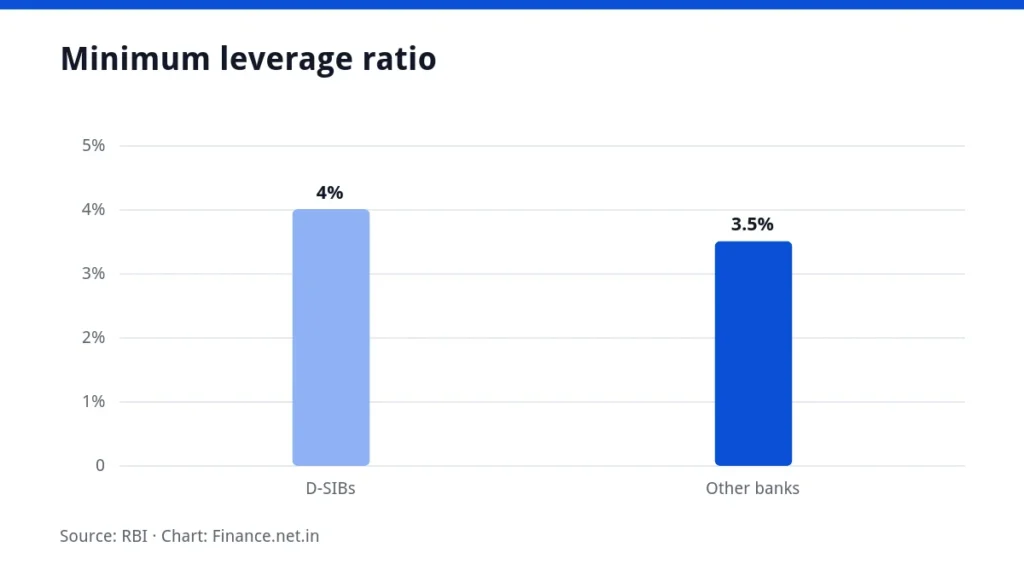
A D-SIB must keep a leverage ratio of at least 4%. Other banks must keep at least 3.5%. Branches in India of global systemically important banks must keep 3.5% plus the leverage buffer applicable to them, and if such a branch falls short, limits apply on how much of its earnings it can distribute.
Why it is in the news
On 23 October 2026 the RBI released the final Leverage Ratio 2017 Standard directions, which take effect from 1 April 2027. You can read our earlier note on how the RBI amended its leverage ratio rules to match the Basel standard.
The same day, the RBI issued a second amendment on minimum capital for operational risk, which is the risk of loss from failed processes, people or systems. It sets the implementation date for the new Basel III Standardised Approach, gives an indicative mapping of Business Indicator components to financial statement line items, and adds clarifications the Basel Committee issued after the original directions of 28 November 2025. Details are in our report on the 1 April 2027 start for operational risk capital rules.
The RBI Governor had said on 1 October 2025 that the revised Basel III capital framework would apply from 1 April 2027 to commercial banks, excluding small finance banks, payments banks and regional rural banks. These October 2026 directions are pieces of that larger shift, which brings in the 2017 final reforms described above.
What it means for you
As a depositor or borrower, you will not see a change in your account. These rules apply to banks’ balance sheets, not to customers directly.
What they do is make the system sturdier. Higher and better-quality capital, liquidity rules and a leverage backstop mean banks are better placed to absorb losses without calling on depositors or taxpayers. The RBI’s choice of a 9% minimum, above the Basel 8%, and extra capital for the largest banks, are part of that cushion.
Banks may adjust how they manage their balance sheets before April 2027, but the sources do not say how that will affect loan or deposit pricing. When you read a bank’s results, the capital adequacy ratio, often reported as CRAR, tells you how far above the minimum it sits. If you want to see how a bank’s rates affect your own money, you can use the FD Calculator or the EMI Calculator.