
What is an NBFC
An NBFC, short for non-banking financial company, is a company that lends money, invests in securities or offers other financial services without holding a banking licence. If you have bought a phone on EMI at a shop counter, taken a gold loan from a specialist lender or financed a used car through a company that is not a bank, there is a good chance you have dealt with one.
The Reserve Bank of India (RBI) gives the formal answer to what is an NBFC in its frequently asked questions on the sector. It is a company registered under the Companies Act whose principal business is loans and advances, buying shares, bonds, debentures or other securities, leasing, hire-purchase and similar activities. A company whose main business is farming, manufacturing, trading in goods, providing services or buying and selling property is not an NBFC, even if it also lends some money.
The 50-50 test
How does the RBI decide whether finance is a company’s principal business? It uses what is often called the 50-50 test. A company counts as an NBFC when both of these are true:
- Its financial assets are more than 50% of its total assets (after removing intangible assets).
- Income from those financial assets is more than 50% of its gross income.
A company that meets both conditions must register with the RBI before it carries on that business.
How NBFCs differ from banks
NBFCs lend and invest, so their work looks a lot like banking. The RBI points to three differences that matter to customers:
| Bank | NBFC | |
|---|---|---|
| Savings or current accounts (demand deposits) | Yes | No, NBFCs cannot accept deposits repayable on demand |
| Cheques and the payment system | Part of the payment and settlement system; issues cheques | Not part of it; cannot issue cheques drawn on itself |
| Deposit insurance (DICGC) | Available to depositors | Not available to depositors of NBFCs |
In practice, that means you can borrow from an NBFC, and in a few cases place a fixed deposit with one, but you cannot run your salary account or write cheques through it. And if a deposit-taking NBFC fails, there is no insurance cover for its depositors of the kind bank customers get.
Types of NBFCs
The RBI groups NBFCs in three ways: by whether they take deposits, by size under its scale-based regulation, and by the kind of business they do. Some of the activity-based types listed in the RBI’s FAQ are:
- Investment and Credit Company (ICC): the broad category for lenders and investment companies, covering asset finance, loans and advances, and buying securities. Most consumer and business lenders fall here.
- Housing Finance Company (HFC): lenders focused on home loans, with a minimum net owned fund of ₹20 crore.
- NBFC-Microfinance Institution (NBFC-MFI): a non-deposit-taking NBFC with at least 60% of its assets in microfinance loans, which the RBI defines as collateral-free loans to households with annual income up to ₹3 lakh.
- NBFC-Factor: companies whose main business is factoring, that is, buying a business’s unpaid invoices and collecting them.
- NBFC-Peer to Peer Lending Platform (NBFC-P2P): online platforms that connect lenders and borrowers and facilitate loans between them.
- NBFC-Account Aggregator (NBFC-AA): companies that collect your financial information from different institutions, with your consent, and share it with a lender or adviser you choose.
Other categories include infrastructure finance companies, mortgage guarantee companies and standalone primary dealers in government securities.
How the RBI regulates NBFCs
An NBFC needs a certificate of registration from the RBI under Section 45-IA of the RBI Act, 1934. Applications are made on the RBI’s PRAVAAH portal. A new NBFC must have a minimum net owned fund, broadly its own capital, of ₹10 crore, with different amounts for specialised types; the RBI’s FAQ says existing NBFCs have until 31 March 2027 to reach that level.
Since October 2022, the RBI has regulated NBFCs by size under its scale-based framework. They are placed in four layers: Base, Middle, Upper and Top. The bigger and more connected a company is, the higher its layer and the stricter the rules on capital, governance and disclosure, because a failure at a large NBFC can spread to banks and markets.
Across all layers, the RBI sets directions on prudential matters such as leverage and provisioning, a fair practices code for dealing with customers, and governance and disclosure. The list of registered NBFCs is published on the RBI website under Regulation, then Non-Banking.
How an NBFC makes money
An NBFC raises money from banks, bond markets and, for a few, depositors, lends it out to customers and keeps the gap. The reported numbers follow that chain:
- Net interest income (NII): the interest earned on loans minus the interest paid on funds. CNBC-TV18 called it the core income of Bajaj Finance.
- Assets under management (AUM): the total loans the company manages.
- Cost of funds: what the company pays to raise money. Because NBFCs cannot collect cheap savings deposits, their cost of funds is usually higher than a bank’s.
- Gross NPA: the share of loans that borrowers have stopped repaying. Net NPA is the same measure after setting aside provisions, amounts kept aside for possible losses.
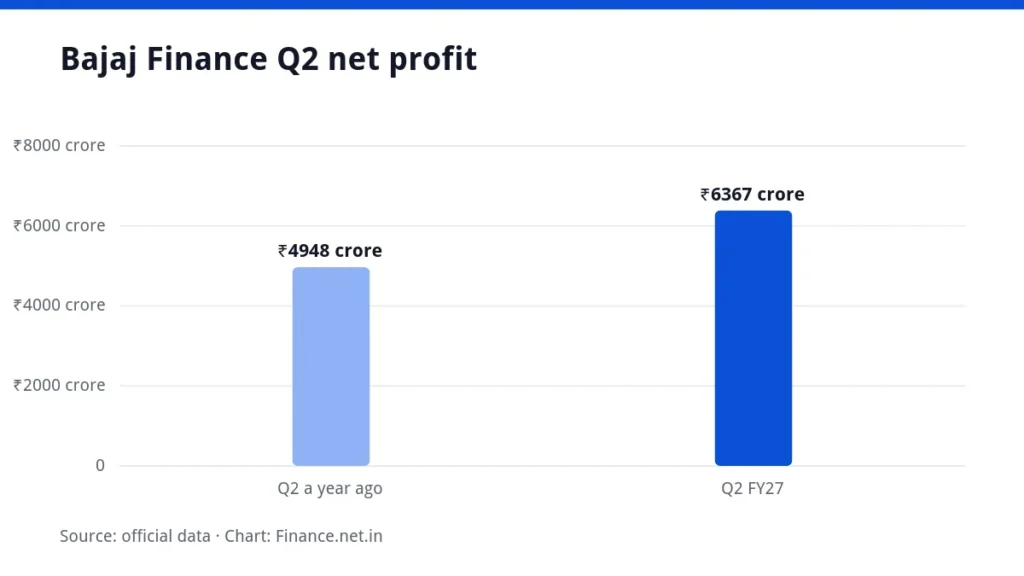
The Bajaj Finance Q2 results show these in practice. For the September 2026 quarter, net profit rose 29% to ₹6,367 crore from ₹4,948 crore a year earlier. NII rose 24% to ₹13,335 crore. AUM grew 26% to ₹5.85 lakh crore as of 30 September 2026. Gross NPAs were 1.06%, up from 0.96% in the June quarter but lower than 1.24% a year earlier, and the cost of funds fell by nine basis points from the previous quarter to 7.31%, according to CNBC-TV18.
NBFC deposits: what to check first
Some NBFCs offer fixed deposits, often at higher rates than banks. Before you put money in one, know the rules the RBI’s FAQ sets out:
- Only licensed NBFCs can take public deposits. The RBI has not issued a licence to any new NBFC to accept public deposits since 1997, as a matter of policy that only banks should take them. Check the RBI’s list of NBFCs allowed to accept deposits before you invest.
- Rating and limit: a deposit-taking NBFC needs at least a BBB- credit rating from a SEBI-registered agency and can hold public deposits only up to 1.5 times its net owned fund.
- Rate cap: the maximum interest an NBFC can offer on deposits is currently 12.5% a year.
- Term: deposits must be for at least 12 months and at most 60 months. There are no deposits repayable on demand.
- No insurance: NBFC public deposits are unsecured, and the RBI’s deposit insurance does not cover them. The RBI also says it does not guarantee the financial soundness of any NBFC.
A higher rate is compensation for that extra risk. Partnership firms, individuals and other unincorporated bodies cannot legally run deposit schemes as their main business, so treat any such offer as a red flag.
Why NBFCs are in the news
Two NBFC events landed within a week of each other in October 2026.
First, Bajaj Finance reported the results above on Monday, 19 October. It booked 13.45 million new loans in the quarter and added 4.42 million customers, taking its customer base to 128.85 million. It expects to disburse 60-62 million new loans in FY27, according to CNBC-TV18.
Second, Vaibhav Vyapaar opened its ₹42.10 crore IPO on 13 October on the NSE SME platform, a segment of the exchange for smaller companies, with a price band of ₹51-54 a share. Per Economic Times, it plans to use ₹32 crore of the net proceeds to augment its capital base. An initial public offering (IPO) is a company’s first sale of shares to the public, and the price band is the range within which investors can bid.
The two stories show different ends of the sector: a large lender with more than 128 million customers, and a small one raising capital to support lending, which ties back to the RBI’s rules on net owned funds.
Borrowing from an NBFC or a bank
For many borrowers the choice is not either-or. NBFCs often reach people and products that banks serve less well: buyers at a shop counter, small traders without long credit histories, used-vehicle buyers, gold-loan customers in smaller towns. They are frequently quicker to decide and more flexible on paperwork.
That convenience usually comes at a price. Because their own funds cost more than a bank’s deposits, NBFC loans are often priced higher. Processing fees, insurance bundled with the loan and charges for late payment can add a lot to the real cost. If you have a choice, get a written offer from both a bank and an NBFC for the same amount and tenure, and compare the total you will repay, not just the headline rate.
Whichever you choose, the same discipline applies: borrow only what you need, keep the EMI comfortably within your monthly budget and read the sanction letter before signing.
Warning signs of an unregistered lender
The RBI’s FAQ is blunt about the risks of dealing with entities that are not registered. Be wary if a lender or deposit scheme:
- cannot be found on the RBI’s list of registered NBFCs;
- offers deposits repayable on demand, or interest above the 12.5% cap that applies to NBFC deposits;
- is run by an individual or partnership firm collecting deposits as its main business;
- uses brokers or agents who cannot show they are authorised by the company.
If something looks wrong, stop, check the RBI website and report it on Sachet.
If you have a problem with an NBFC
Every NBFC must have a grievance redressal system set by its board, under which disputes are heard at least one level above the official who made the decision. Start there, in writing.
If the NBFC takes deposits, or deals with customers and has assets of ₹100 crore or more, it is covered by the RBI’s Integrated Ombudsman Scheme, 2021. If your complaint is not resolved within a month, you can take it to the RBI Ombudsman through the RBI’s complaint management system at cms.rbi.org.in.
If you come across an entity collecting deposits or lending without RBI permission, you can report it on the RBI’s Sachet portal (sachet.rbi.org.in).
What it means for you
Knowing what is an NBFC helps you judge the lender in front of you. Before you borrow or invest, run through a short checklist:
- Confirm the company is registered on the RBI’s list of NBFCs.
- For a deposit, confirm it is on the separate list of NBFCs allowed to accept public deposits, and check its credit rating.
- Read the loan terms: interest rate, processing fees, penalties and what happens if you miss a payment.
- Compare the EMI with a bank’s offer for the same loan. You can estimate a loan’s monthly cost with the EMI calculator.
- Keep a record of every communication in case you need to complain.
If you follow NBFC results as an investor, look at several numbers together rather than profit alone: loan growth, bad-loan ratios, cost of funds and provisions. In Bajaj Finance’s case, loan losses and provisions rose 4% to ₹2,166 crore, including a ₹337 crore provision for management and macroeconomic risks. Without that extra provision, they fell 12% to ₹1,829 crore.
This article is explanatory and is not a recommendation on any company or share. Fundraising by small NBFCs through SME IPOs carries its own risks, and you should read the offer documents before any decision.