What it is
An initial public offering, or IPO, is the first time a company sells its shares to the general public. After the sale, the shares are listed on a stock exchange and can be bought and sold there.
An IPO can take two forms, or a mix of both. In a fresh issue, the company creates new shares and the money raised goes to the company. In an offer for sale, existing shareholders sell some of their shares and the money goes to them, not the company.
How it works
In India, a company files draft documents with the market regulator, SEBI, and needs its approval before it can launch the issue. Once the issue opens, investors apply for shares during a fixed window of a few days.
Most large issues are book-built. The company sets a price band, a range within which you can bid, and the final price is fixed inside that range. The minimum investment for a retail applicant is the price multiplied by the minimum number of shares (the lot) you must bid for.
Some issues first sell to anchor investors, large institutions that commit money just before the issue opens. After the window closes, shares are allotted, and then the company lists on an exchange. Smaller companies list on SME platforms, such as the NSE SME platform, which are separate segments for small and medium enterprises.
Before listing, you may hear about the grey market premium (GMP). This is an unofficial indicator of what traders are willing to pay over the issue price. It is not regulated and does not guarantee the listing price.
Why it is in the news
Several IPO developments came together in mid-October 2026.
- Easier rules in India: On 13 October 2026, SEBI extended till March 2027 a temporary relaxation that lets companies revise the size of a fresh issue without filing fresh draft documents, Economic Times reported. See our coverage of the extension.
- Approval for a new issue: Indian Gas Exchange received SEBI’s nod for an IPO that is purely an offer for sale by its promoter, Indian Energy Exchange, according to Economic Times. Read more in this report.
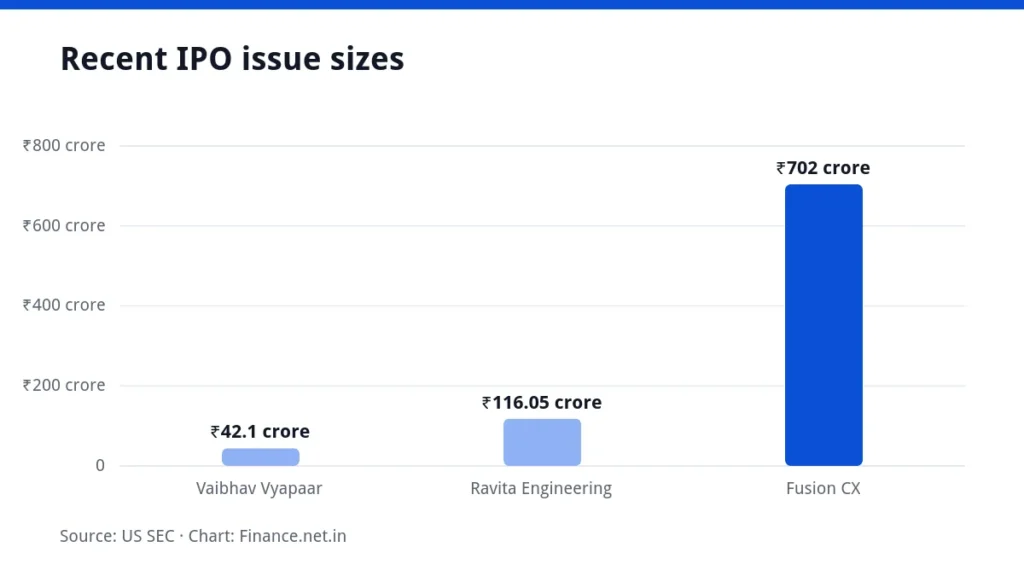
- An SME issue: Vaibhav Vyapaar opened a ₹42.10 crore IPO on the NSE SME platform on 13 October 2026 at a price band of ₹51-54 a share, per Economic Times. Details are in our report.
- A mainboard issue: Fusion CX opened a ₹702 crore IPO on 14 October, running to 16 October, at ₹275-289 a share with a minimum retail investment of ₹14,739, Economic Times reported. It raised ₹315 crore from anchor investors. See the Fusion CX coverage.
Ravita Engineering Services also opened a ₹116.05 crore book-built issue, made up entirely of fresh shares. Allotment was expected on 19 October and listing on the NSE SME platform on 22 October 2026, according to Economic Times.
In the United States, an advisory panel that counsels the SEC on small-business rules will hold a public meeting on 27 October 2026. The morning is set aside for ways to make going public easier, including the offering process, communication rules and analyst research. In the afternoon, members will look at Regulation Crowdfunding, a route for early-stage companies to raise money.
What it means for you
The examples show why the details matter before you apply. Check whether an issue is a fresh issue or an offer for sale, because that tells you whether the company receives the money. Look at what the company says it will use the proceeds for: Vaibhav Vyapaar, a non-banking finance company, said it would mainly strengthen its capital base.
Check the minimum amount you must invest, the dates for allotment and listing, and the platform where the shares will list. SME platform issues are for smaller companies and have their own lot sizes.
A GMP or anchor investor interest tells you something about demand, but neither is a forecast of returns. This article does not suggest applying to any issue.
If you are an NRI, check with your broker or bank about how to apply, since the sources here do not cover NRI eligibility.