
What it is
Health insurance is a contract between an insurer and a person or group. The insurer agrees to provide specified medical cover in return for a payment called the premium, under the terms written in the policy.
The sum insured is the maximum the policy will pay. According to the insurance regulator IRDAI, policies range from a sum insured of ₹5,000 in micro-insurance to ₹50 lakh or more in some critical illness plans. Most insurers offer policies between ₹1 lakh and ₹5 lakh.
How it works
Types of cover
The commonest policies in India cover hospitalisation. A hospitalisation policy pays all or part of the actual treatment cost during the policy period, and can include expenses for a specified period before and after admission.
- Individual or family floater: an individual policy covers one person. A family floater has one sum insured shared by all insured family members in any proportion, up to the overall limit.
- Hospital daily cash: pays a fixed amount for each day in hospital, sometimes more for ICU stays.
- Critical illness: pays a lump sum on diagnosis of a specified illness or a specified procedure. Usually the plan ends once the lump sum is paid.
- Surgical cash and senior citizen plans: other products pay a lump sum for a specified surgery or are designed for particular groups.
Cashless or reimbursement
Insurers either pay the hospital directly (cashless), reimburse your expenses, or pay a fixed benefit when an illness occurs. For cashless treatment, you go to a hospital in the insurer’s network, and a Third Party Administrator pays the bill on the insurer’s behalf. You still pay anything above policy limits or sub-limits, and anything not covered. Cashless is not available at hospitals outside the network.
What drives the premium
Age is a major factor, with older people paying more. Prior medical history also matters, and a clean history keeps the premium lower. Claim-free years may earn a discount.
After a claim
A settled claim reduces your cover by the amount paid. For example, on a ₹5 lakh policy, a ₹2 lakh claim in April leaves ₹3 lakh for the rest of that policy year. Any number of claims is allowed unless the policy caps them, but the sum insured is the ceiling.
Waiting periods and exclusions
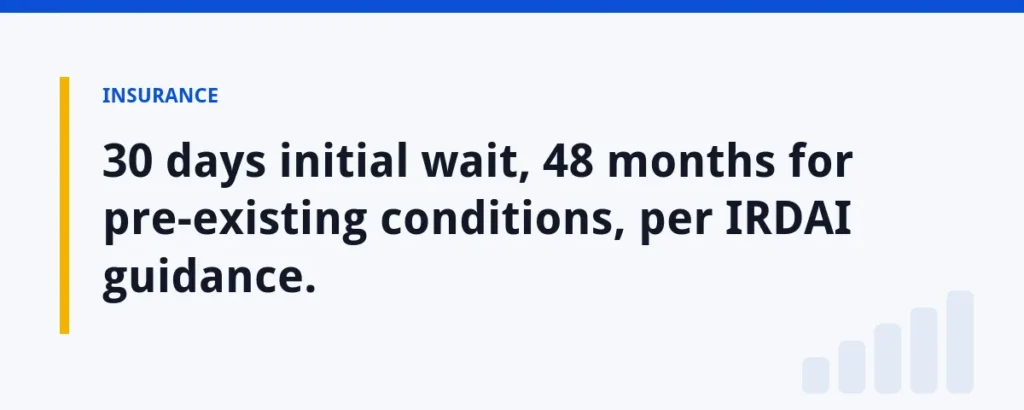
IRDAI’s guidance says a new policy generally has a 30-day waiting period from inception during which hospitalisation is not payable, except emergency admissions due to an accident. It does not apply on renewal.
Pre-existing conditions, meaning those that existed before you took the policy, can be considered for payment only after 48 months of continuous cover. Policies also commonly exclude items such as spectacles, hearing aids, dental treatment unless hospitalisation is needed, and pregnancy or childbirth treatment. Read the policy wording for the full list.
What it means for you
IRDAI says buying health insurance protects household savings from sudden hospital costs. Its checklist for buyers:
- Confirm the insurer is registered with IRDAI.
- Buy through a licensed agent or broker and ask for an identity card or licence, or buy directly from the company.
- Read the brochure or prospectus to see what is and is not covered.
IRDAI also notes that room rent and other payouts are increasingly linked to the sum insured, and that raising it after a claim may be hard.
If you miss a renewal date, you have a 15-day grace period to pay, but there is no cover for the gap, and the policy lapses if you pay later. You can port a policy to another insurer or plan without losing renewal credits for pre-existing conditions, limited to the earlier sum insured including bonus. IRDAI’s page says this has applied since 1 October 2011.
On tax, Section 80D of the Income Tax Act allows a deduction for premiums paid by a non-cash mode. IRDAI’s page quotes ₹15,000 for self, spouse and dependent children (₹20,000 for senior citizens), plus a further ₹15,000 for parents (₹20,000 if they are senior citizens). Those figures are as stated on that page and limits can change, so check the current rules, including how they differ between tax regimes, using the income tax calculator.
Common mistakes to avoid
- Skipping the exclusions and waiting-period sections of the policy.
- Assuming cashless works at any hospital rather than only network hospitals.
- Letting the policy lapse past the grace period.
- Not checking what counts as a pre-existing condition in the policy wording.