What it is
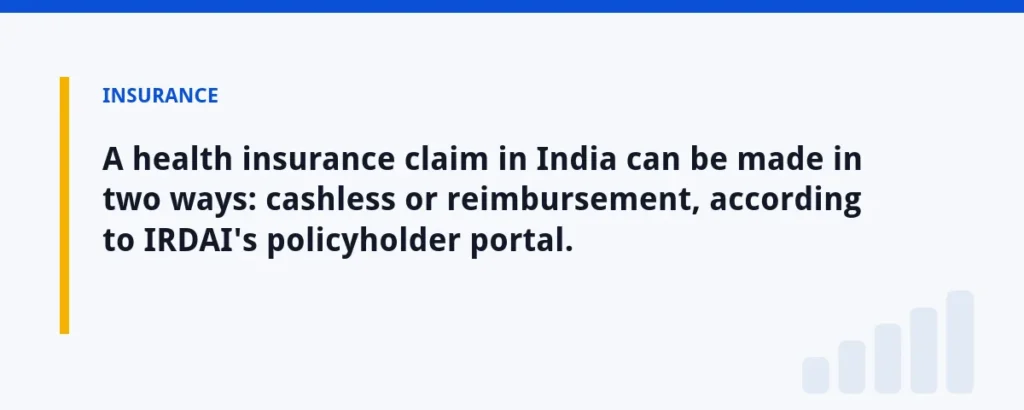
A health insurance claim is your request to the insurer to pay for medical costs the policy covers. IRDAI, the insurance regulator, says on its policyholder portal that you can claim in two ways: on a cashless basis or on a reimbursement basis.
In a cashless claim, the insurer (through a Third Party Administrator, or TPA, which services the policy on its behalf) pays the hospital directly. In a reimbursement claim, you pay the hospital yourself and the insurer pays you back for covered expenses.
This is the basic split within a health insurance policy that covers hospital costs.
How it works
Cashless claims
Insurers tie up with hospitals across the country to form a network. If your policy offers cashless facility, you can be treated at a network hospital without paying the bill yourself. The TPA pays the hospital on behalf of the insurer.
Two conditions matter. First, treatment must be at a network hospital of the TPA servicing your policy. Cashless facility is not available at a hospital outside the network. Second, you have to seek authorisation for cashless treatment, following the procedure and the prescribed form.
Cashless does not mean everything is free. Expenses above the policy’s limits or sub-limits, or items the policy does not cover, must be settled directly by you with the hospital.
Reimbursement claims
Here you inform the insurance company when the claim arises, as the policy procedure requires. After hospitalisation, you collect and keep ready the documents you will need to submit. IRDAI lists the claim form, discharge summary, prescriptions and bills.
The exact procedure and document list sit in the claims clause of your policy document, so the regulator advises reading it as soon as you receive the policy rather than waiting for a claim.
| Point | Cashless | Reimbursement |
|---|---|---|
| Who pays the hospital | TPA, on behalf of the insurer | You, upfront |
| Where you can be treated | Network hospital only | Policy clause governs; check your document |
| What you do | Seek authorisation in the prescribed form | Inform insurer, then submit claim form, discharge summary, prescriptions, bills |
What it means for you
Before you need a claim, read the claims section of your policy and find out which hospitals are in the network. IRDAI’s guidance is to familiarise yourself with the process early.
Whichever route you use, a few policy features affect what gets paid:
- Waiting period: a new policy generally has a 30-day waiting period from inception during which hospitalisation charges are not payable. Accident emergencies are excepted, and it does not apply on renewal.
- Pre-existing conditions: these are generally covered only after 48 months of continuous cover.
- Exclusions: policies commonly exclude items such as spectacles, contact lenses and hearing aids, and most pregnancy-related treatment.
- Sum insured: after a claim is settled, cover reduces by the amount paid. If you hold a ₹5 lakh policy and claim ₹2 lakh, ₹3 lakh remains for the rest of that policy year.
Premiums paid by a non-cash mode may also qualify for a deduction under Section 80D of the Income Tax Act. The portal quotes ₹15,000 for self, spouse and dependent children (₹20,000 for senior citizens), but those are older figures, so check current limits and your tax regime before relying on them. You can estimate your tax with the income tax calculator.
Common mistakes to avoid
- Reading the policy only after hospitalisation.
- Assuming a hospital is in the network without confirming it for your policy.
- Throwing away bills, prescriptions or the discharge summary, which a reimbursement claim needs.
- Forgetting that costs above limits or outside cover are yours to pay.
- Letting a policy lapse. Renewal is possible if you pay within the 15-day grace period, but there is no cover for the gap.