A family walks into a bank branch asking for ₹20 lakh for a course that costs ₹14 lakh. The officer will not sanction ₹20 lakh, however good the student’s marks. Education loan eligibility in India comes down to need: the bank starts from the cost of the course, subtracts your own share, and then asks whether the people signing the loan can be trusted to repay it. Your loan amount is decided by those three questions, not by how much you would like.
So the way to get a bigger sanction is not to ask harder but to give the bank fewer reasons to cut. This guide looks at the loan from the banker’s chair: what is checked, why it matters to the bank, and what you can do before applying to strengthen each point. Terms vary by bank, and no step here guarantees approval, but each one removes a common reason for a smaller sanction.
Step one for the bank: what does the course really cost?
Under the IBA Model Education Loan Scheme that banks follow, the amount is based on the cost of the course. The banker builds that cost from the documents you give. Expenses that can be financed include:
- Fees payable to the college and the hostel.
- Examination, library and laboratory fees.
- Travel or passage money for studies abroad.
- Insurance premium for the student borrower, where applicable.
- Caution deposit, building fund or refundable deposit, backed by receipts.
- Books, equipment, instruments and uniforms.
- A computer at reasonable cost, if it is needed for the course.
- Other expenses needed to complete the course, subject to a ceiling.
Here is where many families lose money without noticing. If you submit only the tuition fee letter, the bank’s cost figure is only tuition. Hostel charges, the laptop, the lab deposit and the travel cost never enter the calculation, and the sanction comes out lakhs short. Then the family scrambles for a personal loan at a higher rate in the second semester.
A worked example
Say a student has admission to a two-year postgraduate course in India. As an illustration, the full cost looks like this: tuition ₹9.6 lakh, hostel and mess ₹3 lakh, exam and lab fees ₹50,000, a laptop ₹60,000 and books and equipment ₹30,000. That is ₹14 lakh in total. If the family had shown only the fee letter, the bank’s starting figure would have been ₹9.6 lakh.
Your own share: margin money
Banks rarely finance 100% of a large cost. The part you pay yourself is called margin. On Canara Bank’s IBA scheme terms, there is no margin for loans up to ₹4 lakh. Above ₹4 lakh, the margin is 5% for studies in India and 15% for studies abroad. Other banks have their own terms.
In the example above, taking 5% of the ₹14 lakh cost, the family brings about ₹70,000 and the loan works out to about ₹13.3 lakh. For a study-abroad course costing, say, ₹30 lakh, a 15% margin would be ₹4.5 lakh, leaving about ₹25.5 lakh to borrow. Scholarships help here: a scholarship from the National Scholarship Portal (scholarships.gov.in) reduces the amount you need to fund at all.
The course, the institution and the seat
After cost, the banker looks at what the money is buying. Eligible courses include graduate, postgraduate and professional or technical courses in India at UGC, AICTE or government-approved institutions, IITs, IIMs and similar, and undergraduate, postgraduate, PhD and PG diploma courses abroad. A course outside these categories may not qualify for an education loan under the scheme at all.
Merit seat or management seat
How the student got the seat also matters. On Canara Bank’s terms, management-quota seats can need collateral even for small loans. A merit seat through an entrance exam or counselling is seen as lower risk. If you have both options, factor this into the decision, because a management seat can turn a collateral-free loan into one that needs property.
Quality institutions open a separate door
Students admitted to a quality higher education institution (QHEI) under PM-Vidyalaxmi can get loans from banks and financial institutions covering the full tuition fee and other course expenses without collateral or a guarantor. QHEIs are institutions in the top 100 of the NIRF overall, category or domain rankings, state government institutions ranked 101 to 200, and all central government institutions. For these students the Government gives banks a 75% credit guarantee on loans up to ₹7.5 lakh, which makes banks more willing to lend.
The co-borrower: whose income stands behind the loan
An education loan is granted jointly with a parent or guardian. For a married student, the co-borrower can be the spouse or the parents or parents-in-law. A student has no income yet, so the co-borrower carries much of the weight in education loan eligibility.
Income and existing loans
The bank wants to see that the co-borrower can keep the account healthy if the student takes time to find work. It looks at their income and at the EMIs they already pay on a home loan, car loan or personal loan. A parent earning well but paying three EMIs looks weaker than one earning less with no debt. This is a common reason a sanction comes in lower than the cost.
Credit history
The co-borrower’s repayment record tells the bank how they have handled loans and cards in the past. Late payments, defaults or a settled account are red flags. A clean record is one of the strongest supports you can give an application.
Collateral above ₹7.5 lakh
On Canara Bank’s terms, loans up to ₹7.5 lakh need no collateral, because they are covered by CGFSEL, the Credit Guarantee Fund Scheme for Education Loans. CGFSEL guarantees education loans up to ₹7.5 lakh given without collateral or a third-party guarantee, covering up to 75% of the amount in default. That cover protects the bank; the borrower still owes the full loan.
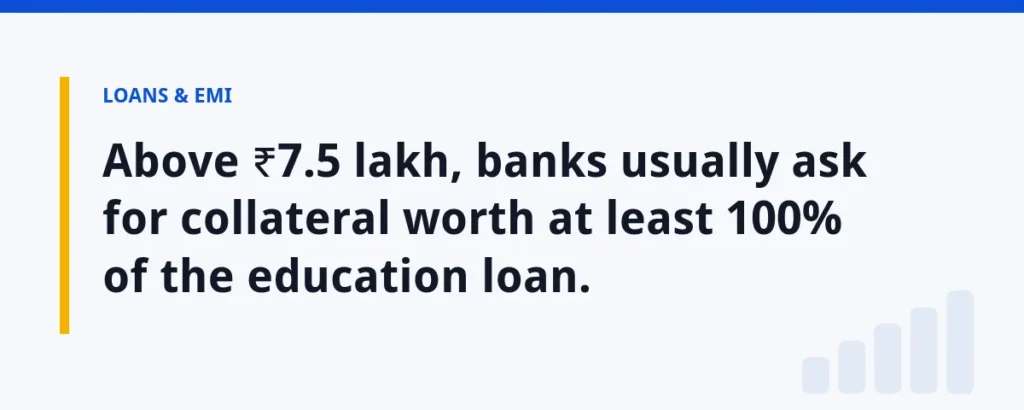
Above ₹7.5 lakh, the bank asks for tangible collateral worth at least 100% of the loan. In all cases, the student’s future income is assigned to the bank. So in our ₹13.3 lakh example, the family needs property or other tangible security worth at least ₹13.3 lakh, unless the student is at a QHEI and the loan qualifies under PM-Vidyalaxmi’s collateral-free route. If you have no collateral, the realistic limit at many banks is ₹7.5 lakh, and the rest has to come from savings, scholarships or a different plan.
Expected employability: will the student be able to repay?
EMIs can run for up to 15 years after the moratorium, which is the course period plus one year. The banker is betting that the course leads to a job that can carry the EMI. The institution’s standing, the course and the field all feed into that judgement.
You should make the same judgement for yourself. In the example, a ₹13.3 lakh loan repaid over 10 years at an assumed 10% a year for illustration means an EMI of about ₹17,600, before adding any interest that builds up during the moratorium. If the likely starting take-home pay is, say, ₹50,000 a month, that EMI eats about a third of it. If the likely salary is ₹25,000, the same loan becomes a burden. Check the numbers in the EMI calculator before you push for a bigger sanction, and borrow only what the course needs.
Education loan eligibility: what the bank checks and how to strengthen it
| What the bank checks | Why it matters to the bank | How to strengthen it |
|---|---|---|
| Cost of the course | The loan is need-based, so cost sets the ceiling | Submit the full cost: fee letter, hostel charges, deposit receipts, equipment and computer quotes, travel estimates |
| Margin money | Shows the family has a stake in the course | Keep savings ready for 5% (India) or 15% (abroad) above ₹4 lakh; use scholarships to cut the gap |
| Course and institution | Eligible courses and recognised institutions carry less risk | Confirm approval status; check if the college is a QHEI under PM-Vidyalaxmi |
| Merit or management seat | Management-quota seats can need collateral even for small loans | Prefer a merit seat where possible; be ready with security if not |
| Co-borrower income and existing loans | The co-borrower backs the loan while the student has no income | Add the parent with the stronger income; close or reduce small loans before applying |
| Co-borrower credit history | Past repayment predicts future repayment | Clear overdue dues and card balances; pay every EMI on time in the months before applying |
| Collateral above ₹7.5 lakh | Banks typically need security of at least 100% of the loan above this level | Identify property or other tangible security early; get documents in order |
| Expected employability | Repayment depends on the student’s future salary | Show the course’s relevance; keep the loan in line with realistic earnings |
Five moves that raise the sanction
Pulling the table together, these are the moves that actually change the number:
- Document the complete cost. Ask the college for an itemised fee structure including hostel, deposits and exam fees. Get quotes for the laptop and equipment. For study abroad, include travel and insurance. Every rupee you can show is a rupee the bank can consider.
- Add an earning co-borrower. If one parent has a higher or steadier income, make them the co-borrower. For a married student, the spouse or parents-in-law can also be co-borrowers.
- Clear existing debts first. Paying off a small personal loan or a credit card balance before applying frees up repayment capacity in the bank’s eyes.
- Apply to several banks at once through PM-Vidyalaxmi. The unified portal at pmvidyalaxmi.co.in uses one common application form that all banks accept. One application can reach several banks instead of being tied to one branch’s view. The same portal handles the 3% interest subvention for families earning up to ₹8 lakh a year.
- Arrange collateral if the cost is above ₹7.5 lakh and the student is not on the collateral-free QHEI route.
Banks, NBFCs and some fintech-led lenders also give education loans, especially for study abroad, often at higher rates. NBFC loans may not qualify for some government schemes, so check before you choose.
A rejection is not the end of the road
If a bank turns you down or sanctions less than the cost, ask what held it back. Was it the co-borrower’s existing EMIs, a gap in the cost documents, a management seat or missing collateral? Each of those can be fixed or worked around. You can add a stronger co-borrower, submit fuller cost papers, reduce the amount and fund the rest from scholarships, or apply to other banks through the portal, where one application reaches many lenders. Education loan eligibility is judged bank by bank, and one branch’s decision reflects that branch’s assessment on that day, not a permanent verdict on the student.
What a rejection should also prompt is an honest look at the EMI. If every bank is cautious, the loan may simply be too large for the likely salary, and a cheaper course or a smaller loan may be the safer path. This is general information, not personal advice.
Checklist before you meet the bank
- Itemised cost of the course, with receipts or quotes for every head.
- Margin money set aside if the loan is above ₹4 lakh.
- Scholarship applications on the National Scholarship Portal done first.
- The co-borrower with the stronger income and cleaner credit record chosen.
- Small existing loans and card dues cleared.
- Collateral papers ready if the loan is above ₹7.5 lakh.
- College checked against the QHEI list; application made on the PM-Vidyalaxmi portal to several banks.
- EMI checked against a realistic starting salary.
More guides on student loans are in our Knowledge Base.