What happened
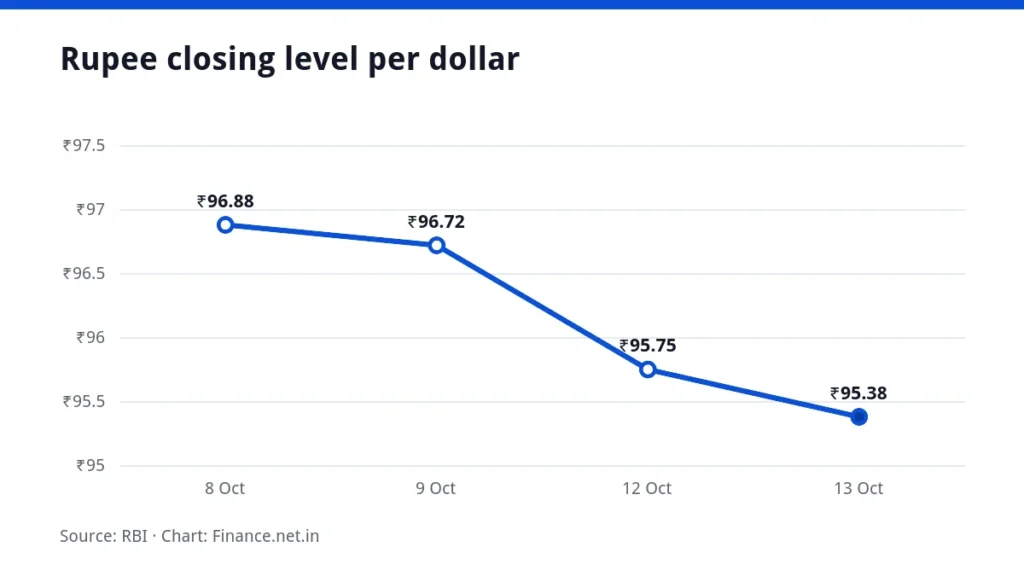
The rupee ended a volatile week stronger. It closed at 96.88 against the dollar on 8 October 2026 and at 95.38 on 13 October, after RBI announced a set of measures for the foreign exchange market.
Forex traders quoted by The Hindu tied the early pressure to a strong global dollar and Brent crude near $104 a barrel. On 9 October, the rupee rose 16 paise to 96.72 as the dollar weakened and crude eased after remarks by Donald Trump that the US would refrain from military action against Iran. On 12 October it jumped 96 paise to 95.75, and on 13 October it gained another 40 paise to 95.38.
A paise is one-hundredth of a rupee, so a 96 paise move is almost ₹1 per dollar.
Why the rupee swings
The exchange rate reflects demand and supply for dollars. Reports in The Hindu pointed to three drivers during this stretch: the strength of the dollar globally, the price of crude oil, and geopolitical remarks that shifted both.
India pays for oil in dollars, so higher crude prices raise the demand for dollars and can weigh on the rupee. When crude eases or the dollar weakens, the pressure tends to lift.
What RBI did
RBI said the steps were meant to keep the forex market orderly. It acted on several fronts.
Tighter rules on forex derivatives
On 10 October, RBI issued two circulars covering foreign exchange derivatives, which are contracts whose value depends on a currency rate. Banks that deal in foreign exchange are called Authorised Dealers.
- No rebooking: Authorised Dealers cannot let users rebook a rupee derivative contract that was cancelled after the directions were issued. Rollover on maturity is still allowed, subject to existing rules.
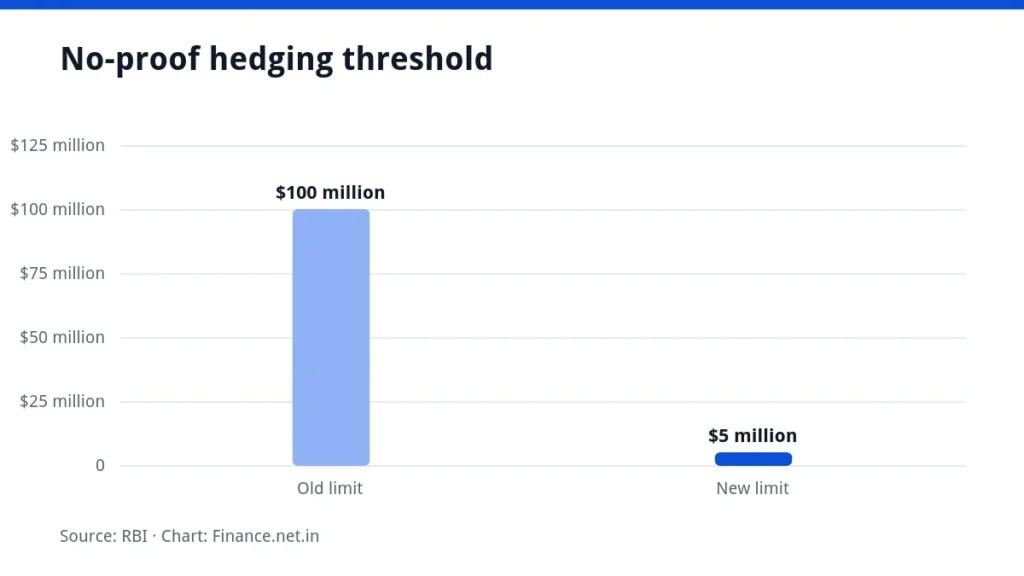
- Lower no-proof limit: The amount a user can hedge without showing an underlying exposure fell to $5 million from $100 million. The same cut applies to positions in exchange-traded currency derivatives across all recognised stock exchanges taken together.
- Extra paperwork: Users hedging contracted exposures must give an undertaking that the same exposure has not been hedged with another Authorised Dealer.
- Foreign Exchange Risk Reserve (FERR): For contracts with a notional value above $2 million, Authorised Dealers must keep a cash reserve with RBI equal to 20% of the rupee value of each transaction. This applies to contracts hedging current account exposures where the user buys foreign currency against the rupee.
Notional value is the full face amount of a contract, not the money actually paid upfront.
Special dollar window for oil companies
From Monday, 12 October, RBI sells dollars through designated banks to meet the entire daily dollar requirement of Indian Oil, Hindustan Petroleum and Bharat Petroleum. The facility continues until further notice. You can read more in our coverage of the special dollar window.
Limits for non-residents and bank hedging
In Circular No. 27 of 12 October, RBI said certain Authorised Dealers must offer non-deliverable derivative contracts involving the rupee to non-residents only for hedging. Earlier these could be offered without any restriction on purpose. Non-deliverable contracts are settled in cash without exchanging the currencies.
The circular also applies the 20% FERR to banks buying foreign currency against rupees to hedge their own assets and liabilities. The reserve is held in cash with RBI daily until the contract ends. It covers contracts undertaken after the directions were issued. See our report on the NDDC and FERR rules.
What it means for you
The curbs target companies and banks that trade currency derivatives, not individuals sending money or paying for travel. Still, the exchange rate affects imports, overseas education costs and remittances. For a quick check of what a transfer is worth, you can use our money transfer calculator.
Currency moves can reverse quickly. Our weekly tracking shows the rupee rebound from 96.88 over the week.
Background
RBI has said the FERR and related steps are meant to strengthen market discipline and risk management. On 15 October, RBI also published frequently asked questions on the reserve, summarised in our FERR FAQ explainer.