What it is
AU Small Finance Bank is a lender that takes money from customers and lends it out, earning from the gap between what it charges borrowers and what it pays for funds. Like any bank, its health is judged on how much it earns, how many of its loans go bad and how much financial cushion it holds. Vehicle loans are one of the businesses in the news around it right now.
You do not need a banking background to read its numbers. Four measures cover most of what a results announcement says.
How it works
Interest income is what the bank earns on loans and similar assets. Net interest income (NII) is that figure minus the interest the bank pays out, mainly to depositors. Net interest margin (NIM) expresses NII as a percentage of what the bank earns on, so it shows how profitable lending is per rupee deployed.
A non-performing asset (NPA) is a loan where borrowers have stopped paying as scheduled. Gross NPA is the share of bad loans before the bank sets money aside; net NPA is what remains after those provisions. Our guide on non-performing assets and the explainer on how to read bank results go further.
The Capital Adequacy Ratio compares a bank’s own capital with its risk-weighted loans. A higher figure means a thicker cushion against losses.
Here is how these fit together using the bank’s own numbers. For July to September 2026, AU Small Finance Bank reported interest income of ₹5,612 crore and net interest income of ₹2,820 crore. The difference, about ₹2,792 crore, is roughly what it paid out in interest costs.
Why it is in the news
Q2 results, announced 24 October 2026
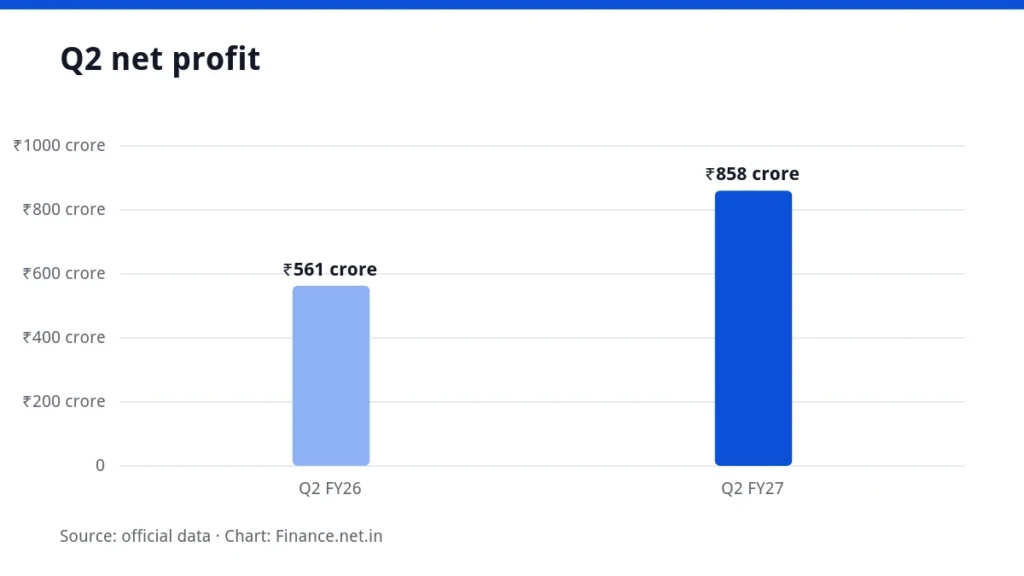
On Saturday, 24 October 2026, the bank reported net profit of ₹858 crore for the quarter ended 30 September 2026, up 53% from ₹561 crore a year earlier. Total income rose to ₹6,382 crore from ₹5,224 crore, according to reports in BusinessLine and The Hindu citing its regulatory filing. See our full results report.
NII grew 32% to ₹2,820 crore from ₹2,144 crore. NIM rose to 5.8% from 5.5% at the end of September 2025, a gain of 0.3 percentage point (30 basis points). A basis point is one-hundredth of a percentage point.
Asset quality improved. Gross NPAs fell to 1.99% from 2.41%, and net NPAs to 0.81% from 0.88%. The Economic Times reported provisions of ₹359 crore against ₹481 crore a year earlier, and annualised credit cost of 0.8% against 1.2%. Credit cost is the share of loans the bank expects to lose to defaults over a year.
One measure went the other way: the Capital Adequacy Ratio eased to 18.54% from 18.78%.
Managing Director and CEO Sanjay Agarwal described the quarter as one that “combines growth with profitability, and ambition with prudence”.
Data leak probe, 30 October 2026
On Friday, 30 October 2026, the bank said it had begun a probe into a possible leak of information about its vehicle loan customers. PTI reported that this followed a claim by a hacker group that it had broken through the lender’s cyber defences. The matter relates to a cloud software platform run and hosted by Salesforce.
BusinessLine reported the bank’s statement that its own systems remain unaffected and all banking services are operating normally. The Economic Times reported on 31 October that Salesforce said it had found no vulnerability at its end, and that the data reportedly affected includes KYC records and identity documents. The bank’s probe is continuing; read our report on the investigation.
What it means for you
If you are a customer, the main point from the bank is that services are working as usual and its core systems were not affected. Whether any individual’s data was exposed is what the investigation is meant to establish, and the outcome has not been reported.
If you follow the bank’s financials, the quarter shows higher profit, a wider margin and fewer bad loans, alongside a slightly lower capital cushion. None of this is a signal to act on the shares; it is a snapshot of one quarter.
When you read any lender’s results, compare the same quarter a year earlier, as above, and check profit, margin, bad loans and capital together rather than relying on the profit headline alone.