Suresh retired from a state electricity board in Coimbatore last month at 58. His gratuity, leave encashment and provident fund have landed in his bank account, and he wants a safe income that arrives every three months. If he acts within three months, he can put that money into the Senior Citizens Savings Scheme, the government’s savings plan built for people who have stopped working.
The scheme is offered at post offices and authorised banks under the Senior Citizens’ Savings Scheme, 2019 and its later amendments. You make one deposit, the government pays interest every quarter, and the money comes back after five years, with an option to extend. This guide explains who can invest, the limits, how interest is paid, what early closure costs, how extension works and how tax and TDS apply.
Who can open a Senior Citizens Savings Scheme account
The basic rule is simple: you can open an account once you are 60. Three groups can join earlier.
- Civilian retirees aged 55 to 60. Anyone who has retired on superannuation or otherwise can open an account, provided it is done within three months of receiving retirement benefits. You must attach proof of when the benefits were paid and a certificate from the employer with details of the retirement, benefits and service.
- Retired defence personnel aged 50 and above. Retired members of the defence services, other than civilian defence employees, can join from 50, subject to the same conditions.
- Spouses of government employees who died in service. Since a November 2023 amendment, the spouse of a Central or State government employee who died in harness after turning 50 can open an account, subject to the other conditions.
The three-month window was one month until that 2023 amendment, so older articles may still quote one month.
You can hold the account alone or jointly with your spouse, and with no one else. In a joint account only the first holder’s age counts for eligibility, there is no age limit for the spouse, and the whole deposit is treated as belonging to the first holder. The opening form includes a declaration that the holders are resident citizens of India.
How much you can invest
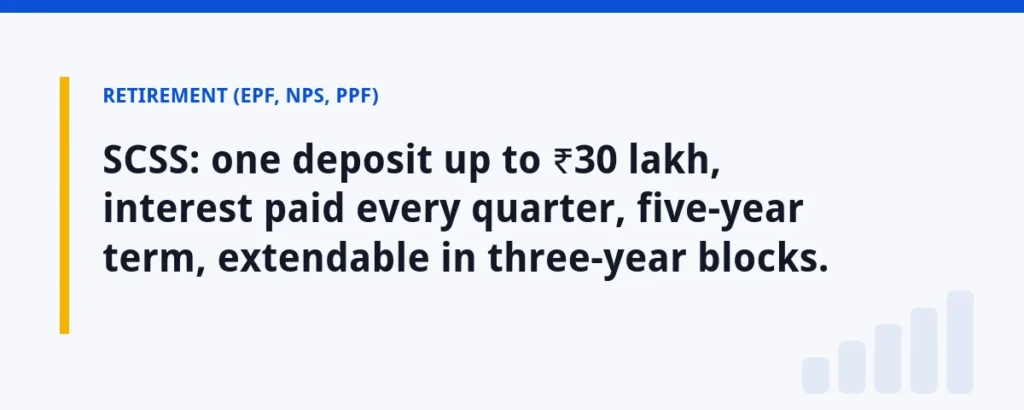
Each account takes exactly one deposit, of at least ₹1,000 and in multiples of ₹1,000. The ceiling is ₹30 lakh across all your accounts in the scheme taken together. The limit was ₹15 lakh until it was raised to ₹30 lakh in 2023.
You may open more than one account, for example to stagger maturity dates, as long as the total stays within ₹30 lakh. A husband and wife who are each eligible can invest up to ₹30 lakh each in their own names.
For those joining between 55 and 60 on retirement, the deposit is limited to the retirement benefits actually received. These include provident fund dues, gratuity, commuted pension, leave encashment and ex gratia under a voluntary retirement scheme. If you deposit more than the ceiling by mistake, the excess is refunded and earns only the Post Office Savings Account rate for the time it was held.
| Feature | Rule |
|---|---|
| Minimum age | 60; 55 for civilian retirees; 50 for retired defence personnel |
| Deposit | One deposit per account, ₹1,000 multiples |
| Maximum | ₹30 lakh across all accounts of one person |
| Interest payout | Quarterly, on the first working day of April, July, October and January |
| Rate for Oct to Dec 2026 | 8.2% a year |
| Tenure | 5 years, extendable in blocks of 3 years |
| Tax | Deposit deductible under the old regime; interest taxable |
Interest rate and quarterly payouts
Small savings rates are reviewed every quarter by the Ministry of Finance. For October to December 2026, a ministry office memorandum dated 30 September 2026 kept all rates unchanged from the previous quarter, and India Post lists the Senior Citizens Savings Scheme at 8.2% a year.
Unlike PPF, where a new rate applies to the whole balance, an SCSS deposit carries the rate notified for the period in which it is made. Amendments to the scheme are worded this way: a deposit made on or after a given date bears a given rate. So the rate on the day you invest is the one you keep for five years.
Interest is paid every quarter on the first working day of April, July, October and January. The first payment covers the period from the date of deposit to the end of that quarter. You can have it credited automatically to a savings account. Interest you do not claim on time can be claimed later, but it earns nothing extra while it waits.
As an illustration, ₹30 lakh at 8.2% a year pays ₹61,500 a quarter, or ₹2.46 lakh a year, before tax. ₹10 lakh pays ₹20,500 a quarter. Compare this with a bank deposit on the FD calculator.
Premature closure and its cost
You can close the account early at any time, but the deduction depends on how long it has run.
- Before one year: no interest. Any interest already paid is recovered from the deposit.
- After one year but before two: 1.5% of the deposit is deducted.
- After two years but before five: 1% of the deposit is deducted.
Partial withdrawals are not allowed; it is all or nothing. As an illustration, closing a ₹10 lakh account after 18 months would cost ₹15,000 in deduction, on top of losing the higher rate you locked in.
Maturity and extension in blocks of three years
The deposit matures five years after opening. You then have two choices: take the money back, or extend the account for a further block of three years by applying within one year of maturity.
Since the November 2023 amendment, extension is no longer a one-time option. You can extend again at the end of each three-year block, as many times as you wish. The extension counts from the maturity date even if you apply later within the one-year window. The extended account earns the rate applicable on the date of maturity, or on the date the previous block ended.
Closing an extended account is cheaper. After one year from the date of extension, you can close it with no deduction. Before one year, 1% of the deposit is deducted. If you do neither, close nor extend, the deposit earns only the Post Office Savings Account rate after maturity, so do not let the date slip.
You can also close a matured account and open a fresh one, within the ₹30 lakh ceiling, to lock in a better rate if the scheme rate has risen.
What happens if the account holder dies
If the holder dies before maturity, the account is closed and the money, with interest at the scheme rate up to the date of death, is paid to the nominee or legal heirs. From the date of death to final closure, interest is paid only at the Post Office Savings Account rate.
There is one exception. If the spouse is the joint holder or the sole nominee, and is eligible to open an account on the date of death, the spouse can apply to continue the account on the same terms. Where both spouses hold separate accounts and one dies, the deceased spouse’s own account is closed.
Senior Citizens Savings Scheme tax and TDS
The deposit qualifies for the ₹1.5 lakh savings deduction long known as section 80C, according to India Post’s scheme page. From 1 April 2026 the Income-tax Act, 2025 replaced the 1961 Act, and the deduction continues under the new law, but only if you choose the old tax regime. The new regime is the default and does not allow it.
The interest is fully taxable at your slab rate, whichever regime you use. The post office or bank deducts tax at source once the interest crosses a threshold. The Budget for 2025-26 doubled the TDS threshold on interest paid to senior citizens by banks, co-operative societies and post offices from ₹50,000 to ₹1 lakh a year. If your total income is below the taxable limit, you can submit the senior citizens’ self-declaration form so that no tax is deducted. Estimate your tax on the income tax calculator.
Opening the account and planning around it
To open an account, fill in the application form at a post office or authorised bank and attach your KYC documents, proof of age and, if you are under 60, the proof of retirement benefits and the employer’s certificate. The form also asks for details of any other SCSS accounts you hold, so that the ₹30 lakh ceiling can be checked. Add a nominee at the same time.
A few planning points are worth thinking through before you sign:
- Keep an emergency fund outside. Because early closure costs money and partial withdrawals are not allowed, keep some savings in a bank account or short deposits for medical bills and repairs.
- Consider more than one account. Two or three smaller accounts opened at different times give you different maturity dates and the option of closing one without touching the others.
- Use both names. If you and your spouse are both eligible, separate accounts can double the family’s ceiling and spread the interest across two tax returns.
- Match payouts to expenses. Quarterly interest suits bills that come every three months, such as insurance premiums or property tax. For monthly expenses, park each payout in a savings account and draw from it.
As an illustration of how timing works, say Suresh receives ₹25 lakh of retirement benefits on 1 November and opens his account on 15 December. His first interest payment, on the first working day of January, covers 15 to 31 December. From then on he receives a full quarter’s interest every three months until the account matures five years later.
Key takeaways
- Open at 60, or at 55 (civilian) or 50 (defence) within three months of receiving retirement benefits.
- One deposit per account, up to ₹30 lakh across all your accounts; a spouse who is eligible has a separate ₹30 lakh.
- India Post lists 8.2% a year for October to December 2026, paid quarterly; the rate on the day you invest stays for that deposit.
- Closing in the first year costs all interest; later closures cost 1.5% or 1% of the deposit.
- Extend in three-year blocks within a year of maturity, as often as you like.
- Interest is taxable; submit the self-declaration if your income is below the taxable limit.
This guide is general information, not personal advice. Confirm the latest rules and rate at your post office or bank before you invest your retirement money.