What happened
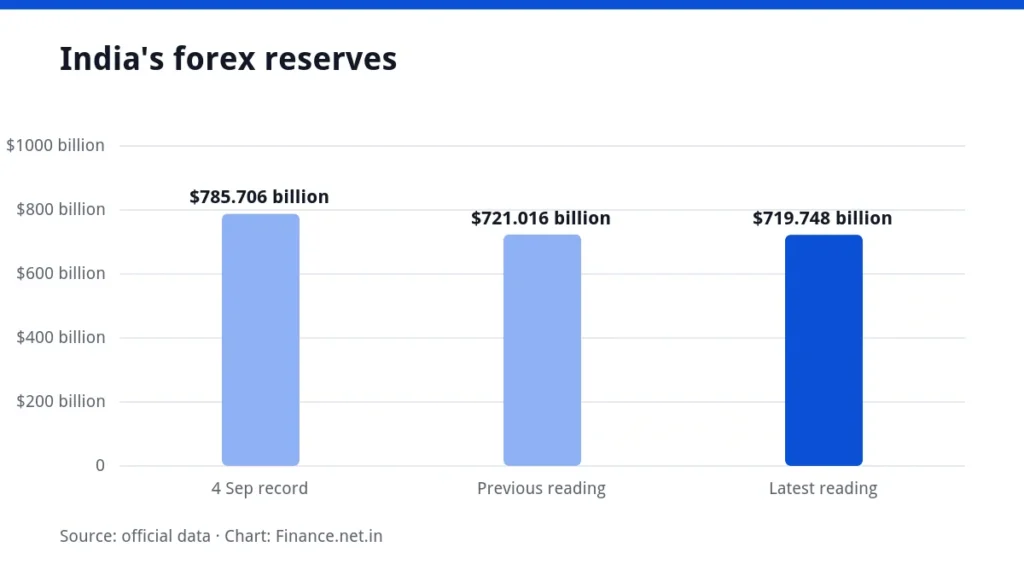
The total stock of foreign currency, gold and other reserve assets held by India slipped $1.269 billion to $719.748 billion, based on figures the Reserve Bank of India (RBI) published on Friday, 30 October 2026. The reading before it was $721.016 billion, which had itself been a decline of $5.011 billion.
The latest total is about $66 billion short of the peak of $785.706 billion, reached in the week ended 4 September. Even so, Times of India reported, citing RBI figures, that reserves remain $28.640 billion higher than at the end of March 2026.
How the components moved
- Gold reserves: down $2.65 billion to $103.15 billion.
- Foreign currency assets: up $1.358 billion to $593.205 billion. This is the largest part of the reserves. Because it is counted in dollars, it also reflects gains or losses in the value of currencies such as the euro, pound and yen that the RBI holds.
- Special Drawing Rights (SDRs): up $27 million to $18.605 billion. SDRs are a reserve asset created by the International Monetary Fund (IMF).
- Reserve position with the IMF: down $4 million to $4.787 billion.
Put simply, the fall in gold’s value more than offset the rise in foreign currency assets. Times of India described the gold decline as the main driver of the week’s drop.
What it means for you
Forex reserves are the foreign currency, gold and similar assets the central bank holds. They act as a cushion for paying for imports and for steadying the rupee when it is under pressure. You can read more in our explainer on foreign exchange reserves.
A weekly dip of this size does not by itself change day-to-day costs such as fuel or loan EMIs. The direction over several weeks is what analysts watch, since it shows how much room the RBI has to act in currency markets.
If you send money to India or hold rupee-linked deposits, you can check current rates with our currency converter.
Background
CNBC-TV18 reported that the September record was driven by a special concessional swap window for deposits from the Indian diaspora, through which banks raised nearly $133 billion. A swap lets banks exchange foreign currency with the RBI for rupees for a set period. Reserves have been falling since.
Experts quoted by CNBC-TV18 attribute the decline to the deployment of FCNR(B) money, which is foreign-currency deposits held by NRIs in Indian banks, and to dollar sales by the RBI to defend the rupee.
Credit and money supply
The RBI’s weekly statistical supplement also showed faster growth in banking aggregates, as reported by Times of India:
- Outstanding bank credit rose 18.2% year-on-year as of 15 October 2026, to ₹227.43 lakh crore, against 11.6% a year earlier.
- Aggregate deposits grew 16.7% to ₹278.76 lakh crore, against 9.5% a year earlier.
- Broad money supply (M3), the total money in the economy including deposits, grew 16.0%, against 9.2% a year earlier.
What to watch next
The next weekly RBI releases will show whether the drawdown from the September peak continues, and whether gold prices or currency moves keep swinging the total.