
Ravi works in Dubai, flies home to Hyderabad every Diwali and spends a long summer with his parents. One year his stays add up to 140 days, and his bank asks whether he is still an NRI. The answer is not about his passport or his visa. Your residential status for income tax depends on how many days you spend in India, how many days you spent here in earlier years and, for some people, how much they earn in India.
From 1 April 2026 the Income-tax Act, 2025 decides this, starting with tax year 2026-27. The Income Tax Department has said the basic tests did not change from the 1961 Act; they now sit in section 6 of the new Act. Status is worked out afresh for each tax year (April to March), and it decides one big thing: whether only your Indian income is taxed in India or your income from the whole world.
Why residential status matters
The Act has three buckets for individuals: resident and ordinarily resident (often shortened to ROR), resident but not ordinarily resident (RNOR or NOR), and non-resident. Your bucket fixes the scope of your taxable income under the new Act (section 5, according to the Act text as published).
- Resident and ordinarily resident: all income, wherever it is earned or received, is taxable in India.
- Not ordinarily resident: Indian income and anything received in India are taxed, but income earned and received outside India is left out, unless it comes from a business controlled in India or a profession set up in India.
- Non-resident: only income received (or deemed received) in India, or which accrues or arises (or is deemed to) in India, is taxed.
So a non-resident’s salary paid abroad for work done abroad is outside Indian tax, while rent from a flat in Pune, interest on an NRO deposit or capital gains on Indian shares stay taxable here. The same salary becomes taxable in India the year you turn resident and ordinarily resident.
The two basic day-count tests
Under section 6(2), you are resident in India in a tax year if you meet either test:
- You are in India for 182 days or more in that tax year; or
- You are in India for 60 days or more in that tax year and for 365 days or more in total during the four tax years before it.
If you meet neither, you are a non-resident for that year. The second test catches people who spend a few months here every year. Say Tom, a British engineer with no Indian roots, worked on projects in India for 90 days in each of the last four years. That is 360 days over four years, just short of 365, so a 70-day stay this year keeps him non-resident. One more week in any of those earlier years would have tipped him over. As the next section shows, Indian citizens and people of Indian origin living abroad get extra relief from this test.
Keep your passport stamps, boarding passes and travel records. Days in India are a fact you may have to prove, and arguing about them years later without paperwork is hard.
Relaxations for people working abroad and visitors
The 60-day test would be harsh on Indians who live abroad and visit family, so the Act switches it off in three situations.
Leaving India for a job or as ship crew
An Indian citizen who leaves India in a tax year for employment outside India, or as a crew member of an Indian ship, is resident that year only if he stays 182 days or more. The 60-day test does not apply to him for that year. The department’s FAQ confirms this relief continues unchanged under the new Act.
Indian citizens and PIOs coming on a visit
An Indian citizen or person of Indian origin who lives outside India and comes on a visit also gets the 60-day test switched off. For most such visitors, only the 182-day test matters.
The 120-day rule for high Indian income
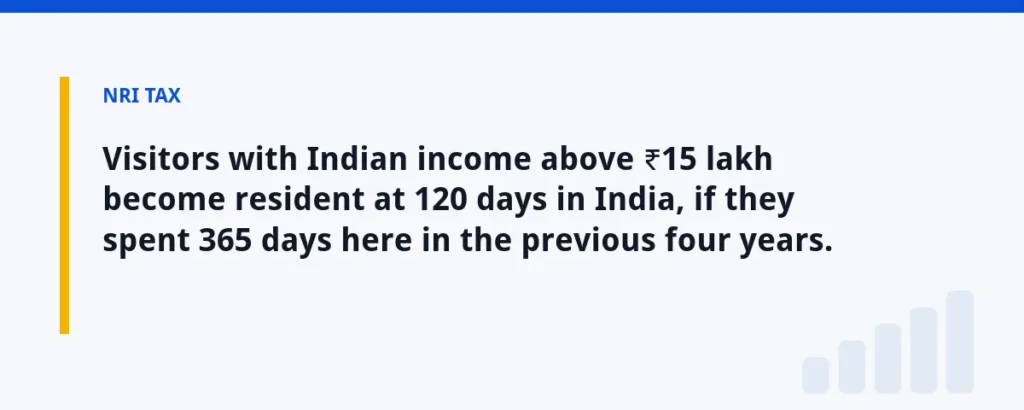
There is a catch for visitors with big Indian incomes. If your total income, other than income from foreign sources, is more than ₹15 lakh in the tax year, the second test applies to you with 120 days in place of 60. In other words, you become resident if you are in India for 120 days or more in the year and 365 days or more in the preceding four years.
“Income from foreign sources” means income that accrues or arises outside India and is not deemed to arise in India, except income from a business controlled in India or a profession set up in India. So rent, interest, dividends and capital gains from India all count towards the ₹15 lakh. A salary earned abroad does not.
Deemed residency: resident without setting foot in India
Section 6(7) adds a rule that has nothing to do with days. An individual is deemed resident in India if he is an Indian citizen, is not liable to tax in any other country or territory because of domicile, residence or similar criteria, and has total income above ₹15 lakh (other than income from foreign sources) in the year. The department’s FAQ puts it plainly: in this case the number of days in India does not matter.
The rule targets Indian citizens who are not tax residents anywhere, for example someone who keeps moving between countries without becoming taxable in any. It applies only if you are not already resident under the day-count tests. Anyone living in a country with no personal income tax and earning more than ₹15 lakh from India should check this rule with a tax adviser, because “not liable to tax” is a question of fact and law.
Resident but not ordinarily resident
RNOR is a halfway house. Under section 6(13), a resident individual is not ordinarily resident in a tax year if any one of these is true:
- he was a non-resident in nine out of the ten tax years before that year; or
- he was in India for 729 days or less in total during the seven tax years before that year; or
- he is an Indian citizen or PIO with Indian income (excluding foreign sources) above ₹15 lakh who became resident because of 120 days or more but less than 182 days in India; or
- he is an Indian citizen who is deemed resident under section 6(7).
So visitors caught by the 120-day rule and deemed residents are taxed as RNOR, which means their foreign income stays outside Indian tax unless it comes from a business controlled or profession set up in India. The look-back years can include years under the old 1961 Act; the department’s FAQ says the nine-out-of-ten and 729-day tests reach back into those years.
RNOR status is also what usually protects people returning to India after many years abroad, for the first two or three tax years after they come back.
Residential status at a glance: who pays tax on what
This table sums up the residential status rules and the income each category pays tax on in India.
| Status | How you get there (individuals) | Income taxed in India |
|---|---|---|
| Resident and ordinarily resident | Meet 182 days, or 60 days plus 365 days in four prior years (with relaxations), and none of the RNOR conditions | Worldwide income |
| Resident but not ordinarily resident | Resident, but non-resident in 9 of 10 prior years, or 729 days or less in 7 prior years, or caught by the 120-day rule, or deemed resident | Indian income, income received in India, and foreign income only from a business controlled or profession set up in India |
| Non-resident | Fail both day-count tests and not deemed resident | Income received, accruing or arising in India (actual or deemed) |
Worked examples
These illustrations use round numbers and assume the people are Indian citizens.
Ravi, the Gulf employee
Ravi lives in Dubai and visits India. His Indian income is interest on an NRO deposit and rent of, say, ₹6 lakh a year. Because he is a visiting citizen, the 60-day test is off, and his Indian income is below ₹15 lakh, so the 120-day version does not apply. His 140 days in India are below 182, so he stays a non-resident. Only his Indian rent and interest are taxed here.
Anjali, the investor with big Indian income
Anjali lives in London. Her Indian rent, interest and capital gains come to, say, ₹22 lakh a year. She spends 130 days in India this year and spent 400 days here over the previous four years. Because her Indian income exceeds ₹15 lakh, the 120-day rule applies: 130 days plus more than 365 days in four years makes her resident. But because she reached residency through that rule with less than 182 days, she is RNOR, so her UK salary is not taxed in India.
Sunil, who moved abroad mid-year
Sunil left India on 1 November for a job in Toronto. He was in India for about 214 days of that tax year, which is more than 182, so he is resident for that year even though he now lives abroad. From the next year, with fewer than 182 days in India, he will be a non-resident.
Income tax status is not the same as FEMA status or “NRI” at the bank
Banks open NRE and NRO accounts under the Foreign Exchange Management Act (FEMA), which uses its own definition of “person resident outside India”. That test is based on your stay in the preceding financial year and your intention, such as going abroad for a job. It is possible to be a non-resident under FEMA and resident under the Income-tax Act in the same year, or the other way round.
This matters for one popular benefit. The department’s FAQ says the exemption for interest on an NRE account, now in Schedule IV of the new Act, continues to depend on your non-resident status under FEMA, not on your income tax residential status. Tell your bank promptly when your FEMA status changes, and work out your income tax status separately each year.
Non-residents also keep the special rules for investment income of NRIs, which the department says now sit in sections 213 to 217 of the new Act, including the option to skip filing a return when your only income is such investment income or long-term capital gains with full tax deducted at source.
What to do each year
A little record-keeping saves a lot of argument. Here is a checklist.
- Count your days in India for the tax year (April to March) and for each of the previous four and seven years.
- Add up your Indian income, leaving out income from foreign sources, to see whether you cross ₹15 lakh.
- Decide your status and the scope of income that goes with it, then pick the correct return and declare your residential status in it.
- If you are resident in India and also taxed abroad, check the tax treaty with that country for relief.
- Use the income tax calculator to estimate tax on your Indian income, and the NRI FD calculator to compare NRE and NRO deposit returns.
Key takeaways
- Residential status is decided each tax year, by days in India and, for some, by Indian income above ₹15 lakh.
- The 182-day test applies to everyone; the 60-day plus 365-day test is relaxed for citizens leaving for jobs abroad and for citizens and PIOs visiting India.
- Visitors with Indian income over ₹15 lakh face a 120-day test, and citizens not taxed anywhere may be deemed resident; both are treated as RNOR.
- Your FEMA status for bank accounts is a separate question from your income tax status.
This guide gives general information about the law as it applies from tax year 2026-27. Rules for earlier years follow the 1961 Act. If your situation is borderline, speak to a chartered accountant before you file.