The Finance Ministry is studying changes to capital gains tax on shares and equity mutual funds, but nothing has been decided. Central Board of Direct Taxes (CBDT) chairman Ravi Agrawal said on 16 November 2026, at the inauguration of a CBDT lounge at the India International Trade Fair in New Delhi, that suggestions raised by stakeholders were being analysed. Asked whether relief would come, he said: “We will consider it, and I’m sure on February 1 you will get to know.” The Union Budget for 2027-28 is due on 1 February 2027.
So the rules you follow today remain in force until then. This article sets out what the CBDT chairman said, what the current rates and holding periods are, what industry bodies have asked for, and what a change could mean for a family that holds shares or SIPs. Nothing here is a forecast, and nothing is a call to buy or sell anything.
What the CBDT chairman actually said
According to a PTI report carried by ThePrint on 16 November, Mr Agrawal said the ministry is examining capital gains tax on equities using inputs from pre-Budget meetings. He did not say which proposals might be accepted. He said analysis of the points raised by stakeholders was under way, and that short-term gains were among the suggestions being examined. A Taxscan report the next day also noted that the review includes the possible effect on tax collections.
Two things are worth separating. First, the review itself is real and was stated by a senior tax official. Second, the outcome is open. A review of suggestions is routine every year before a Budget, and the chairman’s own words point to the Budget speech as the place where any decision would be announced.
What industry bodies have asked for
Reports on the review describe requests made by industry chambers, not by ordinary investors. As reported by PTI, they include:
- Abolishing long-term capital gains tax on listed equities.
- Rationalising short-term capital gains tax and securities transaction tax (STT) on equities, to draw in more foreign money.
- Raising the holding period for long-term treatment from 12 months to somewhere between 18 and 24 months.
- Different treatment for foreign portfolio investors, since several emerging markets do not tax their long-term equity gains.
Other voices have pushed in different directions. A Business Today report of 15 October said SBI Research has recommended abolishing the long-term tax on equities, while market participants want STT eased after its increase on derivatives in Budget 2026. Business Today also reported that the Finance Minister has not announced or committed to any cut.
Capital gains tax rules in force today
Since the July 2024 changes, listed shares and equity-oriented mutual funds are taxed as follows, according to Business Today and ThePrint. The Income Tax Department’s own filing guidance confirms the Rs 1.25 lakh limit for long-term gains on listed equity.
| Item | Current rule |
|---|---|
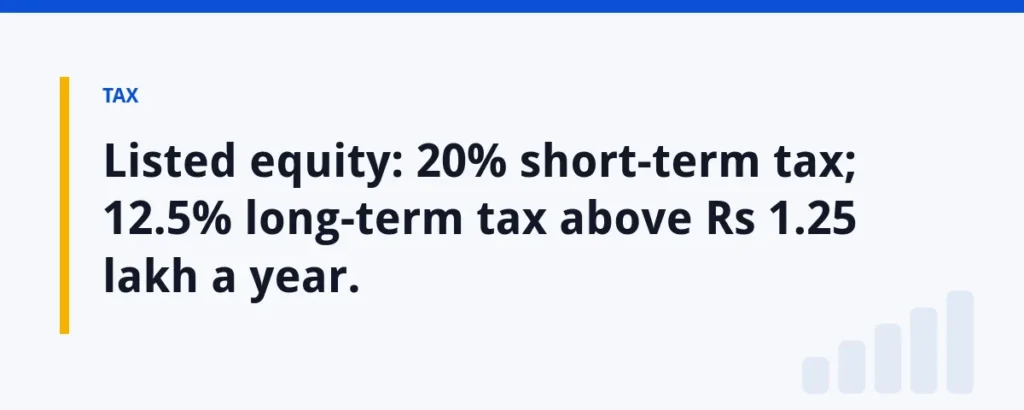
| Short-term gain (sold within 12 months) | 20% on the gain |
| Long-term gain (held more than 12 months) | 12.5% on gains above Rs 1.25 lakh in a year |
| Surcharge on these gains | Capped at 15% for the enhanced slabs, per the Income Tax Department |
| Cess | Added on top, as ThePrint notes |
| Indexation | Not available |
A worked illustration
Say you sell shares after 18 months and book a gain of Rs 3 lakh in the year, with no other long-term equity gains. The first Rs 1.25 lakh is exempt, so Rs 1.75 lakh is taxable at 12.5%, which is Rs 21,875 before cess and any surcharge. Now say you sold a different holding after 8 months for a gain of Rs 1 lakh. At 20%, the tax is Rs 20,000 before cess. The figures are round numbers for illustration, not your actual position.
How securities transaction tax fits in
STT is charged each time you trade on an exchange, whether or not you make a profit. Budget 2026 raised it on derivatives. The Budget speech, as reported in news coverage and the Finance Bill memo, set the rate on futures at 0.05%, up from 0.02%, and on options premium and exercise at 0.15%, up from 0.1% and 0.125%. The revised rates apply to transactions entered into on or after 1 April 2026.
Most long-term savers who buy shares and funds for the long run will never pay the derivatives rate. As an illustration, a futures contract worth Rs 10 lakh attracts STT of Rs 500 at 0.05%, against Rs 200 at the old 0.02%. The industry’s request to rationalise STT is mostly about trading volumes and foreign flows, so the benefit of any cut would reach active traders first.
Why a change is not a given
The government has been cautious in public. In a written reply in Parliament reported on 29 July 2026, Minister of State for Finance Pankaj Chaudhary said there was “no such proposal under consideration” to abolish long-term capital gains tax on equity for domestic investors, and that rates are reviewed in the annual Budget process. The same reply said the Income-tax (Amendment) Ordinance, 2026 exempts FPIs only on interest and capital gains from eligible government securities, from 1 April 2026.
The November comments are softer in tone, because the chairman said the ministry will “consider” the suggestions. The two statements are not easy to reconcile, and neither one amounts to a decision. A tax cut also costs revenue, and the ministry has said it will look at the effect on collections. Any final choice rests with the Finance Minister and will be announced in the Budget.
What a change could mean for you
These are possibilities, not predictions, and each depends on what the Budget actually says.
- A longer holding period would mean a sale at, say, 14 months, which is long-term today, could be taxed at the short-term rate of 20% instead of 12.5%. That would matter to anyone who sells to fund a purchase or a school fee on a fixed date.
- A higher exemption limit would shield more of your yearly gain. At Rs 1.25 lakh the exemption covers a modest gain, so long-term holders with larger portfolios feel the tax most.
- A lower or zero long-term rate would mainly help those with sizeable gains, and might widen the gap with other assets that do not get the exemption.
- Lower STT would reduce trading costs, but chiefly for those who trade often.
If you invest through SIPs, your tax is worked out on each instalment’s holding period, so a rule change could affect older and newer units differently. Our calculators show returns before tax, so keep the tax separate when you plan. You can try the SIP calculator and the lumpsum calculator to see pre-tax growth.
Key takeaways and a short checklist
The review is real, but no change has been announced, and the Budget on 1 February 2027 is where any decision would appear. Until then, plan with today’s rules.
- Keep a record of each purchase date and sale date, because the 12-month line decides the rate.
- Check your gains so far this year against the Rs 1.25 lakh long-term limit before you sell more.
- Do not delay or rush a sale only because of a possible Budget change, since the outcome is unknown.
- Read the Budget papers on 1 February 2027 for the final rules, and note the date they apply from.
- If your tax position is complicated, talk to a chartered accountant. This is general information, not personal advice.