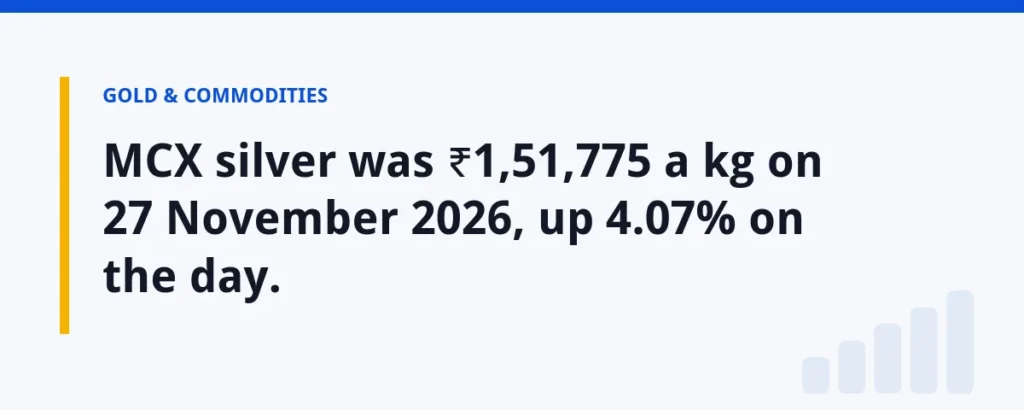
The silver price in India fell sharply through the second half of November 2026 before bouncing on 27 November. MCX December silver futures traded near ₹1.71 lakh a kg on 16 November, according to a Business Today report that day. On 20 November they were at about ₹1.49 lakh, down 5.7% on the day, as reported by Goodreturns. By the afternoon of 27 November the contract was at ₹1,51,775, up 4.07% on the day.
Retail quotes tell a different-looking story, because they include dealer margins and local charges. Goodreturns put the retail rate at ₹1.70 lakh a kg on 27 November, up ₹5,000 from the previous day. This article explains how silver moved, what pushed it, and what a fall of this size means if you buy silver jewellery, coins, bars or silver ETFs. It is general information, not a call to buy or sell.
How the silver price in India moved in November
The month began after a sharp slide at the end of October. Goodreturns reported that silver slid sharply between 29 and 31 October, and that prices were flat from 1 to 4 November. On 5 November it recorded the first gain in ten days, as the dollar softened after early US midterm election results.
The recovery did not last. On 16 November, silver ETFs fell by as much as 5% in a single session, and Business Today reported that the four ETFs it examined were each about 54% below their late January highs. On 18 November Goodreturns quoted the retail rate at ₹1.85 lakh a kg, down ₹5,000. By 20 November, spot silver had slipped to around $41.50 an ounce, and Goodreturns reported that spot silver had fallen nearly 28% over the month so far.
| Date (2026) | Quote | Level | Source |
|---|---|---|---|
| 16 November | MCX futures, per kg | about ₹1.71 lakh | Business Today |
| 18 November | Retail, per kg | ₹1.85 lakh | Goodreturns |
| 20 November | MCX futures, per kg | about ₹1.49 lakh | Goodreturns |
| 27 November | MCX futures, per kg | ₹1,51,775 | Goodreturns |
| 27 November | Retail, per kg | ₹1.70 lakh | Goodreturns |
Do not compare rows with different quote types. Futures and retail rates are not the same thing, and websites that publish city rates often differ from one another on the same day. Use the table to see the direction, not to work out a price you will actually pay.
Why silver fell
The reports from Goodreturns and Business Today point to a cluster of causes, most of them about the United States rather than India.
- A stronger US dollar. Goodreturns reported the dollar index near 104 on 20 November, its highest since April 2025. Silver is priced in dollars, so a firmer dollar tends to weigh on it.
- Expectations of US interest rate hikes. Goodreturns said markets were pricing a Federal Reserve hike in December, with Governor Christopher Waller reported to have suggested 50 basis points. Higher rates make non-yielding metals less attractive.
- A selloff in technology shares. Goodreturns linked part of the metal selloff to investors raising cash after an AI-led equity decline.
- Weak industrial and jewellery demand. Goodreturns cited the Silver Institute’s forecast of a 5% fall in global silver demand in 2026, with jewellery demand down 22%.
- Fund outflows. The same report cited Metals Focus expecting net outflows from exchange-traded products of 45 million ounces in 2026.
The Fed hike is also covered in our article on the 9 December meeting. For silver, the point is that US rate expectations moved the metal more than anything happening at home.
Why the rebound on 27 November
Goodreturns reported that silver first fell on 27 November after strong US data, including October core PCE inflation at 3.3% and an upward revision of third-quarter US GDP growth to 4.3%. It then recovered on bargain buying and safe-haven demand after proposed new US tariffs on 14 trading partners. An analyst quoted in the report expected prices to consolidate over the US Thanksgiving break.
One day does not make a trend. On 16 November, Business Today quoted Ashish Rajodiya of PL Capital saying that a hawkish Fed could extend the fall, while signs that the Fed would stop after December could help metals recover. Those are the analysts’ views, not outcomes, and the next Fed decision is still ahead.
What it means if you buy silver jewellery, coins or bars
The silver price in India you pay at a shop is the benchmark rate plus making charges, taxes and the dealer’s margin. That is why the retail quote of ₹1.70 lakh a kg on 27 November sat about 12% above the MCX quote of ₹1,51,775 the same day. If you are comparing offers, ask for the rate, the making charge and the final invoice amount separately.
As an illustration, 100 grams of silver at ₹170 a gram costs ₹17,000 before charges. At the ₹185 a gram retail quote of 18 November, the same 100 grams would have cost ₹18,500. That is ₹1,500 less, or about 8% lower. Cheaper silver is not automatically a better time to buy. The same fall could continue, and prices can swing 4% in a day, as 27 November showed.
Many families buy silver for a festival, a wedding gift or anklets for a baby. If the purchase has a fixed date, buying in two or three small lots lets you avoid putting all the money in at one rate. Hallmarking and purity (999 or 925) matter more to what you get than the day’s rate.
What it means for silver ETF investors
Silver ETFs hold silver or silver-linked assets and trade on the stock exchange, so their prices fall with the metal and can swing more on bad days. Business Today reported on 16 November that one ETF traded at a discount of about 31% to its indicative NAV that day. A gap like that is rare but shows that exchange prices of thin ETFs can drift from the value of what they hold. Check the iNAV before placing an order, and use limit orders instead of market orders.
AMFI data released on 11 November, as reported by Kotak Neo, showed silver ETF net inflows of ₹3,092.22 crore in October 2026, up from ₹1,974.32 crore in September. Investors were still putting money in as the price slid at the end of that month. AMFI publishes monthly data in the first half of each month, so November figures should appear in December.
If you are tracking an ETF or a silver-linked fund over time, the SIP calculator and the lumpsum calculator on the site help you see how a fall in value changes returns. For a general explainer, see our guide “Investing in silver guide”.
Questions to ask before buying silver
- Is this for use (jewellery, gifts) or for investment? The answer changes how much the making charge matters.
- What share of my savings is already in precious metals?
- Can I live with a fall of 30% or more, which silver has just shown?
- Am I paying a rate, a charge and a tax I understand?
Key takeaways
- MCX silver futures fell from about ₹1.71 lakh a kg on 16 November to about ₹1.49 lakh on 20 November, then traded at ₹1,51,775 on 27 November after a 4.07% rise on the day.
- Reports point to a strong dollar, expected US rate hikes, an equity selloff and weak demand as the main reasons.
- Retail rates differ from futures rates and from city to city; always check the final invoice.
- Silver ETFs fall with the metal and can trade away from their NAV; check the iNAV and use limit orders.
- Nothing here is advice to buy, hold or sell silver; the next big trigger cited by analysts is the US Fed decision in December.
You can use the lumpsum calculator or the SIP calculator to test how different returns would change your own silver or ETF holding.