India’s oil import bill has jumped sharply in the latest data. Provisional data from the Petroleum Planning and Analysis Cell (PPAC), as reported on 19 November 2026, put the net oil and gas import bill for October at about $16 billion, around 60% above the roughly $10 billion of October 2025. The crude oil bill alone was reported at $19.5 billion, up 87.5%. The Commerce Ministry’s trade data of 13 November separately showed petroleum imports of $22.82 billion for the month, up 54.3% from a year earlier.
The story has a second half. Brent crude, the global benchmark, has fallen from its October levels and closed at $94.61 on 25 November, according to CNBC. So the oil import bill for November may look milder, while your petrol, diesel and cooking gas prices have barely moved since mid-2026. Here is what the numbers say, why the bill rose and what it could mean for your household budget.
What the October numbers show
Three different figures are being quoted, and they measure different things. The net oil and gas bill subtracts what India earns from selling petroleum products abroad. The crude bill counts only crude imports. The Commerce Ministry’s petroleum line covers crude and products in the monthly trade release. Do not add them up, and do not be surprised that they differ.
| Measure (October 2026) | Figure | Change on October 2025 | Source |
|---|---|---|---|
| Net oil and gas import bill | About $16 billion | Up about 60% | PPAC provisional, as reported 19 November |
| Crude oil import bill | $19.5 billion | Up 87.5% | PPAC provisional, as reported 19 November |
| Petroleum imports in trade data | $22.82 billion | Up 54.3% | Commerce Ministry, 13 November |
| Crude import volume | 23.3 million tonnes | Up about 11% | PPAC provisional, as reported 19 November |
The PPAC figures are provisional and may be revised when final data is published.
Why India’s oil import bill rose so much
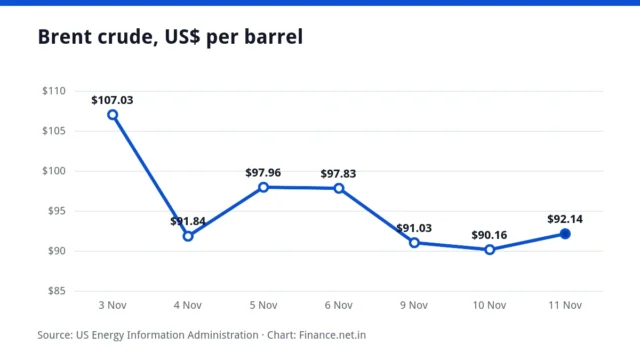
Price did most of the work. Volumes grew about 11% on the year, but the crude bill grew nearly eight times as fast. The Indian crude basket, the mix of grades that refiners actually buy, averaged around $120 a barrel in October, according to the same report. Trading Economics reported Brent above $103 on 9 October, and on 3 November it settled at $103.60, its lowest close since 7 October, as per a Nation Thailand report.
The cause was the conflict involving Iran and the repeated attacks on shipping near the Strait of Hormuz, a narrow route that carries a large share of the world’s oil. India buys most of its crude abroad, so a spike in the global price shows up in the bill within weeks.
A simple illustration: say a month’s crude imports cost $10 billion. If volumes rise 11% and the average price rises 50%, the bill becomes about $16.7 billion. October’s crude bill of $19.5 billion against $10.4 billion a year earlier points to an even bigger price jump than that.
Crude has fallen since, but the picture is mixed
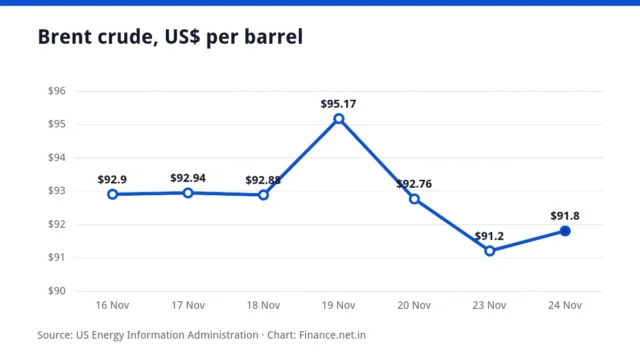
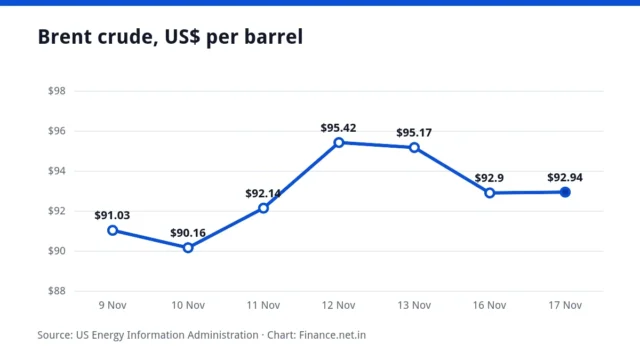
Brent fell sharply in early November. Reuters reported that it dropped 5.85% to $92.57 on 9 November, after a fall of 16% in the previous week, which it described as the steepest weekly drop since the start of the Covid pandemic. Talk of de-escalation and a weak physical market were the reasons given. On 16 November Trading Economics reported Brent below $94, helped by recovering Middle East exports and an IEA forecast of a fourth-quarter surplus.
It has not been a straight line down. Brent rose about 2.4% to $90.91 on 24 November, and on 25 November it closed at $94.61 after the Houthis claimed an attack on Saudi Arabia’s Ras Tanura refinery, CNBC reported. PVM analyst Tamas Varga was quoted attributing the rally to a rising geopolitical risk premium and short covering, while NLI Research’s Tsuyoshi Ueno said the expected glut was keeping prices in check. OPEC+ meets on 29 November to discuss 2027 output.
What it means for petrol and diesel prices
State-run fuel retailers raised pump prices in May 2026, after a long freeze, with several revisions over the month. In Delhi, petrol went from ₹94.77 a litre on 1 May to ₹102.12 by the end of the month, a rise of ₹7.35 or about 7.8%. The PPAC website listed petrol at ₹102.12 and diesel at ₹95.20 a litre in Delhi on 26 November, and a price tracker showed no change in petrol since the end of May apart from brief blips in August and September.
So the high October bill has not been passed on at the pump. For the retailers it means a thinner margin on each litre, though no figure for any November under-recovery has been published. For a household, the useful number is what the May rise already costs. As an illustration, say your scooter and car together use 40 litres of petrol a month. At ₹7.35 extra per litre, that is about ₹294 more a month, or roughly ₹3,500 a year, compared with April.
Whether pump prices fall if crude stays near $90 is a decision for the oil companies and the government, and nothing official says they will. Treat any social media claim of an imminent cut with caution until the fuel retailers announce one.
LPG cylinders and cooking gas
The domestic 14.2 kg cylinder in Delhi costs ₹942, according to a GoodReturns report that says prices have been unchanged since 7 June 2026, when they rose by ₹29 from ₹913. At the time the government said cumulative under-recoveries on domestic LPG had reached about ₹60,000 crore by the end of the previous financial year, and that the Union Cabinet had approved ₹30,000 crore of compensation to the oil companies, as reported by Outlook Business. Ujjwala beneficiaries pay an effective ₹642 after a ₹300 subsidy on the first four refills a year.
Commercial 19 kg cylinders were raised by ₹10 in Delhi on 1 November to ₹2,820, which matters mostly to restaurants and small eateries.
The link to inflation and your budget
Data from the National Statistics Office, released on 12 November, shows retail inflation at 6.09% in October 2026, up from 5.54% in September. Food inflation was 8.94%. Pump prices have been steady since May, so the oil bill is not what pushed October’s number up, but a lasting rise in crude can feed into freight and transport costs later.
A larger oil bill also takes more dollars out of the country, which can weigh on the rupee. For savers, it is one more reason to compare what a deposit earns with inflation over a full year. Our FD calculator shows what a deposit earns, and the EMI calculator shows what a higher loan rate would cost you.
Key takeaways
- October’s net oil and gas bill was reported at about $16 billion, up about 60%, on provisional PPAC data.
- Price, not volume, drove most of the rise; crude volume was up about 11%.
- Brent has fallen from its October levels but still moves with each Hormuz headline: $94.61 on 25 November.
- Delhi petrol (₹102.12) and diesel (₹95.20) were unchanged on 26 November; the domestic LPG price (₹942) has been unchanged since 7 June.
- Check fuel prices on your oil company’s website; nothing official yet points to a cut or a hike.