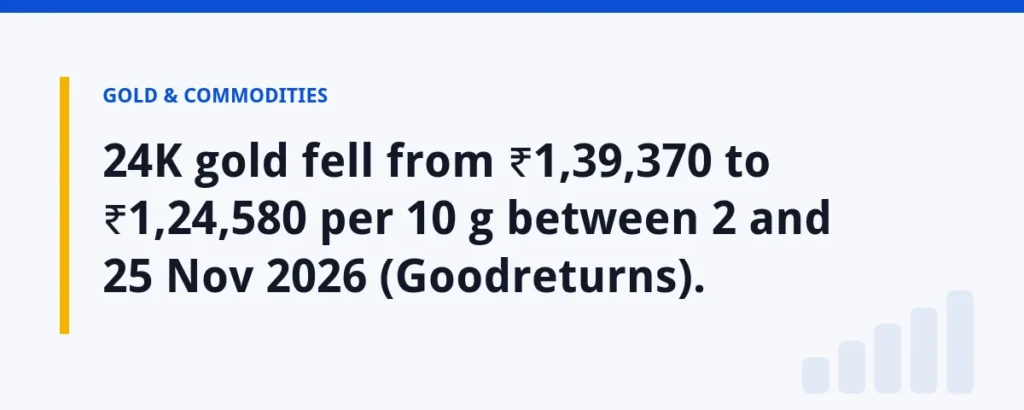
The gold price in India fell sharply in the second half of November 2026. Goodreturns reported on 25 November that 24-carat gold was ₹1,24,580 per 10 grams, down ₹3,220 in a day, against ₹1,39,370 on 2 November, the start of the Dhanteras and Diwali week. That is a fall of about 10.6% in under four weeks. On 26 November, Upstox reported a rise of about 2% from its own previous-day rate, to roughly ₹1,25,890 per 10 grams; its base differs slightly from Goodreturns.
If you are planning a wedding purchase, hold a gold ETF or own a sovereign gold bond (SGB), the swings matter. This article sets out what moved, the official prices the RBI fixed for two SGB tranches that came due this month, and what changes for each type of gold buyer. It is information, not a call on whether to buy or sell.
How the gold price in India moved through November
Retail rates are reported by bullion websites, so they differ a little from site to site. Taking one source, Goodreturns, the 24-carat rate was ₹1,39,370 per 10 grams on 2 November, with 22-carat at ₹1,27,750. By 16 November the same source had 24-carat at ₹1,36,800 and 22-carat at ₹1,25,400.
Business Today put the 24-carat benchmark at about ₹1,32,320 on 18 November, and MCX gold futures fell 1.85% that day. On 25 November Goodreturns had 24-carat at ₹1,24,580 and 22-carat at ₹1,14,200.
| Date (2026) | 24-carat, per 10 g | 22-carat, per 10 g | Source |
|---|---|---|---|
| 2 November | ₹1,39,370 | ₹1,27,750 | Goodreturns |
| 16 November | ₹1,36,800 | ₹1,25,400 | Goodreturns |
| 25 November | ₹1,24,580 | ₹1,14,200 | Goodreturns |
| 26 November (about) | ₹1,25,890 | ₹1,15,400 | Upstox, per-gram rate times 10 |
Treat these as indicative. Your local jeweller’s board rate will differ by a few hundred rupees, and the benchmark used by the India Bullion and Jewellers Association (IBJA) is separate again.
Why gold prices fell
Most of the push came from outside India. Investing News reported on 20 November that gold had fallen to a 14-month low in international trading. It attributed the slide to a stronger US dollar and expectations of further US interest-rate increases, citing the Federal Reserve’s October meeting minutes. Gold pays no interest, so higher rates and a firm dollar make it less attractive to hold.
Goodreturns on 16 November said futures markets put the odds of a quarter-point Fed rate rise at the 8 to 9 December meeting at roughly 88% to 91%. By 25 November it quoted a figure of about 95%, citing CME FedWatch, though the same article also gave 96.4% elsewhere. It added that a sell-off in technology shares and a firm dollar weighed on gold that day.
Home factors played a smaller part. Business Today on 18 November listed festive demand as a support, while rate-hike worries and high crude oil pulled the other way. Goodreturns on 25 November also mentioned that India’s retail inflation of 6.09% in October, above the RBI’s 6% upper tolerance limit, had raised talk of an RBI rate rise.
What analysts are saying
Prithviraj Kothari, president of the India Bullion and Jewellers Association, said on 16 November that oversold conditions favoured a near-term bounce, according to Goodreturns. Joe Cavatoni, a senior market strategist at the World Gold Council, said on 20 November that central bank buying and returning ETF demand look like the main drivers into 2027, but that it is hard to name gold’s next catalyst. Treat these as views, not forecasts you can rely on.
What changes for jewellery buyers
Jewellery is priced on the day’s gold rate plus making charges, and tax is added on top. When the base rate falls, the bill falls with it, but only if you buy on a day when the rate is low.
As an illustration, take 10 grams of 22-carat jewellery with making charges of 10% of the gold value. At the 25 November rate of ₹1,14,200, the gold is ₹1,14,200 and making charges are ₹11,420, so the bill is about ₹1,25,620 before tax. At the 2 November rate of ₹1,27,750, the gold alone would have cost ₹13,550 more. Making charges differ by shop and design, so ask for the rate and the charge separately.
- Ask for the day’s rate in writing and compare it with a published benchmark.
- Check the hallmark and the purity, and ask how the shop values old gold if you exchange it.
- Remember that the 24-carat rate moved by ₹3,220 per 10 grams in a single session on 25 November, so the price at the counter may differ from the one you saw in the morning.
What changes for gold ETF investors
AMFI data reported by Business Today on 11 November showed gold ETFs drew net inflows of ₹3,474.03 crore in October 2026, down 21.9% from ₹4,450.61 crore in September. Silver ETF inflows rose 56.6% to ₹3,092.22 crore. The report said the fall in gold inflows coincided with a roughly 7% drop in MCX gold prices during October but that the data does not prove cause and effect.
A gold ETF or gold fund tracks the domestic gold price, so its value follows the same ups and downs shown in the table above. Over four weeks the 24-carat rate fell about 10.6%, and a fund tracking it would have moved similarly, before small costs. If you invest through a monthly SIP, the instalment buys more units when prices are lower. You can test the idea with the SIP calculator using a return you assume for illustration, since no one can promise one.
Sovereign gold bonds: official redemption prices this month
For SGB holders, the RBI publishes the premature redemption price on each eligible date. It is the simple average of the IBJA closing price of 999-purity gold over the three business days before the redemption date. Premature redemption is allowed after the fifth year from issue, on an interest payment date.
| Tranche | Redemption date | Price per unit | Averaging days |
|---|---|---|---|
| SGB 2020-21 Series VIII | 18 November 2026 | ₹13,499 | 13, 16 and 17 November |
| SGB 2020-21 Series II | 19 November 2026 | ₹13,345 | 16, 17 and 18 November |
As an illustration, a holder redeeming 10 units of Series VIII received ₹1,34,990, while 10 units of Series II fetched ₹1,33,450. The gap between the two reflects the gold price falling between the averaging days.
Tax treatment of SGBs changed from 1 April 2026. The National Institute of Securities Markets describes the capital gains exemption as now limited to original subscribers who hold until maturity, with premature redemption no longer exempt. Check the current Income-tax Act, 2025 provisions or ask a tax professional before you redeem.
What this means for your household
Gold can swing sharply in either direction. A 10% move in under four weeks shows how wide the range can be. Nothing in this article tells you whether to buy, hold or sell.
- If you need gold for a wedding on a fixed date, a price fall helps, but nobody can know what comes next, so many families split purchases across dates.
- If gold is already a large share of your savings, a 10% fall in four weeks is a reminder to check how large.
- If you hold SGBs, find your tranche’s next interest date and read the RBI’s price notice a day or two before it.
Key takeaways
- As reported by Goodreturns, 24-carat gold fell from ₹1,39,370 per 10 grams on 2 November to ₹1,24,580 on 25 November, then rose again on 26 November (Upstox reports about 2% on its own base).
- Reports linked the fall to a stronger dollar and expected US rate rises.
- Check the rate and the making charge separately when buying jewellery.
- The RBI fixed ₹13,499 and ₹13,345 per unit for two SGB tranches redeemed on 18 and 19 November 2026.
- Rates vary by city and seller, and these figures are a snapshot, not a forecast.