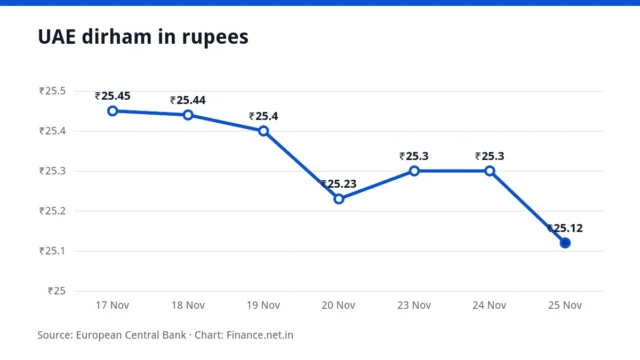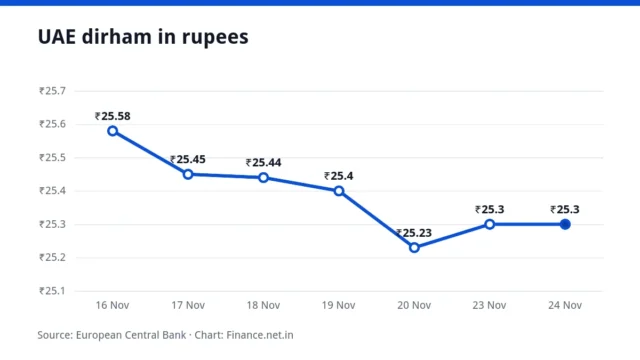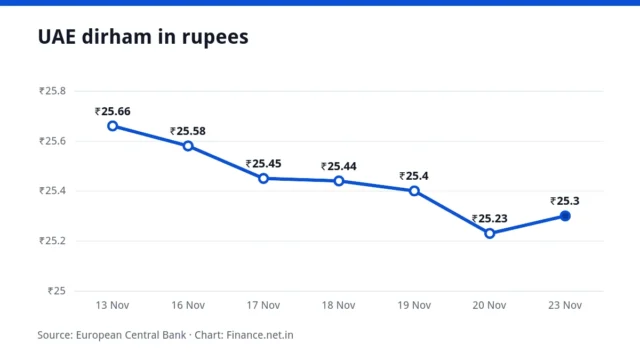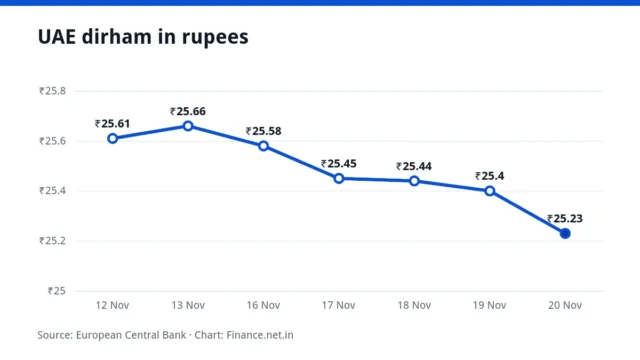
The rupee vs dollar story in November 2026 has been a sharp swing in both directions. The rupee closed at 93.91 per dollar on 6 November as foreign buyers returned to Indian shares, slipped to 94.24 on 13 November as US rate worries lifted the dollar, and then climbed to about 92.2 on 25 November, which one market report called an eight-month high for the rupee. On 26 November it was quoted near 92.4 in early trade. These are market-report figures, so check the day’s rate before you transact.
A move of two rupees looks small on a screen, but it changes real bills: a student’s fee, an NRI’s monthly transfer, an importer’s invoice. Here is what pushed the rupee around, what the RBI has said, and how a family can think about timing.
How the rupee moved through November
The month began after a hard stretch. The rupee had touched record lows in May, and it was still near 94.47 per dollar on 5 November. Then it turned. On 6 November it closed at 93.91, up 56 paise in a day, its strongest weekly gain of the year according to a report published on 8 November.
It then gave some of that back. A report on 14 November said the rupee closed at 94.24 on Friday 13 November, 0.3% weaker than the week before, after hotter US inflation data and talk of Federal Reserve rate hikes strengthened the dollar. By 17 November it had recovered to 93.47, which a Reuters-based report called its strongest close in seven months.
| Date (2026) | Rupee per US dollar | What was happening |
|---|---|---|
| 5 November | 94.47 | Start of the rally |
| 6 November | 93.91 (close) | Foreign buying, softer crude |
| 13 November | 94.24 (close) | Stronger dollar, US rate fears |
| 17 November | 93.47 (close) | Foreign inflows, lower crude |
| 25 November | about 92.2 | Strongest in around eight months, per a market report |
From 94.47 on 5 November to about 92.2 on 25 November is a gain of roughly 2.4% for the rupee, in line with a report that called it Asia’s best-performing currency this month.
Why the rupee vs dollar rate changed
Three forces did most of the work, according to the reports we read.
- Foreign money returned to shares. Market participants quoted in a 14 November report said foreign portfolio investors had bought over $8 billion of Indian equities in November so far. A 26 November report put their cumulative November buying at about ₹1.22 lakh crore. When foreigners buy Indian shares they sell dollars for rupees, which supports the rupee.
- Crude oil. India imports most of its oil, so cheaper crude means fewer dollars needed. A report on 8 November said Brent had fallen nearly 20% from its peak. Brent was still about $95 a barrel on 13 November, and an oil spike was blamed for the rupee’s slip that day.
- The US dollar and US rates. Strong US inflation numbers raised bets on further Fed hikes on 12 and 13 November. Later, a 26 November analysis quoted Brown Brothers Harriman strategists saying investors were moving away from the AI trade, with India benefiting.
The same 26 November report warned that if the global AI trade recovers, foreign interest in India could cool. Flows can turn within days.
What the RBI has done
The RBI does not announce a target for the rupee. Its Monetary Policy Committee did raise the policy repo rate by 25 basis points to 5.50% on 7 October 2026 and changed its stance to calibrated tightening, the RBI’s published minutes of 21 October show. One member cited exchange rate depreciation among the inflation risks, and another credited the scheme for FCNR(B) deposits with helping to stabilise the rupee.
That scheme is the RBI’s biggest official tool this year. Under a swap facility opened on 8 June 2026, banks reported foreign currency inflows of $143,596 million through 18 September, of which $132,980 million came as FCNR(B) deposits. The FCNR(B) window closed on 31 August. Inflows through ECBs and overseas foreign currency borrowings can continue until 31 December 2026.
On the market side, a report on 8 November said the RBI bought dollars near 93.88 on 6 November, which kept the rupee from rising faster. The report named an Emkay Global economist, Madhavi Arora, as expecting the RBI to use good inflows to rebuild its reserves rather than let the rupee appreciate sharply. That is an analyst’s view, not an RBI statement. Reserves stood at $719.5 billion in the week ended 6 November, a report on RBI data said.
The next policy decision is due on 4 December, according to a 26 November market report that also quoted Commerzbank analysts expecting another 25 basis point hike. Treat that as one bank’s expectation.
What a stronger rupee means for NRIs sending money home
If you send dollars to India, a stronger rupee works against you: each dollar buys fewer rupees. As an illustration, say you send $2,000 a month. At 94.24 rupees per dollar your family receives ₹1,88,480. At 92.40 it receives ₹1,84,800. The gap is ₹3,680 a month, or about 2%.
Do not read too much into the rupee vs dollar gap. Transfer fees and the margin a provider adds to the rate often matter as much as a one or two rupee move, so compare the final rupee amount received, not the headline rate. You can run the numbers on our currency converter. For deposits in India, our NRI FD calculator shows how returns add up over time.
Waiting for a better rate is a bet, and the rate can move either way.
Students abroad and importers
For parents paying overseas fees the picture is better. Say a semester fee is $30,000. At 94.24 that costs ₹28,27,200. At 92.40 it costs ₹27,72,000, a saving of ₹55,200. Under the Liberalised Remittance Scheme, a resident individual can remit up to $250,000 per financial year, and studies abroad is a listed purpose, according to the RBI’s Master Direction on Other Remittance Facilities, updated to 1 October 2026. Above that limit prior RBI permission is needed, though the limit may be exceeded for studies if the university requires it.
Importers gain in the same way. As an illustration, a $1 lakh invoice costs ₹94.24 lakh at 94.24 and ₹92.40 lakh at 92.40, a difference of ₹1.84 lakh. Many businesses cover such risk with forward contracts through their banks, and the choice depends on their own cash flow.
The risks that remain
Three things can undo this month’s gains. A hawkish US central bank keeps the dollar firm, as 13 November showed. Oil can jump on tensions in West Asia: a 14 November report linked Brent’s rebound to stalled US and Iran talks. And a 26 November report cited proposed US tariffs on Indian imports as a pressure point.
Also, the rupee is still weaker than at the start of the year. A 12 November report said it was down about 4% for the year, despite the month’s recovery.
Practical steps for your family
- If you have a fixed dollar bill coming, split the payment into two or three parts instead of picking one day.
- Compare the rupees received after fees across at least two providers on the day you transfer.
- Check whether you or your child need LRS paperwork or tax collected at source on large outward payments, and ask your bank for the current rule.
- Do not borrow in dollars or take a large currency position on the hope that this month’s trend continues.
Key takeaways
- In the rupee vs dollar contest the rupee strengthened about 2.4% from 5 November to about 25 November, after dipping to 94.24 on 13 November.
- Foreign equity inflows and softer crude helped; a stronger dollar and oil spikes pulled it back.
- The RBI raised the repo rate to 5.50% on 7 October and has used swap schemes and dollar purchases to manage the rupee.
- A stronger rupee helps students and importers but means fewer rupees per dollar sent home by NRIs.
- This is general information, not advice on when to convert currency.