The India US trade deal is still not signed as of 26 November 2026, and on 25 November the picture became more complicated. The US Trade Representative (USTR) announced that day that it considers India’s industrial practices actionable under Section 301 of the US Trade Act and proposed additional duties of up to 25% on Indian goods, falling to 17% if India reaches a trade agreement that answers the findings. These are proposals open for comment, not final tariffs.
This matters because India and the US announced a framework for an interim deal back in February, and Indian officials have said for weeks that the first part is nearly done. If you work in textiles, leather, gems, engineering or any export business, or if your job depends on one, the rate that finally applies will decide a lot. Here is what has been announced and what has not.
What the India US trade deal framework promised
The joint statement published by the White House on 6 February 2026 is the basic document. It describes a framework for an interim agreement, not a signed treaty. The US said it would apply an 18% reciprocal tariff on Indian goods, naming categories such as textiles and apparel, leather and footwear, plastics and rubber, organic chemicals, home decor and certain machinery. It also said the reciprocal tariff would be removed on a list of goods, including generic medicines, gems and diamonds and aircraft parts, once the interim agreement is concluded.
India, for its part, said it would remove or cut tariffs on all US industrial goods and on a range of farm products, among them tree nuts, fruit, soybean oil, wine and spirits. India also said it intends to buy $500 billion of US energy products, aircraft and parts, precious metals, technology goods and coking coal over five years. The statement set no signing date.
| Item | What the 6 February statement said |
|---|---|
| US tariff on Indian goods | 18% reciprocal tariff on originating goods |
| Goods to be freed of the tariff | Generic medicines, gems and diamonds, aircraft parts (subject to concluding the interim agreement) |
| India’s tariff offer | Eliminate or reduce on all US industrial goods and many farm products |
| Purchase intention | $500 billion over five years |
| Signing date | None stated |
Why the 18% figure no longer applies
The tariff structure the framework was built on changed after the US Supreme Court struck down the emergency-powers (IEEPA) tariffs on 20 February 2026, according to a law-firm summary by Holland & Knight. Washington then used a temporary global tariff under another section of its trade law, which expired on 24 July. From that date, a different tool took over. USTR announced on 23 July that it was imposing Section 301 tariffs on 60 economies for failing to ban imports made with forced labour. India was placed in the 10% tier, the lowest. Holland & Knight notes that for India this duty is added on top of the normal customs duty.
So the practical position today is a 10% additional US tariff on most Indian goods, with exemptions for some products. USTR lists the exemption categories, including raw materials and goods that cannot be sourced elsewhere at reasonable prices. An importers’ group has also challenged the Section 301 tariffs in a US trade court, as reported by the same law firm.
The 25 November proposal in detail
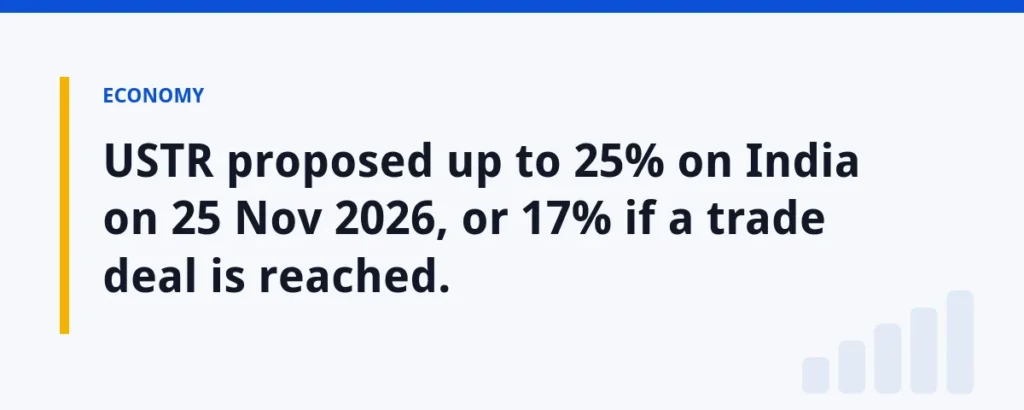
The new proposal comes from a separate Section 301 investigation, started in March 2026, into what USTR calls structural excess capacity in manufacturing. In its 25 November release, USTR said it found the practices of 14 economies actionable, including India, China, the European Union, Japan, Korea, Vietnam and Bangladesh. For India it proposed up to 25%, or 17% if India reaches an Agreement on Reciprocal Trade that responds to the findings. USTR describes most of the proposed rates as net of existing Section 301 tariffs, so the exact stacking with India’s current 10% needs to be read in the notices.
The Tribune reported that USTR named pharmaceuticals and medical devices, steel, solar energy and information and communications technology among the concerns. USTR set 5 January 2027 as the deadline for comments and requests to speak, and public hearings begin on 25 January 2027. Nothing takes effect before that process runs its course.
- The 17% rate is conditional on a deal, which gives India a reason to sign.
- Other Asian exporters face proposed rates between 15% and 35%, so the comparison with competitors matters as much as the headline number.
What Indian officials say about the talks
Commerce Minister Piyush Goyal said on 27 October, according to the Hans India, that most discussions had concluded and the agreement was being fine-tuned. The same report says a team led by Commerce Secretary Rajesh Agrawal held talks in Washington from 15 to 17 October, and that US Secretary of State Marco Rubio said on 20 October the sides were very close with a small number of items left.
On 18 November, Swarajya reported, Agrawal told a FICCI event that the first tranche, which covers goods only, is close to finished but India will not sign until Washington settles its new tariff framework and the Section 301 outcomes become clear. Services are left for a later round. In other words, the 25 November proposal is the thing India was waiting to see, and it has now arrived with a price tag attached to signing.
What it could mean for exporters and jobs
Trade data from the Commerce Ministry, as reported by All India Radio, showed India’s merchandise exports to the US at around $51 billion in April to September 2026, against $45.73 billion a year earlier. That is a rise of about 11.5% on our calculation, so the existing tariffs have not stopped shipments. The US takes roughly one-tenth of India’s total merchandise exports on the same figures, about 10.7% by our calculation.
Tariffs are paid by the US importer, but the cost usually gets shared back along the chain. As an illustration, say a US buyer imports a $10,000 consignment. A 10% additional duty adds $1,000 to the buyer’s bill on top of normal duty. Moving to 17% or 25% on the same consignment, if the extra duty were applied in full, would add $1,700 or $2,500. The buyer may then press the Indian supplier for a lower price or shift orders to a cheaper country.
For a worker, this does not mean automatic job losses or gains. It means small exporters with thin margins feel pressure first. Sectors the US statement singles out, such as textiles, leather, gems and home decor, tend to employ many people, so a lower and more certain rate would be welcome news for them. Whether it arrives depends on a signed agreement that does not yet exist.
Your own money sits further downstream. Exporters who earn dollars and NRIs who send money home are affected only indirectly, through the overall trade picture. If you are planning a transfer, the currency converter on this site gives a quick check at current rates.
What is still unknown
Several things cannot be stated yet. No signing date exists. The final tariff on Indian goods after the January hearings is unknown. The exact way the proposed 25% and the existing 10% combine is in the notices, which readers should check on the USTR site. Goyal was also reported to have said on 15 November that India had agreed preferential access with lower duties than competitors; no official record of that remark has been published.
Key takeaways
- As of 26 November 2026 the India US trade deal is a framework from 6 February, not a signed agreement.
- India faces a 10% additional US tariff on most goods under Section 301 since 24 July 2026.
- On 25 November USTR proposed up to 25% on India, or 17% with a trade agreement; comments are due 5 January 2027.
- India’s Commerce Secretary said on 18 November that signing waits for clarity on US tariffs.
- Exports to the US were up in April to September 2026, so the effect so far has been uneven rather than a collapse.
This article is general information on public announcements, not investment or business advice.