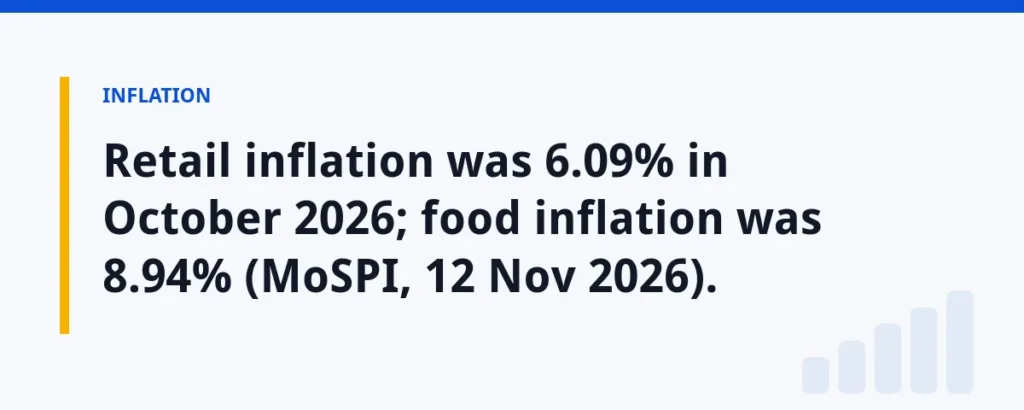
Retail inflation in India rose to 6.09% in October 2026, according to provisional data released by the National Statistics Office under MoSPI on 12 November 2026. That is above the 6% upper tolerance limit the Reserve Bank of India works with, and up from 5.54% in September. Food was the main push: the food price index rose 8.94% over a year earlier.
For a family, the headline number matters less than what sits behind it. Vegetables, onions, eating out and personal care items are getting dearer faster than rent, health or phone bills. This article walks through the official figures, shows what they do to a monthly budget, a fixed deposit and a home loan EMI, and explains why the RBI’s next policy meeting from 2 to 4 December is being watched closely.
What the October 2026 data showed
MoSPI’s press release of 12 November 2026 uses the new Consumer Price Index with 2024 as the base year. Year-on-year inflation for the all-India index was 6.09% for October. Rural India saw 6.63% and urban India 5.41%. Both were higher than in September, when the final figures were 6.08% for rural and 4.88% for urban areas.
| Measure | September 2026 (final) | October 2026 (provisional) |
|---|---|---|
| All-India CPI inflation | 5.54% | 6.09% |
| Rural | 6.08% | 6.63% |
| Urban | 4.88% | 5.41% |
| Food (CFPI) | 7.74% | 8.94% |
The October figures are provisional and can be revised when MoSPI publishes final numbers. The next release, for November, is scheduled for 14 December 2026.
Which prices are rising fastest
The release splits the basket into divisions. Food and beverages, which carry the largest weight at 36.75 out of 100, ran at 8.51%. Restaurants and accommodation services came in at 10.06%, and personal care, social protection and miscellaneous goods and services at 10.14%. Clothing and footwear was at 4.96% and transport at 5.84%.
At the other end, health inflation was 2.05%, and housing, water, electricity, gas and other fuels was 2.90%. Actual rent paid for housing rose only 2.36%. So the squeeze is concentrated on the kitchen and the plate, not on the monthly rent or the electricity bill.
Items that moved the most
Among individual items, onion prices were 116.22% higher than a year earlier and garlic 60.74% higher. Silver jewellery was up 52.39%, ginger 48.32% and lemon 47.30%. Some foods got cheaper: potato fell 14.24%, cauliflower 10.57%, coconut 5.60%, brinjal 3.34% and cabbage 1.92%. If you buy mostly onions and spices, your personal inflation is well above 6%. If your plate is potato and cabbage heavy, it is lower.
What 6.09% retail inflation means for your budget
Take a household that spent ₹10,000 a month on food a year ago. If its basket moved exactly with the official food index, the same groceries now cost about ₹10,894. That is ₹894 more every month, or roughly ₹10,700 over a year, before any change in what you buy. This is an illustration, not your bill, but it shows why a number that looks small on paper is felt at the shop.
Prices of the whole basket are 6.09% higher than a year ago. A salary that rose 5% in the last appraisal has therefore lost a little buying power, even though the rupee amount is bigger. Households that pay mostly fixed costs, such as rent and school fees, feel this less than those whose spending is food heavy.
- Compare your own last three grocery bills rather than relying on the national average.
- Keep a note of which items jumped, because vegetable spikes often fade within a few months.
- Review subscriptions and eating out, the two areas where official inflation is above 10%.
What it does to fixed deposit returns
Real return is the interest you earn minus inflation. Say, for illustration, a deposit pays 7% a year. Against 6.09% retail inflation, the real return before tax is about 0.86%, since ₹1 lakh grows to ₹1.07 lakh while prices rise 6.09%. Interest on deposits is added to your income and taxed at your slab rate. Assume a taxpayer in the 30% slab: the after-tax return is 4.9%, and the real return turns negative, at about minus 1.1%.
This does not mean deposits are a bad idea. They give certainty, and safety is the reason many people hold them. It does mean that the money you will need in five or ten years should not rely on a deposit alone to beat prices. You can test different rates and tenures with the FD calculator, and see how a long-term plan might look with the SIP calculator, remembering that market-linked returns are not guaranteed.
What it means for home loan EMIs and the RBI
On 7 October 2026 the RBI’s Monetary Policy Committee raised the policy repo rate by 25 basis points to 5.50% and changed its stance to calibrated tightening. The vote on the rate increase was unanimous. In that statement the RBI projected CPI inflation of 6.0% for the October to December quarter of 2026-27 and 5.7% for January to March 2027. The October reading of 6.09% is slightly above that quarterly path, although one month does not make a quarter.
The next meeting runs from 2 to 4 December 2026. Aditi Nayar, chief economist at ICRA, told ThePrint she expects inflation to stay above 6% for the next couple of months and described a further 25 basis point rate hike as almost certain. That is one economist’s view, not a decision, and she added that later steps would depend on crude oil prices. The RBI itself has announced nothing yet.
A rough EMI illustration
How fast a change in the repo rate reaches your loan depends on how your loan is linked and on your lender’s rules, so check your sanction letter. As an illustration, assume a ₹50 lakh loan for 20 years at 9% a year. The EMI is about ₹44,986. If the rate rose to 9.25%, the EMI would be about ₹45,793, which is ₹807 a month more. Alternatively, many borrowers see the tenure stretch instead of the EMI rising. You can test your own numbers in the EMI calculator.
| Illustration (₹50 lakh, 20 years) | Rate assumed | EMI |
|---|---|---|
| Before a rise | 9.00% | about ₹44,986 |
| After a 0.25 point rise | 9.25% | about ₹45,793 |
| Difference | about ₹807 a month |
What to watch next
Three dates matter in the coming weeks. The RBI decision is due on 4 December, the end of the meeting that starts on 2 December. The November retail inflation print arrives on 14 December. Between them, food prices, especially onion, milk and sugar, and crude oil prices will shape how the numbers look. Nayar’s note to ThePrint said she expects food inflation to stay above 8% in November, again an attributed expectation and not an official forecast.
Keep in mind that the October figure is provisional, and that the new series with base year 2024 is still young. Year-on-year comparisons can also swing because of last year’s low base. Do not treat one month as a trend.
Key takeaways
- Retail inflation was 6.09% in October 2026, above the RBI’s 6% upper tolerance limit, with food at 8.94%.
- Rural inflation (6.63%) is running higher than urban (5.41%).
- Restaurants, personal care, onions and spices rose the most, while rent, health and housing costs rose slowly.
- A deposit paying less than about 6.1% before tax has a negative real return at the current rate.
- The RBI meets from 2 to 4 December; any change in loan rates comes from lenders after that.
- Check your own bills, loan terms and savings plans, and treat this as general information, not personal advice.