Suppose you sold one share this year for a profit of ₹80,000 and another for a loss of ₹50,000. You might expect to be taxed on ₹80,000, or perhaps to lose the ₹50,000 loss because it is a different stock. The law does neither. Capital loss set off lets you net the two, so tax is charged only on ₹30,000. And if your losses are larger than your gains, you can carry the rest forward and use it later, provided you follow one filing rule that many investors miss.
This guide explains how losses from shares, mutual funds, property and other capital assets are adjusted under the Income-tax Act, 2025, which applies from 1 April 2026. It covers the difference between short-term and long-term losses, the eight-year carry-forward, why filing on time matters, and what people mean by tax-loss harvesting. It does not suggest what to buy or sell. It describes the rules, and your own decisions should rest on your goals and risk, not on a tax saving.
Short-term and long-term: the line that matters
Every capital gain or loss is either short-term or long-term, and the two are treated differently. Under section 2 of the Act, an asset held for not more than 24 months before it is transferred is short-term. For some assets the period is only 12 months: a security listed on a recognised stock exchange in India, a unit of the Unit Trust of India, a unit of an equity-oriented fund and a zero-coupon bond. So a listed share sold after 13 months produces a long-term result, while a flat sold after 13 months is still short-term.
The tax rates explain why the difference matters. On listed shares or equity-oriented fund units where securities transaction tax is paid, short-term gains are taxed at 20% under section 196. Long-term gains on the same assets are taxed at 12.5% on the amount above ₹1,25,000 in a year, under section 198. For other long-term gains, section 197 applies a 12.5% rate. A loss is only useful to the extent it reduces a gain, so the type of loss decides which gains it can cancel.
Capital loss set off: the basic rules
Section 108(2) of the Act gives two rules for a loss in the same year, and they are the heart of capital loss set off.
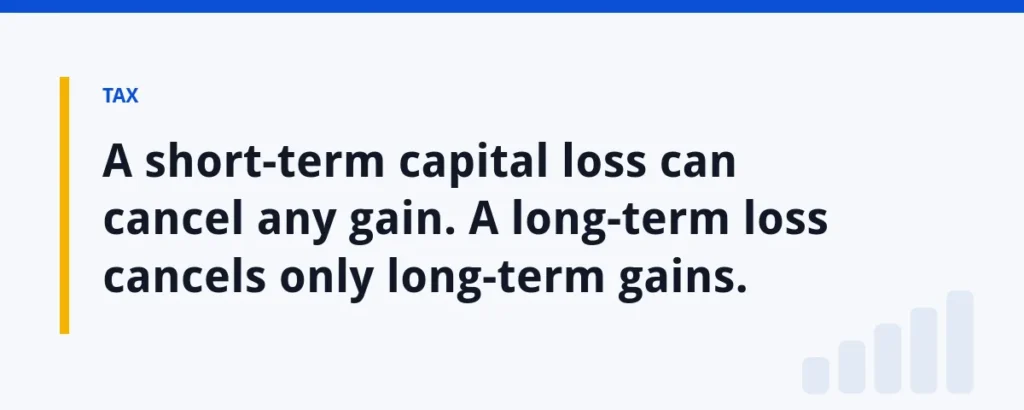
- A short-term capital loss can be set off against any capital gain of that year, short-term or long-term.
- A long-term capital loss can be set off only against a long-term capital gain.
Section 109(2) adds that a loss under the head capital gains cannot be set off against income under any other head. You cannot use it against salary, rent or interest. That is a major difference from a loss on house property, which under the old regime can be set off against other heads up to ₹2,00,000 a year (the new regime in section 202 does not allow that set off), or an ordinary business loss, which cannot be set off against salary.
| Loss type | Can be set off against | Cannot be set off against |
|---|---|---|
| Short-term capital loss | Short-term and long-term capital gains | Salary, rent, interest and other heads |
| Long-term capital loss | Long-term capital gains only | Short-term gains and all other heads |
Because short-term losses are more flexible, the order of adjustment can change your tax. The law does not force you to net shares against property or any other kind of asset separately. A short-term loss on a share can cancel a long-term gain on a flat, and the net figure is what you pay tax on.
Worked examples of capital loss set off
These are illustrations with round numbers. First, short-term loss against short-term gain. Say you made a short-term gain of ₹80,000 on listed shares and a short-term loss of ₹50,000 on others. Net short-term gain is ₹30,000. At 20%, tax is ₹6,000 plus cess, against ₹16,000 without the set off.
Second, long-term loss against long-term gain. Say a long-term gain of ₹1,50,000 on equity and a long-term loss of ₹60,000 on a unit-based investment. The net long-term gain is ₹90,000, which is below the ₹1,25,000 limit, so no tax is due on it.
Third, a case where the rule bites. Say a long-term loss of ₹40,000 and a short-term gain of ₹70,000. The loss cannot be used against the short-term gain, so the gain is taxed in full, and the long-term loss is carried forward for later long-term gains.
Carry forward: eight years, with limits
When a loss is larger than the gains that year, section 111 lets you carry the unused part forward to the following tax year, and onward. A carried-forward short-term loss can be set off against any capital gain in later years. A carried-forward long-term loss can be set off only against long-term capital gains. The loss cannot be carried beyond eight tax years immediately after the tax year in which it first arose.
The tax years run from 1 April to 31 March. A loss that arose in tax year 2026-27 can therefore be used until tax year 2034-35. Say you have a short-term loss of ₹1,00,000 in 2026-27 with no gains. In 2027-28 you have a gain of ₹30,000, so ₹30,000 is set off and ₹70,000 is carried forward. The remaining ₹70,000 remains available for the later years until the eight years run out. Each year you also have to keep a record of what has been used, because the return asks for the balance brought forward.
File on time or lose the right to carry forward
This is the rule that catches people. Section 121 says that a loss which has not been determined in pursuance of a return filed under section 263(1) cannot be carried forward and set off. Section 263(1) is the return due by the due date. Section 263(1)(a)(viii) also says that a person who has sustained a loss under capital gains, and who wants to carry it forward, must furnish a return. For most individuals without business income, the due date is 31 July after the end of the tax year.
A belated return is filed under a different sub-section, section 263(4). Reading the Act as it stands, a loss claimed only in such a return is not covered by the carry-forward protection in section 121. That is the practical reason to file on time even in a year when no tax is due. You can still set a loss off against gains in the same return, because that is the current-year adjustment under section 108. It is the carry-forward that depends on timely filing.
Under the return forms used so far, ITR-1 was not open to people with short-term capital gains or with long-term gains above ₹1,25,000 on listed shares, and an investor with a loss to carry forward will usually need a different form. Check the form for the tax year on the e-filing portal. Our income tax calculator can help estimate the tax effect before you file.
Getting the numbers right before you file
Most mistakes with losses are clerical. Brokers and fund houses issue yearly capital gains statements, and you should match them with your own contract notes. Check the purchase dates in particular, since the 12-month and 24-month tests decide whether a result is short-term or long-term. Units bought in several instalments, as in a monthly investment plan, each have their own holding period, so one redemption can contain both kinds of result.
Work in this order. Total the short-term gains and losses for the year. Total the long-term gains and losses separately. Set the long-term loss against long-term gains first, then use any short-term loss against whatever gain remains, long-term or short-term. Whatever loss is left over is the amount you carry forward, and it goes into next year’s return as a brought-forward figure. If the result is a net gain, apply the lower long-term rate and the ₹1,25,000 limit only to the long-term part that qualifies.
Keep a simple table of your own, with the year the loss arose, its type, the amount used each year and the balance left. Eight years is a long time, and brokers change, statements disappear and old contract notes are hard to find when you need them.
Tax-loss harvesting in plain terms
Tax-loss harvesting means booking a loss on an investment on purpose so it can be set off against gains elsewhere and reduce the tax for the year. It uses nothing more than the rules above. Short-term losses can cancel both kinds of gain, long-term losses cancel only long-term gains, and unused losses carry forward for eight years if the return is filed in time.
A few cautions apply. A tax saving is never a reason to hold or sell by itself, and a loss you book is a real loss of money unless the price recovers. The fresh purchase price becomes your new cost, so a lower cost means a larger gain later. Transaction costs and securities transaction tax can reduce the benefit. And the exercise only helps if you actually have gains to set the loss against, or expect some within eight years. This is a description of the rules and not advice on any security, so a registered adviser or chartered accountant should look at your own case.
Other losses that follow different rules
Do not mix capital losses with other kinds. A loss on a speculation business can be set off only against profit from another speculation business and carried forward for four years under section 113. Losses from house property can be set off against other heads up to ₹2,00,000 a year, with the rest carried forward for up to eight years under section 110, but section 202 does not allow that set off against other heads under the new regime. Business losses go against other heads except salary, and have their own carry-forward under section 112.
Checklist and key takeaways
- Sort every sale into short-term or long-term using the 12-month and 24-month tests.
- Net losses against gains of the right kind within the year.
- Carry forward only the unused loss, and note the year it arose.
- File your return by the due date, even when no tax is payable.
- Keep contract notes and capital gain statements for every year of carry-forward.
- A short-term loss can be set off against any capital gain, and a long-term loss only against long-term gains.
- Capital losses cannot be set off against salary, rent or interest.
- Unused losses can be carried forward for eight tax years.
- Carry-forward needs a return filed by the due date.