A young freelancer opens her first demat account, and the broker asks for a PAN card. She has never had one. A retired uncle is told by his bank that his PAN is inoperative and his FD interest will be cut at a higher rate. Two different problems, one document. Your PAN card is the number that ties your income, tax and large financial transactions to you.
The PAN is a ten-character alphanumeric number allotted by the Assessing Officer for identification under the Income-tax Act. The Income-tax Act, 2025, in force from 1 April 2026, deals with it in section 262. This guide explains who must get a PAN card, how to apply online, how to correct details, how to link it with Aadhaar, what an inoperative PAN means and what the law says about quoting it.
What a PAN card is and who must have one
Section 262(1) lists who must apply for a PAN. You must apply if any of these is true:
- Your total income, or the total income of another person you are assessable for, exceeded the maximum amount not chargeable to tax in a tax year.
- You carry on a business or profession whose sales, turnover or gross receipts are, or are likely to be, more than ₹5 lakh in a tax year.
- You are required to file a return of income.
- You are a resident other than an individual, such as a firm or company, entering into financial transactions of ₹2.5 lakh or more in a tax year. Its directors, partners, trustees and principal officers are covered as well.
- You intend to enter into a transaction the Board has prescribed in the interest of revenue.
Anyone else may apply too, under section 262(2). Many people do, because a PAN card also works as an identity proof for banks, brokers and mutual funds. Even if your income is below the taxable limit, having one is practical.
The law allows only one PAN per person. Section 262(8) says a person who has been allotted a PAN cannot apply for, obtain or possess another. If you find you have two, surrender one rather than keep both.
How to apply for a PAN card online
The quickest route for an individual is the instant e-PAN on the income tax portal. It is free. The department lists the steps:
- On the e-filing home page, click Instant e-PAN under Quick Links, then Get New e-PAN.
- Enter your Aadhaar number and verify the OTP sent to your Aadhaar-linked mobile.
- You are sent to DigiLocker to pick a date of birth proof. Accepted documents include a driving licence, birth certificate, Class X marksheet or certificate and a CGHS card. The document must already be in your DigiLocker.
- Email validation is optional.
- On success, you get an acknowledgement number. Note it down.
The eligibility conditions are strict. You must not already have a PAN, you must not be a minor on the date of the request, you must not be a representative assessee, you must have a valid Aadhaar with an active mobile number linked to it, and you need access to DigiLocker, which you can create during the process. Foreign citizens cannot use the e-KYC route. If your Aadhaar is already linked to a PAN, you cannot apply.
You can later check status or download the e-PAN without logging in. Go to Instant e-PAN, click Continue on the Check Status or Download tile, enter your Aadhaar number and validate the OTP. After login, it is under Services, then View or Download e-PAN. If the e-PAN is allotted, you can view it, download it or create an e-Filing account.
If the instant route fails or does not suit you
If the status shows that the allotment request has failed, the department says to apply through NSDL (Protean) or UTIITSL. These are the two authorised PAN service providers. They also handle physical PAN card requests, reprints and offline applications through PAN service agents. Minors and people without an Aadhaar-linked mobile need this route.
How to correct or update PAN details
Most PAN problems are mismatches in name, date of birth or gender between PAN and Aadhaar. The department’s guidance is to correct the record where the error sits, so the two agree.
- Aadhaar name, date of birth or gender wrong: correct it on the UIDAI website.
- Aadhaar mobile number missing or old: update it at an Aadhaar enrolment centre.
- PAN details wrong: contact Protean or UTIITSL for a PAN update.
- Aadhaar linked to a PAN that is not yours: ask your Jurisdictional Assessing Officer to delink it, then retry.
Section 262(4) puts a duty on you to intimate the Assessing Officer of any change in your address, or in the name and nature of your business, on the basis of which the PAN was allotted. A married woman changing her surname, or a firm changing its name, should therefore update the PAN record, not just the bank record.
Linking PAN with Aadhaar
Section 262(5) says every person eligible to obtain an Aadhaar number must quote it in the PAN application and in the return of income. Section 262(6) goes further: a person who already holds a PAN and is eligible for Aadhaar must intimate it to the prescribed authority. If the person fails to do so, the PAN is made inoperative.
The department’s FAQ says the requirement applies to individuals allotted a PAN on or before 1 July 2017 who are eligible for Aadhaar. It lists those not required to link: residents of Assam, Jammu and Kashmir and Meghalaya, people who are non-resident under the Act, those aged 80 or more at any time in the previous year, and people who are not Indian citizens. Exempt people can still link by choice.
To link, use the Link Aadhaar quick link on the e-filing home page. It works even without logging in. If names, dates of birth or mobile numbers differ, fix them first, as above. If linking still fails, biometric authentication is available at PAN service provider centres, with a Rs 1,000 fee challan and the usual biometric charge.
Inoperative PAN: what it means and how to fix it
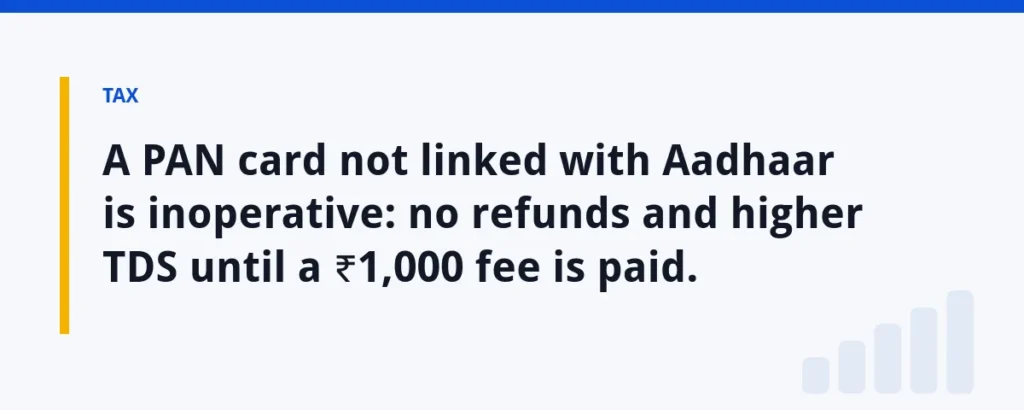
An inoperative PAN is one that has not been linked. It is not cancelled, but you cannot use it as before. The department’s FAQ lists the consequences from 1 July 2023: no refund of tax, no interest on refunds for the period it stays inoperative, and tax deducted at a higher rate where TDS or TCS applies.
Say you earn ₹30,000 a year in FD interest and your PAN is inoperative. Instead of the normal rate, your bank deducts at the higher rate the law prescribes, which cuts your cash flow and gives you a refund claim you cannot collect until the PAN is working again.
To get an inoperative PAN back, pay the fee and intimate your Aadhaar. The FAQ says a fee of one thousand rupees applies to make the PAN operative. The Act now provides for a fee not exceeding ₹1,000 for late intimation of Aadhaar, in section 430. Pay it by challan on the portal and then submit the link request. The PAN becomes operative after the department processes it.
The FAQ page was issued under the old Act and refers to old section numbers. The principle carries over to section 262(6) of the new Act, but check the portal for the current fee and procedure before paying.
When PAN is mandatory in everyday life
Beyond the income tests above, the law lets the Board prescribe transactions where you must quote PAN or Aadhaar in the document. Section 262(9) says a person entering such a transaction must quote PAN or Aadhaar and authenticate it, and the person receiving the document must make sure it is quoted. These transactions are listed in the Income-tax Rules, 2026. The exact list and the value limits are not reproduced here, so check the rules on the portal or ask your bank.
In practice, you will be asked for PAN when you open a bank or demat account, invest in mutual funds, deposit or withdraw large amounts of cash, buy or sell property, or pay for certain high-value purchases. Employers and banks also ask for it so that tax deducted from your salary or interest is credited to the right person.
Section 262(7) adds a useful point. A person who must quote a PAN but has only an Aadhaar number can quote the Aadhaar in its place and will be allotted a PAN in the prescribed manner. And a person whose PAN is already linked can quote the Aadhaar number instead of the PAN. This does not remove the need to get and keep a working PAN, but it eases paperwork in day-to-day dealings.
Penalties and mistakes to avoid
Section 467 of the Act provides a penalty of ₹10,000 where a person fails to comply with section 262. The same amount applies for each default in quoting or authenticating PAN or Aadhaar in a prescribed document, and for knowingly quoting a false number. A person who is responsible for checking that the number was quoted correctly also faces ₹10,000 for each default.
| Problem | What it can cost you |
|---|---|
| Two PANs held | Not allowed under section 262(8); surrender one |
| Failing to link Aadhaar | PAN becomes inoperative; fee up to ₹1,000 to restore |
| Quoting a false PAN in a prescribed document | ₹10,000 for each default |
| Not quoting PAN where required | ₹10,000 for each default |
Keep your PAN, like your Aadhaar, private. Share the number only with banks, brokers, employers and government portals that need it, and never through an unknown link. Our income tax calculator only needs your income, not your PAN.
Key takeaways
- You must get a PAN card if your income crosses the exemption limit, if you file a return, or if your business receipts are likely to exceed ₹5 lakh.
- An individual with an Aadhaar-linked mobile can get an e-PAN free through the instant route, and everyone else applies through NSDL (Protean) or UTIITSL.
- Fix mismatches at the source, whether that is UIDAI for Aadhaar or Protean or UTIITSL for PAN.
- An unlinked PAN becomes inoperative, which stops refunds and raises the rate of tax deducted, and a fee of ₹1,000 restores it.
- You may hold only one PAN, and false or missing quoting in prescribed cases draws a ₹10,000 penalty.
This is general information, not personal advice. Confirm current fees and procedures on the income tax portal.