Every January the payroll team sends the same email: submit your investment proofs, or your take-home pay shrinks for the next three months. If you have stayed with the old tax regime, those proofs are how your employer applies your tax saving deductions, and one missing receipt can mean thousands of rupees of extra TDS. So the questions most families ask are simple. What still counts? How much can I claim? And is the old regime still worth it?
This guide covers the deductions people use most under the old regime: the ₹1.5 lakh investment deduction that everyone still calls 80C, health insurance, the extra ₹50,000 for NPS, education loan interest, home loan interest and donations. From 1 April 2026 the Income-tax Act, 2025 replaced the 1961 Act, so the section numbers have changed even where the rules have not. We give the new numbers only where we checked them against the official text of the Act, and we flag which deductions vanish if you are in the new regime.
First, which regime are you in?
Under section 202 of the new Act, the new tax regime is the default for individuals and Hindu undivided families (HUFs). You are taxed at its slab rates unless you opt out. The new regime slabs for tax year 2026-27 are nil up to ₹4 lakh, then 5%, 10%, 15%, 20% and 25% in steps of ₹4 lakh, and 30% above ₹24 lakh.
The catch is in section 202(2). Income under the new regime is computed without the deductions in Chapter VIII of the Act, apart from a few named exceptions such as the employer’s contribution to your NPS account. It also bars the home loan interest deduction on a self-occupied house. In plain terms, almost every deduction in this guide works only if you choose the old regime.
How you choose depends on your income:
- No business or professional income (salaried people, pensioners, those living on interest or rent): you pick the old regime along with your return each year, so you can switch every year.
- Business or professional income: you exercise the option by the return due date, it carries on to later years, and you can withdraw it only once. After that you cannot opt for the old regime again unless your business income stops.
The ₹1.5 lakh investment deduction: section 123
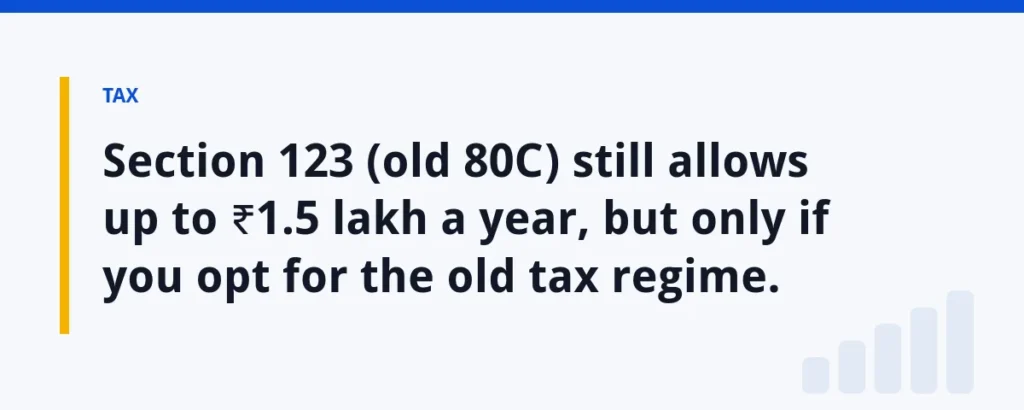
The old Section 80C is now section 123. An individual or HUF can deduct the total of the payments and deposits listed in Schedule XV of the Act, up to ₹1,50,000 in a tax year. This is the biggest of the tax saving deductions for most salaried families, and the limit has not moved.
The Income Tax Department’s own list of what fits inside this single ₹1.5 lakh limit includes:
- Life insurance premium for yourself, your spouse or children
- Provident fund contributions, including your share of EPF and deposits in a PPF account
- Subscriptions to certain equity shares and tax-saving equity funds (ELSS)
- Tuition fees paid for the full-time education of up to two children
- National Savings Certificates
- Repayment of home loan principal
- Payments to a pension annuity plan, and your own contribution to NPS
Two practical points. First, the limit is shared. If your EPF deduction is, say, ₹6,000 a month, that is ₹72,000 a year already used, leaving ₹78,000 for everything else. Many people buy insurance they do not need in March without checking this. Second, the deduction is for money actually paid in the tax year. A premium due in April 2027 does not help your 2026-27 return.
If PPF is part of your plan, our PPF calculator shows how yearly deposits grow. We have a separate guide on PPF itself, so we will not repeat it here.
Health insurance premium: section 126
Health cover is the deduction many people forget, even though it sits outside the ₹1.5 lakh limit. Section 126, the old 80D, allows these amounts:
| Who is covered | Limit (no senior citizen) | Limit (if that person is a senior citizen) |
|---|---|---|
| You, your spouse and dependent children | ₹25,000 | ₹50,000 |
| Your parents | ₹25,000 | ₹50,000 |
| Preventive health check-up (inside the limits above) | Up to ₹5,000 in total | |
So a family that pays premiums for itself and for senior citizen parents can claim up to ₹75,000, and up to ₹1 lakh if the taxpayer or spouse is also a senior citizen. Contributions to the Central Government Health Scheme count in the same bucket as premiums.
If a senior citizen parent has no health insurance at all, the medical bills you pay for them can be claimed, up to ₹50,000 within the same parent limit. Premiums must be paid by any mode other than cash; only the preventive check-up may be paid in cash. If you pay a multi-year policy in one go, the deduction is spread equally over the years the cover runs.
The extra ₹50,000 for NPS: section 124
Section 124(3) gives an additional deduction of up to ₹50,000 for money you pay into your account under the government’s notified pension scheme, which is the National Pension System. This is over and above the ₹1.5 lakh in section 123, but the same rupee cannot be claimed twice. If you put ₹2 lakh into NPS, you could count ₹1.5 lakh under section 123 (if the limit is free) and ₹50,000 under section 124(3).
The Act also lets a parent or guardian count payments into a minor’s pension account, but the combined deduction under the two sub-sections stays at ₹50,000.
There is a separate deduction for your employer’s contribution to your NPS account: up to 14% of salary where the employer is the Central or a State Government, and 10% for other employers. Under the new regime the 10% cap becomes 14% for everyone. This is one of the few deductions that survives in both regimes, so it is worth asking HR whether your company offers it.
As an illustration, someone in the 30% slab under the old regime who puts ₹50,000 extra into NPS cuts the tax bill by ₹15,000 before cess. Remember that NPS money is largely locked in until retirement, with only limited withdrawals before that, and the Act taxes amounts received on closure or exit except where they are specifically exempt.
Education loan interest: section 129
Section 129, the old 80E, lets an individual deduct the full interest paid during the year on a loan for higher education. There is no rupee cap. The conditions are:
- The loan must be from a bank, another notified financial institution or an approved charitable institution. A loan from a relative does not qualify.
- It must be for the higher education of yourself, your spouse, your children, or a student for whom you are the legal guardian.
- Higher education means any course after passing the Senior Secondary (Class 12) examination or its equivalent.
- Only interest counts. The principal you repay gets no deduction here.
The deduction runs for the year you start paying interest and the seven years after it, so eight years at most, or until the interest is fully paid if that is sooner. Say a parent pays ₹1.2 lakh of interest a year on a daughter’s postgraduate loan. In the 30% slab, that is ₹36,000 a year of tax saved before cess, for up to eight years.
Home loan interest and principal
A home loan can give you two separate tax saving deductions under the old regime. The principal you repay counts within the ₹1.5 lakh of section 123. The interest is handled under the house property rules in section 22 of the new Act:
- Self-occupied home: interest is deductible up to ₹2 lakh a year in total, provided the house was bought or built with the loan and the purchase or construction was completed within five years from the end of the tax year in which you borrowed. You need an interest certificate from the lender. In other cases the cap is ₹30,000.
- Interest before possession: interest paid before the year you got the house is allowed in five equal parts over that year and the next four, within the same cap.
- Let-out home: there is no cap on interest, but a resulting loss can be set off against salary or other income only up to ₹2 lakh a year. The rest is carried forward.
Under the new regime you get no interest deduction for a self-occupied home, and a loss from a let-out house cannot be set off against your salary at all. For a family paying ₹2 lakh or more of interest, this one item often decides which regime is cheaper.
Donations to charity: section 133
Section 133, the old 80G, allows a deduction for donations to approved funds and charities. Some, like the Prime Minister’s National Relief Fund, PM CARES Fund and the National Defence Fund, qualify for a 100% deduction. Donations to most registered charitable trusts qualify for 50%, and for several categories the total that counts is capped at 10% of your adjusted gross total income.
Three rules catch people out. Only donations of money count, not goods. Any donation above ₹2,000 must be made by a mode other than cash. And for donations to registered charities, your claim is allowed on the basis of the details the charity reports to the department, so ask for the charity’s donation certificate and check that it carries your PAN.
Other old-regime deductions in brief
A few smaller deductions are also old-regime only. Under the 1961 Act, for the year that ended on 31 March 2026, the limits were:
- Up to ₹10,000 of savings account interest for people below 60
- Up to ₹50,000 of deposit interest for resident senior citizens
- Up to ₹40,000 for treatment of specified diseases (₹1 lakh for senior citizens)
- A deduction for a resident individual with a disability
These carried over into Chapter VIII of the new Act. We have not quoted their new section numbers here, so check the current form instructions when you file.
Old regime or new: which tax saving deductions survive
Here is a quick view of what you keep and what you lose if you switch:
| Deduction | Old regime | New regime |
|---|---|---|
| ₹1.5 lakh investments (section 123) | Yes | No |
| Health insurance (section 126) | Yes | No |
| Own NPS, extra ₹50,000 (section 124(3)) | Yes | No |
| Employer NPS contribution (section 124(1)) | Yes, up to 10% or 14% | Yes, up to 14% |
| Education loan interest (section 129) | Yes | No |
| Home loan interest, self-occupied | Up to ₹2 lakh | No |
| Donations (section 133) | Yes | No |
The new regime has lower rates and wider slabs, so the old one wins only when your deductions are large. A useful habit is to add up what you will actually claim, not what you could claim. A family with ₹1.5 lakh of section 123 items, ₹50,000 of health cover and ₹2 lakh of home loan interest is in a very different place from someone with only EPF. Put both versions into our income tax calculator and compare the final tax, not the slab rates.
Key takeaways
- The new regime is the default; deductions in this guide mostly need the old regime.
- Section 123 (old 80C) still has a single ₹1.5 lakh limit, and EPF often uses much of it.
- Health insurance under section 126 sits outside that limit: ₹25,000 or ₹50,000 each for your family and your parents.
- NPS gives an extra ₹50,000 under section 124(3); employer NPS contributions work in both regimes.
- Education loan interest under section 129 has no cap but lasts at most eight years.
- Keep proofs, pay premiums and large donations through the bank, and compare both regimes every year before you file.
This is general information, not personal tax advice. If your situation is complicated, a chartered accountant can check the numbers for you.