Meera is a freelance designer in Pune. Her clients deduct a little TDS, but most of her fees arrive in full. Last July she filed her return, found she owed ₹90,000, paid it, and was then hit with an interest bill on top. Nobody had told her that tax on income like hers is meant to be paid during the year, in four parts. That system is called advance tax, and it catches thousands of freelancers, landlords, investors and retirees every year.
The idea is simple: if your tax is not fully covered by TDS, you pay it as you earn rather than in one lump after the year ends. This guide explains who must pay, the due dates and percentages, the senior citizen exemption, the special rule for presumptive income, the interest for paying late or too little, and how to pay online. Section numbers are from the Income-tax Act, 2025, which applies from tax year 2026-27.
Who has to pay advance tax
Section 404 of the Act is short: you must pay tax in advance during a financial year if the tax payable for that year, worked out under these rules, is ₹10,000 or more.
The ₹10,000 is not your total tax. Under section 405 you first work out tax on your estimated income for the year, then subtract the tax that will be deducted or collected at source. Only what is left counts. So a salaried person whose employer deducts the right TDS usually has nothing to pay. The people who typically do are:
- Freelancers, consultants and small business owners
- Landlords with sizeable rent where the tenant deducts little or no TDS
- Investors who book capital gains on shares, mutual funds or property
- Salaried people with large interest, rent or other income on the side
- NRIs with taxable Indian income not fully covered by TDS
The senior citizen exemption
Section 403(3) exempts a resident individual who is 60 or older at any time during the tax year and who has no income under the head “Profits and gains of business or profession”. Such a person does not pay advance tax at all and can pay the whole tax as self-assessment tax before filing the return.
Two conditions matter. The person must be resident in India, so a non-resident senior citizen does not get this relief. And there must be no business or professional income. A retired doctor who still runs a clinic, or a retired engineer earning consulting fees, must pay in instalments like anyone else. Pension, interest, rent and capital gains do not take away the exemption.
Advance tax due dates and instalments
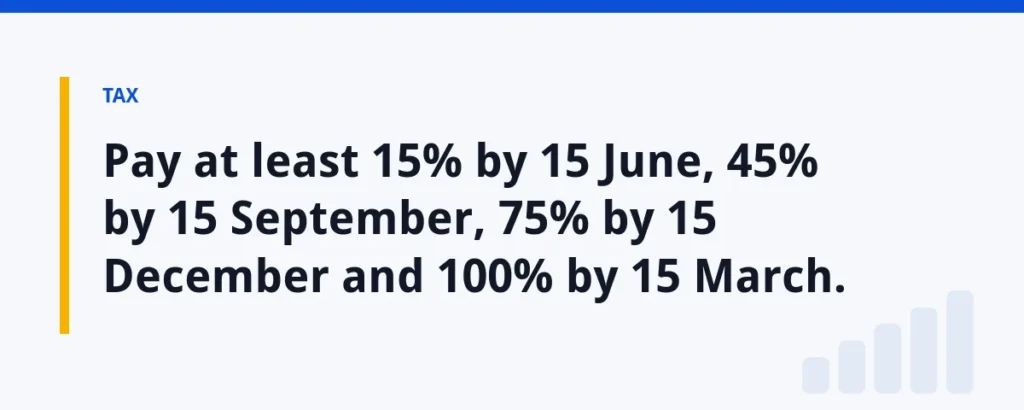
Section 408 sets four instalments for most taxpayers. The amounts are cumulative, which means each date shows how much of your yearly estimate should have been paid by then.
| Due date | Total paid by this date | For tax year 2026-27 |
|---|---|---|
| On or before 15 June | At least 15% | 15 June 2026 |
| On or before 15 September | At least 45% | 15 September 2026 |
| On or before 15 December | At least 75% | 15 December 2026 |
| On or before 15 March | 100% | 15 March 2027 |
Any amount paid on or before 31 March is still treated as advance tax for that financial year. Paying between 16 and 31 March does not avoid interest for the March shortfall, but it does cut the larger interest charge explained below.
Presumptive income: one instalment in March
Small businesses and professionals who declare income under the presumptive taxation scheme in section 58(2) of the new Act (the old sections 44AD and 44ADA) get an easier rule. Section 408(2) lets them pay the whole amount in one go on or before 15 March, instead of four instalments.
This suits a shopkeeper or a small consultant whose income is hard to estimate in June. But if such a taxpayer pays less than the tax due by 15 March, interest at 1% applies on the shortfall, so the single date is not a free pass.
How to work out the amount
There is no form to file. You estimate, pay and adjust as the year goes on. A simple method:
- Estimate your income for the full tax year under each head: salary, rent, interest, business or profession, and capital gains booked so far.
- Work out the tax on it under the regime you plan to use. Our income tax calculator helps here.
- Subtract the TDS and TCS you expect for the year. The balance is what you owe in advance.
- Pay the cumulative percentage due by the next date, and revise your estimate each quarter.
As an illustration, say Meera expects tax of ₹1,40,000 for the year and her clients will deduct ₹40,000 as TDS. Her liability is ₹1,00,000. She should have paid ₹15,000 by 15 June, ₹45,000 in total by 15 September, ₹75,000 by 15 December and the full ₹1,00,000 by 15 March. If a big project comes in during November, she raises her estimate and pays more in December.
Interest if you pay late or too little
The Act has two separate interest charges, and many people end up paying both.
Interest for deferment (section 425)
This applies when an instalment is short. For the June, September and December dates, interest is 3% of the shortfall against 15%, 45% and 75% of the tax due on your returned income. For the March date it is 1% of the shortfall against 100%. There is a small cushion: no interest is charged for the June date if you paid at least 12% of the tax due, or for September if you paid at least 36%.
Interest for default (section 424)
If you paid nothing, or your total paid is less than 90% of the assessed tax, simple interest of 1% a month, or part of a month, runs from 1 April after the tax year until your income is determined, on the unpaid amount. Paying self-assessment tax early stops this clock on the amount paid.
Back to Meera, as an illustration. Suppose she paid nothing in June when ₹15,000 was due. Interest for that instalment is 3% of ₹15,000, which is ₹450. If she skips the whole year and pays ₹1,00,000 only in July, she pays deferment interest on every instalment plus roughly 1% a month on ₹1,00,000 from April to July under section 424. The total can easily run into several thousand rupees for money she owed anyway.
Capital gains, dividends and windfalls
Nobody can predict in June that they will sell a flat in January. Section 425(4) recognises this. No deferment interest is charged on a shortfall caused by under-estimating or not estimating capital gains, dividend income, income from a business or profession that arises for the first time, and a few other items, provided you pay the full tax on that income in the remaining instalments, or by 31 March if no instalment is left.
So if you book a large gain in October, add the tax on it to your December instalment. If the sale happens on 20 March, pay the tax by 31 March. This relief does not cover the section 424 interest if your total payment for the year still falls below 90%.
How to pay advance tax online
Payment is made through the e-Pay Tax service on the Income Tax Department’s e-filing portal, using challan ITNS 280N, the challan for income tax under the new Act.
- Log in to the e-filing portal, or use the e-Pay Tax quick link on the home page with your PAN and an OTP on your mobile.
- Go to e-File, then e-Pay Tax, select the applicable Income-tax Act, and choose New Payment and the Income Tax tile.
- Select the correct year and the minor head Advance Tax (100). Self-assessment tax is a different minor head (300), and each minor head needs a separate challan.
- Enter the amount, choose one of the payment modes shown on the screen, and pay.
- Download the challan receipt. The BSR code, date of payment and challan serial number are also available later under e-Pay Tax, Payment History.
Choosing the wrong year or the wrong minor head is the most common mistake, and it can leave your payment sitting unused while interest is charged. Check both before you pay, and enter the challan details correctly in your return.
Common mistakes and how to avoid them
Most interest bills come from a handful of habits that are easy to fix once you know them:
- Waiting for the final figure. Advance tax is based on an estimate. Nobody expects it to be exact, so pay on a sensible guess in June and correct it later rather than paying nothing.
- Forgetting the cumulative rule. The September figure of 45% includes what you paid in June. If you paid 15% in June, you owe a further 30% by 15 September, not 45%.
- Counting TDS that will not happen. Only subtract tax that will actually be deducted. If a client pays you without deducting TDS, that income is fully yours to pay tax on.
- Ignoring interest income. The TDS a bank deducts on fixed deposit interest can be well below the tax you owe on it if you are in a higher slab. The gap is yours to pay.
- Not revising after a windfall. A bonus from a client, a property sale or a large dividend changes your estimate. Add the tax on it to the very next instalment instead of waiting for March.
Here is a second illustration. Suresh, a retired bank officer aged 58, earns rent of ₹40,000 a month and interest of ₹3 lakh a year. Say his estimated tax is ₹95,000 and the bank deducts ₹30,000 as TDS. His balance of ₹65,000 is above ₹10,000, so he must pay in instalments. Once he turns 60, and as long as he has no business income, the exemption applies and he can settle the balance as self-assessment tax before filing.
A note for salaried people
If salary is your main income, your employer’s TDS usually covers it. Trouble starts when you have side income your employer does not know about: interest on large fixed deposits, rent from a second flat, or gains from selling shares. Tax on these can push your unpaid amount above ₹10,000. Check your Annual Information Statement on the portal around December, add up the extra income and pay the balance by 15 March.
Checklist
- Estimate your tax for the year and subtract expected TDS and TCS; if the balance is ₹10,000 or more, you owe advance tax.
- Resident seniors aged 60 or above with no business income are exempt.
- Pay 15%, 45%, 75% and 100% by 15 June, 15 September, 15 December and 15 March.
- Presumptive taxpayers can pay everything by 15 March.
- Add tax on capital gains to the next instalment after the sale.
- Use ITNS 280N with minor head 100, and keep the challan receipt.
This guide is general information, not personal tax advice.