Rajesh bought a two-bedroom flat in Hyderabad as an investment and let it out for ₹30,000 a month. In his first year he assumed he would pay tax on the full ₹3.6 lakh. He was pleasantly surprised: after property tax, a flat 30% deduction and his home loan interest, the taxable rental income was less than a third of what he had feared. Many landlords either overpay like this or forget to report rent at all, which is worse.
Rent from a house, flat, shop or office you own is taxed under the head “Income from house property”. This guide explains how annual value is worked out, the 30% standard deduction, municipal taxes, home loan interest, the limit on setting off a loss, TDS that tenants must deduct on high rents, and how co-owners are taxed. Section numbers are from the Income-tax Act, 2025, which applies from tax year 2026-27; the rules themselves largely carry over from the 1961 Act.
How rental income is taxed
Section 20 of the Act taxes the annual value of any building, or land attached to it, that you own. It does not matter whether the property is residential or commercial. What matters is ownership: the owner pays tax on the rent, not the person whose name is on the electricity bill.
The one exception is a portion you use for your own business or profession. If a doctor owns a building and runs a clinic on the ground floor, that part is not taxed as house property, because the clinic’s profits are already taxed as business income. The flats she lets out upstairs are.
The calculation follows a fixed order, and it helps to see it before the details:
- Work out the annual value of the property.
- Subtract municipal taxes you actually paid during the year.
- Subtract a flat 30% of what is left.
- Subtract interest on any loan taken to buy, build or repair the property.
Annual value: the starting point
Under section 21, the annual value of a let-out property is the higher of two figures: the rent the property might reasonably be expected to fetch from year to year, and the actual rent received or receivable. In most normal lettings the actual rent is the figure that counts.
A few rules adjust this:
- Vacancy: if the property was let but lay vacant for part of the year, and the actual rent is lower than the expected rent because of that, the actual rent is taken as the annual value.
- Unpaid rent: rent you cannot realise from a tenant is left out of actual rent, subject to the rules.
- Municipal taxes: property taxes levied by the local authority are subtracted from the annual value, but only in the year you actually pay them, whenever they fell due.
- Self-occupied homes: the annual value of a house you live in is nil, for up to two houses you choose. A third house you own and do not let out is taxed on the rent it could reasonably fetch, even though you receive nothing.
The 30% standard deduction
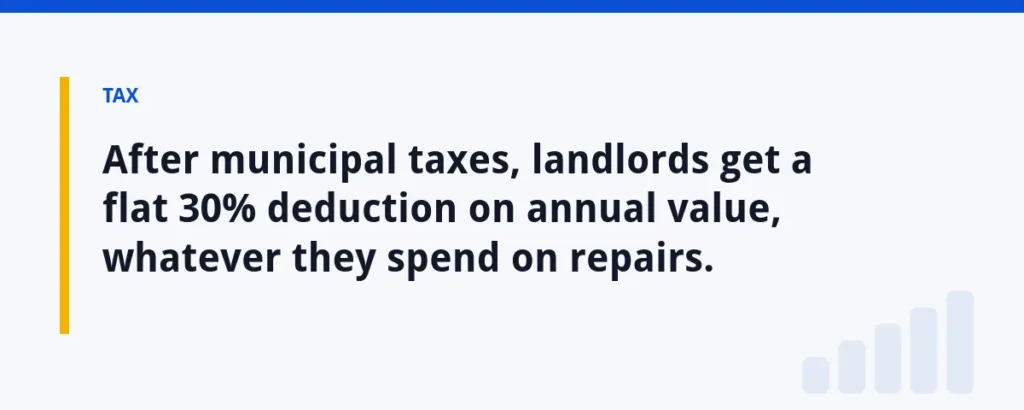
From the annual value left after municipal taxes, section 22 allows a flat deduction of 30%. You get it whether you spent ₹5,000 or ₹5 lakh on the property during the year. It is meant to cover repairs, maintenance, painting and similar costs, so you cannot claim those expenses separately on top of it.
This is the single biggest reason rental income is taxed more lightly than people expect. On a net annual value of ₹3.5 lakh, ₹1.05 lakh is knocked off without a single bill.
Rent that comes in late follows the same idea. Under section 23, arrears of rent, or unpaid rent that you recover later, are taxed in the year you receive them, even if you no longer own the property, and you can deduct 30% of that amount.
A worked example
Here is Rajesh’s flat, as an illustration with round numbers:
| Item | Amount |
|---|---|
| Rent received (₹30,000 x 12) | ₹3,60,000 |
| Less municipal tax paid during the year | ₹10,000 |
| Net annual value | ₹3,50,000 |
| Less 30% standard deduction | ₹1,05,000 |
| Less home loan interest paid | ₹1,50,000 |
| Taxable income from house property | ₹95,000 |
That ₹95,000 is added to his salary and other income and taxed at his slab rate. If you want to see how the loan interest part changes over time, our EMI calculator shows the interest and principal split year by year.
Home loan interest on a rented property
Section 22 allows the interest payable on money borrowed to buy, build, repair or renovate the property. For a let-out property there is no rupee cap on this interest. Interest for the period before you got possession is allowed in five equal parts, starting with the year of purchase or completion.
For a self-occupied home, the interest deduction is capped at ₹2 lakh a year in total, if the house was bought or built with the loan within five years from the end of the tax year of borrowing and you have the lender’s certificate; otherwise the cap is ₹30,000. The principal repaid is not part of this calculation. Under the old regime it counts towards the ₹1.5 lakh investment deduction in section 123.
One limit applies to interest payable outside India: it is not allowed if tax was neither paid nor deducted on it and there is no agent in India for the lender.
When the result is a loss
With a big loan and modest rent, interest can exceed the rent, giving a loss under house property. Section 109 lets you set off such a loss against salary or other income only up to ₹2 lakh in a tax year. Any loss above that is carried forward under section 110 for up to eight tax years, and in those later years it can be set off only against income from house property.
The tax regime matters a lot here. Under the new regime, section 202 does not allow a loss under house property to be set off against any other head of income, and gives no interest deduction for a self-occupied home. Interest on a let-out property still reduces the rental income itself. Investors with large loans often find the old regime works better; compare both in our income tax calculator.
TDS by tenants on rent above the threshold
Tenants paying high rent must deduct tax before paying you. Under section 393, the rules depend on who the tenant is:
| Tenant | TDS rate on rent of building | Threshold |
|---|---|---|
| Individual or HUF who is not a “specified person” (most salaried tenants) | 2% | Rent above ₹50,000 for a month or part of a month |
| Specified person (companies, firms, and individuals or HUFs whose business turnover exceeded ₹1 crore or professional receipts exceeded ₹50 lakh in the previous year) | 10% | Rent above ₹50,000 for a month or part of a month |
For the ordinary individual tenant, TDS is deducted once, when the rent for the last month of the tax year or the last month of the tenancy, whichever applies, is credited or paid. Say a family pays you ₹60,000 a month for the whole year. As an illustration, 2% of ₹7.2 lakh is ₹14,400, deducted from the March rent.
The tenant must give you a TDS certificate, Form No. 132 for this kind of deduction under the new rules, and the amount should appear in your Form 26AS and AIS. You claim it as a credit in your return. TDS is not an extra tax; it is an advance payment of your own tax.
Co-owners: each pays on their share
Many couples and siblings own property jointly. Section 24 says that where the shares are definite and ascertainable, co-owners are not taxed as a group. Each person’s income from the property is worked out separately on their share and added to their own income. The self-occupied relief is also available to each co-owner individually.
As an illustration, if a husband and wife own a let-out flat 50:50 and the taxable income from it is ₹2 lakh, each reports ₹1 lakh. If both are co-borrowers on the loan, each claims interest on what they actually pay. Splitting income this way can lower the family’s total tax when one spouse is in a lower slab, but the shares must be genuine and backed by the purchase documents.
Reporting rental income without mistakes
Rent you receive is already visible to the department in many cases. When a tenant deducts TDS, it shows up against your PAN in Form 26AS and in your Annual Information Statement (AIS). If your return shows no rent while the AIS shows TDS on rent, expect a question. A few habits keep you safe:
- Report every property. Each let-out property is shown separately in the return, with its rent, municipal taxes and interest. A third house that sits empty must also be shown, at the rent it could reasonably fetch.
- Claim the tenant’s TDS. Check the AIS before filing. If the tenant deducted tax but it is missing, ask them to correct their filing, because your credit depends on what is reported against your PAN.
- Watch advance tax. Rent usually comes without much TDS. If the tax on your total income, after TDS, is ₹10,000 or more, you are expected to pay it in instalments during the year, not in one go when you file.
- Keep the paperwork. The rent agreement, bank statements showing rent received, property tax receipts and the lender’s interest certificate are what you will need if the department asks.
- Do not double count. Repairs and upkeep are already covered by the 30% deduction, and home loan principal belongs in the investment deduction, not in the house property working.
Key takeaways
- Rental income is taxed on annual value: the higher of expected rent and actual rent, with relief for vacancy and unpaid rent.
- Municipal taxes are deducted in the year you pay them, then a flat 30% covers all repairs and upkeep.
- Home loan interest on a let-out property has no cap; on a self-occupied home it is limited to ₹2 lakh.
- Under the old regime a house property loss can reduce other income by only ₹2 lakh a year, with the rest carried forward for up to eight years; under the new regime it cannot be set off against other income at all.
- Individual tenants paying above ₹50,000 a month deduct 2% TDS once a year; businesses above the turnover limits deduct 10%.
- Co-owners with clear shares are taxed separately on their own share.
Keep the rent agreement, rent receipts, municipal tax receipts and the lender’s interest certificate. This guide is general information, not personal tax advice.