Every June, salaried people across India start asking HR the same question: has my Form 16 come yet? It is the document most of us use to file the income tax return, and it is the employer’s official record of how much salary it paid you and how much tax it deducted. If the numbers in it are wrong, your return can go wrong too, so it pays to read it rather than just upload it.
This guide explains what is in Part A and Part B, when your employer must issue the certificate, how to match it with Form 26AS and the Annual Information Statement (AIS), what happens when you have more than one employer in a year, and what to do if you spot an error. It also covers the name change: under the new income tax rules, the salary TDS certificate for tax year 2026-27 onwards is called Form 130.
What Form 16 is
Form 16 is a certificate of tax deducted at source (TDS) on salary. Your employer deducts tax from your salary every month, deposits it with the government and, after the year ends, gives you this certificate as proof. A specified bank that deducts tax from a senior citizen’s pension and interest also issues it.
The Income Tax Department describes it simply: it tells you your income, the exemptions and deductions your employer allowed, and the tax deducted, so you can work out whether you owe more tax or are due a refund. It is not filed with your return. You use it to fill in the return and to check the figures the portal pre-fills.
Form 16 is different from Form 16A, which is the certificate for TDS on income other than salary, such as interest or professional fees. If your bank deducts TDS on fixed deposit interest, that shows up on a separate certificate, not on Form 16.
Part A: the tax deducted
Part A is the record of tax deducted and deposited. It is generated and downloaded by your employer from TRACES, the TDS portal of the Income Tax Department, using the TDS returns the employer has filed. That is why Part A is the more reliable half: it shows what the department has actually received against your PAN.
Two practical points follow from how Part A is produced:
- A valid PAN is essential. TRACES cannot generate Part A without a valid PAN. If your employer did not have your PAN, tax may have been deducted at a higher rate, and the employer has to file a correction statement with your PAN before the certificate can be produced.
- Part A follows the TDS return. If the employer deducted tax but did not report it properly in its quarterly return, it will not appear correctly in Part A or in your tax credit statement.
Part B: your salary and deductions
Part B is the detailed working. The department says it includes details of your salary such as allowances, deductions and rebates. In practice this is where you see gross salary, exempt allowances like house rent allowance, the standard deduction, the deductions you declared to your employer, the taxable income and the tax on it.
Part B is only as good as the information you gave HR. If you never submitted your investment proofs or rent receipts, Part B will not show those deductions, even if you are entitled to them. You can still claim valid deductions in your return; Form 16 is the employer’s working, not the final word.
If your perquisites matter, such as a company car or accommodation, the employer gives the details in a separate statement, Form 12BA, where salary paid or payable is above ₹1,50,000. In other cases the information goes into Form 16 itself.
When your employer must issue Form 16
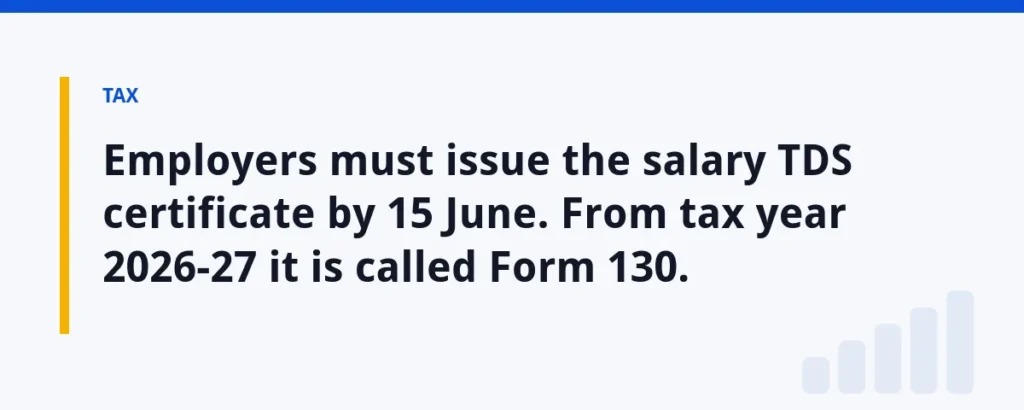
The deadline is 15 June of the financial year after the year in which the salary was paid and tax was deducted. For salary paid in the year ended 31 March 2026, that means by 15 June 2026. The same 15 June deadline applies to the new Form 130 for tax year 2026-27, so you should receive it by 15 June 2027.
The employer must verify both parts before issuing them. It can sign by hand or digitally. A digitally signed certificate cannot be changed after signing, carries a control number, and the employer keeps a log of certificates issued. If you lose your copy, the rules for Form 130 allow the employer to issue a duplicate marked as such on your request.
Note that the obligation arises where the employer has deducted tax from your salary.
Form 130: the new name from tax year 2026-27
The Income-tax Act, 2025 came into force on 1 April 2026, and the Income-tax Rules made under it renumbered the forms. Rule 215 of the new rules says the certificate for tax deducted from salary is Form No. 130, due by 15 June after the tax year. The certificate for most other TDS, the job Form 16A used to do, is Form No. 131.
| Period | Salary TDS certificate | Due date |
|---|---|---|
| Year ended 31 March 2026 (under the 1961 Act) | Form 16 (Part A and Part B) | 15 June 2026 |
| Tax year 2026-27 onwards (under the 2025 Act) | Form 130 (Parts A, B and C) | 15 June after the tax year |
The purpose is the same: proof of the salary paid and the tax deducted. The structure has three parts instead of two. For the year you are filing for now, you will still see the familiar Form 16; Form 130 shows up from mid-2027. Many people will keep calling it Form 16 for years, and that is fine as long as you know they are the same thing.
Matching Form 16 with Form 26AS and AIS
Before you file, compare the TDS in your certificate with what the department has on record. There are two places to look:
| Document | Who prepares it | What it shows |
|---|---|---|
| Form 16 / Form 130 | Your employer | Salary, deductions allowed, tax deducted |
| Form 26AS (annual tax statement) | Income Tax Department, on TRACES | TDS and TCS credited against your PAN |
| Annual Information Statement (AIS) | Income Tax Department, on the e-filing portal | TDS plus interest, dividends, share and property deals and more, with a feedback option |
The check is simple. The salary and TDS in Part A should match the salary TDS entry against your employer’s TAN in Form 26AS and in AIS. If they match, you are fine. If the TDS in your certificate is higher than what Form 26AS shows, take it seriously: the department restricts the tax credit you can claim in your return to the amount reflected in Form 26AS.
AIS also lets you give feedback if an entry is wrong, and shows both the reported value and the value after your feedback. That is useful for interest or other income, but for a salary TDS gap the fix has to come from your employer.
If you had more than one employer
Changing jobs mid-year is common, and it is where most Form 16 surprises happen. Each employer must give you Part A for the period you worked there. For Part B, you can take one from each employer or only from the last one. Under the new Form 130, each employer issues Parts A and B for its own period, and Part C may come from each employer or only from the last, at your choice.
The trap is that each employer usually calculates TDS as if its salary were your only income. Both may give you the standard deduction and the benefit of the lower slabs. Add the two salaries together and you may find you owe extra tax.
As an illustration, say you earned ₹6 lakh with your first employer and ₹9 lakh with the second, and neither deducted much tax on the assumption that it was your only job. Combined income of ₹15 lakh can mean a tax bill well above the TDS deducted. Run your total through our income tax calculator, and if there is a gap, pay it as self-assessment tax before you file. Better still, give your new employer the salary and TDS figures from your old job when you join, so it can deduct the right amount for the rest of the year.
What to do if Form 16 has errors
Errors fall into three groups, and each has its own fix.
- Wrong or missing PAN, or TDS missing from Form 26AS. Tell your employer in writing. The employer needs to file a correction or revised TDS return. Once it is processed, the credit appears in Form 26AS and a corrected certificate can be issued.
- A deduction you are entitled to is missing from Part B. Claim it in your return, provided you have proof, such as premium receipts or rent receipts. The return is what the department processes. Our HRA calculator helps you work out the rent exemption if HR missed it.
- Salary figures look wrong. Ask HR for the working. If the salary is overstated and TDS was reported on it, the employer must correct its TDS return; if understated, report the right income in your return and pay any extra tax.
If you have already filed and the credit later turns out short, the department’s guidance is the same: the employer files a revised TDS return. Depending on the stage, you can then file a revised return, or a rectification request if you have already received the intimation after processing.
Do you need Form 16 to file your return?
Strictly, no. The certificate is not uploaded with your return, and the return form does not ask for a copy. What you need is the right numbers. The e-filing portal pre-fills much of the return using the Taxpayer Information Summary, which is built from the AIS after taking into account any feedback you have given. Salary and TDS reported by your employer usually flow in from there.
That is exactly why the certificate still matters. It is the only document that shows how your employer arrived at the taxable salary: which allowances it treated as exempt, which deductions it allowed and which regime it used. If the pre-filled figure looks odd, Part B is where you find out why. Keep the certificates for at least as long as your return can be reopened, along with your proofs of investment and rent.
Checklist before you file
- Check your name, PAN and the employer’s TAN on the certificate.
- Match salary TDS in Part A with Form 26AS and AIS.
- Check that Part B shows the deductions and exemptions you claimed, and keep proofs for any you add in the return.
- If you changed jobs, collect certificates from every employer and add the salaries.
- Remember the name change: Form 130 replaces Form 16 from tax year 2026-27.
- Raise errors with HR early, well before the return due date.
This guide is general information, not personal tax advice.