A relative tells you about a company bond paying 9.5% a year, monthly interest, “safer than shares”. Before you transfer ₹1 lakh, you need to know what you are really lending to, how the price can move, and how the interest is taxed. Corporate bonds and non-convertible debentures (NCDs) can be a sensible part of a family portfolio, but only when you understand the trade you are making: a higher fixed income in exchange for credit risk and, often, poor liquidity.
This guide explains how corporate bonds work, what coupon and yield mean, why prices fall when interest rates rise, how to read a credit rating, the difference between secured and unsecured NCDs, where individuals can buy them, and how the income is taxed under the Income-tax Act, 2025. It is general information, not a recommendation to buy any bond.
How corporate bonds work
A bond is a loan you give to the issuer. A company, a bank, a non-banking finance company or a public sector body borrows money from investors and promises two things: regular interest (the coupon) and repayment of the face value on the maturity date. An NCD is simply a debenture that cannot be converted into shares. In everyday talk, “bond” and “NCD” are used for the same kind of instrument.
Four terms describe almost every bond:
- Face value: the amount the issuer will repay at maturity for each bond, say ₹10,000.
- Coupon: the interest rate on the face value. A 9% coupon on ₹10,000 pays ₹900 a year, whether monthly, quarterly or annually as the terms say.
- Maturity: the date the principal comes back, for example three or five years from issue.
- Call or put option: some bonds let the issuer repay early (call) or let the investor ask for early repayment (put) on set dates.
Some bonds are cumulative: instead of paying interest out, they add it up and pay everything at maturity. Zero-coupon bonds pay no interest at all; they are issued at a discount and redeemed at face value, and the difference is your return.
Coupon, yield and price: why interest rates matter
The coupon is fixed when the bond is issued. The price at which the bond trades later is not. If interest rates in the economy rise after you buy, new bonds will offer higher coupons, so your older, lower-coupon bond becomes less attractive and its market price falls. If rates fall, your bond’s price tends to rise. This see-saw is the single most important idea in bond investing.
Yield is the return you actually earn based on the price you pay. Yield to maturity (YTM) adds up all future coupons and the final repayment and works out the annual return at today’s price. Take an illustration with round numbers:
| Price you pay for a ₹10,000 bond with a 9% coupon | Yearly coupon | Current yield (coupon ÷ price) |
|---|---|---|
| ₹10,000 (at par) | ₹900 | 9.0% |
| ₹9,500 (discount) | ₹900 | about 9.5% |
| ₹10,500 (premium) | ₹900 | about 8.6% |
If you buy at a discount, you also gain ₹500 at maturity, so the YTM is higher still. If you hold to maturity and the issuer pays in full, price swings in between do not matter to you. They matter if you need to sell early. Longer-maturity bonds swing more for the same change in rates, which is why a ten-year bond is riskier on price than a two-year one.
Credit ratings: reading the letters
Corporate bonds offered to individuals usually carry a credit rating from a rating agency registered with SEBI. SEBI describes a rating as the agency’s opinion on how likely it is that the debt will be repaid in full and on time. For long-term debt, the scale runs from AAA at the top, which SEBI describes as the highest degree of safety and the lowest credit risk, through AA, A, BBB, BB, B and C, down to D, which means the instrument is in default or expected to be.
Three things to remember:
- A rating is not a recommendation to buy, hold or sell. SEBI says this in plain words, and expects you to do your own analysis.
- Ratings change. A bond rated AA at issue can be downgraded later, and a downgrade usually pushes its market price down.
- Yield and risk travel together. If one AA bond pays 2 to 3 percentage points more than other bonds with the same rating and tenure, the market is telling you something about it.
Secured vs unsecured NCDs
A secured NCD is backed by a charge on specific assets of the issuer, such as loan receivables or property. If the company defaults, the debenture trustee can act on that security on behalf of holders. An unsecured NCD has no such charge; you rank as an ordinary creditor. Some unsecured issues are also subordinated, which means they are repaid only after senior lenders, and in a public issue they often pay a slightly higher coupon for that reason.
Security reduces loss but does not remove it. In a default, recovery can take years and may be partial. For a family investor the practical rule is simple: compare the extra coupon on an unsecured or subordinated NCD with the extra risk you take, and do not let any one issuer become a large slice of your savings.
Where individuals can buy corporate bonds
Public issues
Companies raise money through public NCD issues that stay open for a few days, with a prospectus that sets out the coupon options, tenure, rating, security and use of funds. You apply through your bank or broker in the same way as a share issue, and the NCDs are credited to your demat account and listed on a stock exchange. Read the offer document, especially the risk factors and the section on who gets priority in repayment.
Secondary market on the stock exchange
Listed NCDs and bonds can be bought and sold through your broker like shares. The catch is liquidity. Many bonds trade rarely, so you may see wide gaps between buy and sell prices, or no trade at all for days.
Online bond platform providers
Online bond platform providers (OBPPs) are apps and websites that let individuals buy listed debt securities. Under SEBI’s framework of 14 November 2022, such platforms must be registered with a stock exchange. In a press release in November 2025 SEBI warned the public that some fintech firms and brokers were offering bond platform services without registration, and that such platforms offer no investor protection or grievance mechanism. Before you transact, check the platform’s name in the lists of registered OBPPs on the SEBI, NSE and BSE websites.
Minimum face value rules
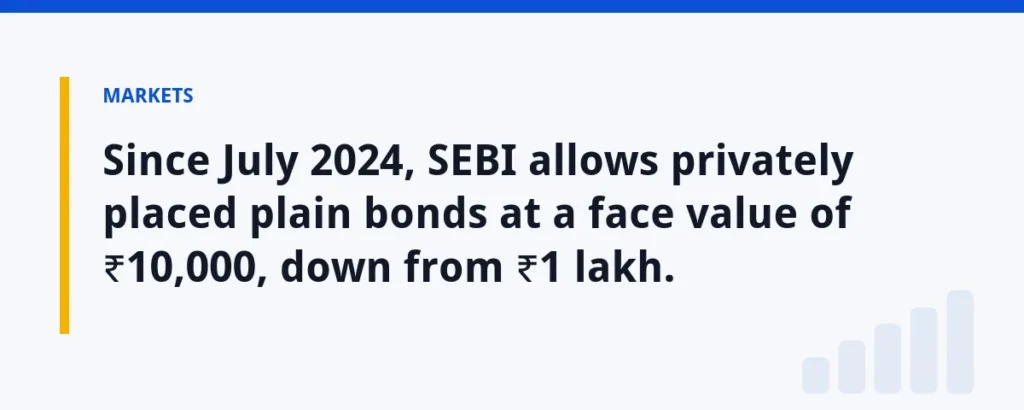
Bonds placed privately with investors used to come in large lots, which kept most individuals out. SEBI cut the face value of privately placed debt securities from ₹10 lakh to ₹1 lakh in October 2022, and in July 2024 allowed issuers to use a face value of ₹10,000. The lower face value comes with conditions: the issuer must appoint at least one merchant banker, and the bond must be a plain interest-paying security with regular coupons and a fixed maturity, without structured features. The trading lot of such listed bonds must always equal the face value, so you can buy a single ₹10,000 bond. Public issues set their own face value in the offer document. These are the rules in the SEBI circulars we checked; SEBI revises debt market rules from time to time, so check the current position before you invest.
Liquidity and the new liquidity window
Because many corporate bonds trade thinly, SEBI introduced an optional “liquidity window” facility in October 2024. An issuer may offer investors a put option on pre-set dates, starting only one year after issue. Each window stays open for three working days and can run monthly or quarterly, as disclosed in the offer document. The issuer must set aside at least 10% of the issue size for such put options over the bond’s life, and may decide whether the facility is for all investors or only retail investors, defined as holders with an aggregate face value of not more than ₹2 lakh. You need to hold the bonds in demat form to use it. Check the offer document; most older bonds do not have this feature.
Risks you should weigh
- Credit risk: the issuer may delay or fail to pay interest or principal. This is the big one for NCDs from finance companies and smaller firms.
- Interest rate risk: if rates rise, the market price of your bond falls, which hurts only if you sell before maturity.
- Liquidity risk: you may not find a buyer at a fair price when you need money.
- Reinvestment and call risk: if the issuer repays early when rates fall, you have to reinvest at lower rates.
- Concentration risk: putting a large amount in one issuer or one sector, such as non-banking lenders, magnifies any single default.
Unlike a bank fixed deposit, corporate bonds and NCDs have no deposit insurance. Spreading money across issuers, sticking mostly to higher ratings and matching maturity with when you need the money are the basic defences. If you want to compare a bond’s income with a bank deposit, the FD calculator and the compound interest calculator give a quick picture.
How corporate bonds are taxed
Interest from corporate bonds and NCDs is taxed as income from other sources at your slab rate. There is no special lower rate. Tax is deducted at source on “interest on securities” once the interest paid to you by an issuer crosses ₹10,000 in a tax year, and for a resident individual the TDS rate on interest from listed debentures is 10%. TDS is only an advance; you still pay the balance at your slab when you file your return.
Gains on selling or redeeming a bond follow the capital gains rules:
| Type of bond | Holding period | How the gain is taxed |
|---|---|---|
| Listed bond or NCD | Up to 12 months | Short-term gain, added to income and taxed at slab rate |
| Listed bond or NCD | More than 12 months | Long-term gain, taxed at 12.5% without indexation |
| Zero-coupon bond | More than 12 months | Long-term gain at 12.5% |
| Unlisted bond or debenture (transferred or redeemed on or after 23 July 2024) | Any period | Treated as short-term gain, taxed at slab rate |
Two points catch people out. First, if you buy a listed bond in the market just before an interest date, the full coupon is taxed in your hands as interest, while the higher price you paid shows up later as a lower capital gain. Second, market linked debentures are treated as short-term regardless of holding period. Our separate guide on capital gains covers set-off of losses and other details; you can also estimate your overall tax with the income tax calculator.
Key takeaways before you buy
- Know exactly who is borrowing your money and whether the NCD is secured, unsecured or subordinated.
- Treat the credit rating as a starting point, not a guarantee, and look at why a bond pays more than its peers.
- Buy only through a broker or an OBPP whose registration you have checked on the SEBI, NSE or BSE lists.
- Assume you may have to hold to maturity; check whether the bond offers a liquidity window.
- Remember that interest is taxed at your slab rate, and TDS applies once interest from an issuer crosses ₹10,000 in a year.
- Spread money across issuers so that one default does not dent your plans.
Used carefully, corporate bonds can add steady income alongside deposits and debt funds. Used carelessly, a chase for an extra 2% can cost you your capital.