You have shares sitting in one demat account and you want them in another, perhaps because you are moving to a different broker, merging a spouse’s holdings with yours, or tidying up old accounts. The question is how to transfer shares between demat accounts without selling them and buying again. The answer is an off-market transfer: an instruction that moves the securities directly from one account to another, outside the stock exchange.
The mechanics are set by the two depositories, CDSL and NSDL, and by SEBI. Since December 2023 there is one extra step that trips up many first-timers: the receiving account must be added as a beneficiary first, with an OTP. This guide walks through the process in order, explains what an unfinished or mismatched instruction does, where stamp duty and tax can come in, and what the charges look like. It is general information, not personal advice.
What an off-market transfer is
NSDL describes off-market trades as trades that are not settled through an exchange’s clearing corporation. When you buy on the exchange, the shares arrive through that settlement system. In an off-market transfer, you simply instruct your depository participant (DP, the broker or bank that holds your demat account) to debit your account and credit another one.
Three common situations use it: moving your own holdings to a new account, a gift or family transfer such as a parent passing shares to a child, and a private sale at an agreed price. The first two have no price attached; the third does, and that changes the stamp duty position.
Transfers can happen within one depository (CDSL to CDSL, NSDL to NSDL) or across depositories (CDSL to NSDL or the reverse). The second kind is called an inter-depository transfer. CDSL’s operating instructions for its participants treat it as a separate process, and it requires the delivery slip to carry the other depository’s DP ID and client ID.
Before you start: details to have ready
Gather these before you open the form or the app.
- The receiving account’s DP ID and client ID. Copy them from the receiving account’s holding statement, not from memory.
- The PAN of the receiving account holder. NSDL checks the PAN, DP ID and client ID of a receiving NSDL account against its own records when you add it.
- The ISIN and quantity of each security you want to move.
- Your registered mobile number and email on the sending account, because the OTP goes there.
- Enough free balance. Shares that are pledged for a loan or margin are not free and cannot be moved until released.
Step 1: add the receiving account as a beneficiary
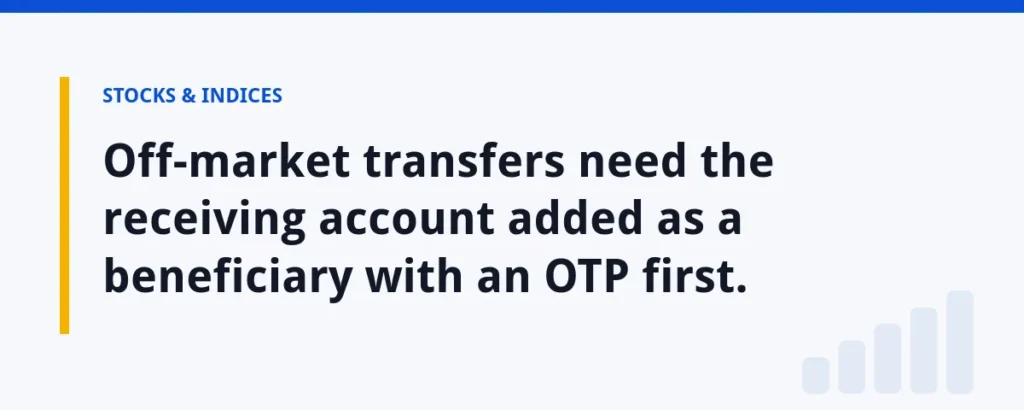
SEBI’s August 2023 circular on erroneous transfers asked depositories to provide a facility to add and verify beneficiaries before off-market transfers, including inter-depository ones. NSDL’s December 2023 circular put this into operation. CDSL’s DP manual now says plainly that off-market transfers are allowed only to transferee accounts that have been added as beneficiaries to the transferor’s account.
The process, as described by the depositories, runs like this.
- You ask your DP to add the receiving account, either on a prescribed request form (paper or digitally signed) or online through the depository’s own login. CDSL participants can also do it through the client’s Easiest login or mobile app.
- The depository sends a link or OTP to the mobile number and email registered on your sending account.
- The receiving account is added once you confirm the OTP.
- If an NSDL request is not confirmed by the end of the day it was raised, it is rejected, and the DP has to start it again.
You can also remove a beneficiary later, again with an OTP. The point is protection: a wrong or fraudulent destination cannot be used unless you approved it.
Step 2: give the delivery instruction
Next comes the instruction that actually moves the shares. There are two routes.
The paper route: delivery instruction slip
The delivery instruction slip (DIS) is the booklet your DP issues. You fill in the receiving account’s DP ID and client ID, the ISIN and quantity, an execution date, and sign exactly as on your account records. CDSL’s manual notes that a transfer between two CDSL accounts can be set up on a DIS received from either the sender or the receiver. NSDL’s page speaks of a delivery instruction form for the sender and a receipt instruction for the receiver, and says the details in the two must match or the transfer will not happen.
A mismatch in the execution date also causes a rejection, according to NSDL, even when everything else matches. If the receiver has opted for a purchase waiver (CDSL’s term for accepting credits without a separate confirmation), no separate receipt instruction is needed in CDSL.
The online route: Easiest and SPEED-e
If your DP is registered for the depository’s online facility, you can submit the instruction yourself. CDSL’s facility is called Easiest and NSDL’s is SPEED-e. Reports on an NSDL circular from early 2026 say password-based SPEED-e users can now start off-market transfers online with OTP authorisation; check with your DP.
Step 3: the OTP and execution
This is where the depository’s own check happens. CDSL says all off-market transactions go through OTP verification unless the reason code is on an exempted list. The instruction stays in a “pending for OTP authentication” status until the sender confirms. If the sender does not authenticate by the end of the execution date, the transaction is rejected.
Timing rules in CDSL’s manual are specific:
- An instruction with the current business date is processed immediately after OTP authentication.
- If you give a Sunday or holiday date, the DP can enter the next available date.
- A future-dated instruction cannot carry an execution date more than 10 days after it is entered.
- If your free balance is short on the execution date, the instruction waits as “overdue” and is retried through the day. If the balance does not turn up by the end of the day, it fails. A partial quantity is not transferred.
Cut-off times differ by DP, so ask yours.
Charges you can expect
Several different charges sit around an off-market transfer, and people often mix them up.
| Charge | Who sets it | What to know |
|---|---|---|
| DP transaction (debit) charge | Your DP, under its tariff | Varies by DP. Ask for the per-ISIN or per-transaction fee before you submit. |
| CDSL’s charge to the DP | CDSL | A flat ₹3.50 per debit transaction from 1 October 2024, with small discounts for some cases. Not the fee you pay. |
| Stamp duty | Indian Stamp Act, collected by the depository | Applies only when the transfer is made for a consideration. See below. |
| Closure or account charges | Your DP | Check whether closing the old account has its own fee. |
One line in CDSL’s tariff is worth knowing. It says no charge is levied for transferring all securities from one account with a DP to another account with another DP if both accounts are held in identical order of names. Read it carefully: it is part of CDSL’s tariff for debit transactions, so it describes CDSL’s own fee to the DP, not a promise about what the DP bills you. Still, if you are moving everything to a new account in your own name, ask the old DP whether it will waive its charge.
Stamp duty: when it applies
Stamp duty on securities was brought into a single system from 1 July 2020. SEBI’s FAQ on the Indian Stamp Act amendments explains that for off-market transactions made for a consideration disclosed by the parties, the depositories collect the duty. NSDL’s calculator page states that in an off-market transaction the transferor pays it.
The rate comes from Schedule I of the Act. An NSDL extract shows 0.015% for transfer of a security other than a debenture on a delivery basis. As an illustration, if you sell shares worth ₹2,00,000 to a friend off-market at an agreed price, the stamp duty would be ₹2,00,000 x 0.015% = ₹30. It is small, but it must be paid before the instruction is executed.
SEBI’s FAQ also answers the question many families ask. It says stamp duty is not charged on off-market transfers without consideration, such as a gift or a legacy transfer, because the duty is collected on market value based on price or consideration involved. So a plain move between your own accounts, or a gift to a relative, carries no stamp duty on that logic. Tell your DP clearly which reason applies.
Income tax: a transfer is not always a sale
An off-market transfer is only a movement in the records. Whether it triggers tax depends on why you did it.
- Moving to a new account in your own name. You have not sold anything at a price, so there is no sale to tax. Keep your purchase dates and costs on record, since the new account may not show them.
- Gift to a relative. The Income Tax Department’s guidance, as summarised in search results, says a gift is not treated as a transfer for capital gains, so the giver has no capital gain, and the receiver inherits the giver’s cost and holding period when selling later. The receiver’s own tax position on the gift is a separate question; see our guide on tax on gifts in India.
- Private sale. This is a sale. Capital gains tax applies as for any sale, and the buyer-seller price should be a genuine one. Our guide to capital gains tax on shares and mutual funds covers the rates.
The Income-tax Act, 2025 governs from 1 April 2026 with new section numbers, so avoid relying on old references.
Moving across depositories and fixing mistakes
For a CDSL account sending to an NSDL account (or the reverse), the sender’s DP sets up an inter-depository instruction. CDSL’s manual says the DP must verify the other depository’s DP ID and client ID on the slip. NSDL’s circular adds that for such transfers the PAN and IDs of the receiving account are not checked when the beneficiary is added; the receiving depository checks them when the instruction is processed. A typo may therefore surface late.
What if shares go to the wrong account? CDSL’s manual describes a reversal process: the depository may advise the receiving DP to reverse the transfer after the documentation is complete, and the DP must give the receiving holder 24 hours’ notice before debiting. If the receiving holder does not co-operate, a joint committee of the depositories examines the case on documents and a hearing. It works but is slow, which is why the beneficiary step matters.
Practical sequence and pitfalls
Here is a sensible order that avoids most problems. Open the new account and confirm that its KYC is active. Add it as a beneficiary on the old account and complete the OTP. Start with one small holding as a test, then move the rest.
- Check that the names on both accounts are in the same order if you hope for a charge waiver.
- Never share an OTP with anyone calling to “help” you transfer shares.
Our guide on demat account basics explains what else sits on an account.
Key takeaways
- An off-market transfer moves shares directly between two demat accounts, within or across CDSL and NSDL.
- The receiving account must first be added as a beneficiary, confirmed by an OTP sent to the sender.
- CDSL rejects an instruction if the sender does not authenticate by the end of the execution date; a future date cannot be more than 10 days out.
- Stamp duty applies when there is a consideration (0.015% on delivery-based transfers), and not on a gift or legacy transfer.
- Charges are set by your DP; ask first and keep your cost records safe.
If you are weighing a sale against a transfer, you can test the numbers in our lumpsum calculator first.