What happened
The Sensex ended Friday, 6 November, at 81,028.02, up 1,718 points or 2.17%. The Nifty 50 closed at 25,030.35, up 494 points or 2.01%, according to the Times of India. It was the seventh session in a row of gains for both indices.
The rise came as global equities sold off. The Times of India reported that the Nasdaq fell 6%, its steepest drop since March 2020, and South Korea’s Kospi dropped more than 9%, triggering a circuit breaker (a automatic trading halt after a large fall). The selling followed the Democratic Party’s win of control of Congress in the US midterm elections, which raised worries about tighter regulation of AI companies.
Why Indian shares rose
- Foreign buying. Foreign institutional investors bought a net ₹14,975 crore of Indian shares on Thursday, per provisional NSE data, the largest single-day net purchase in many years according to the Times of India. Business Today, citing NSDL data, reported that foreign portfolio investors had pulled out ₹34,843 crore in October and ₹35,861 crore in September.
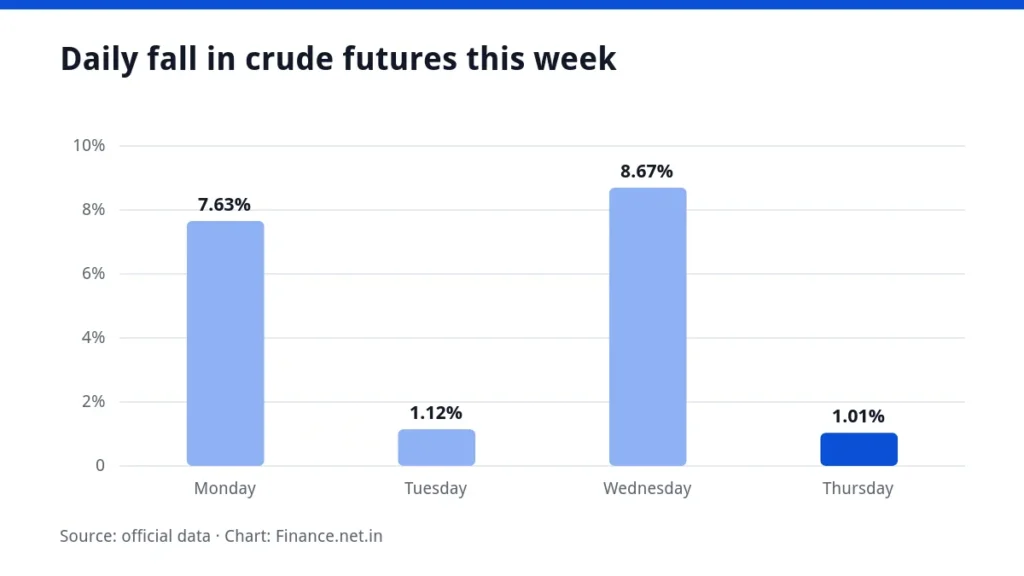
- Cheaper crude. Business Today reported crude futures fell 7.63% on Monday, 1.12% on Tuesday, 8.67% on Wednesday and 1.01% on Thursday, to $93.66 a barrel, a cumulative fall of 18% for the week. Hopes of US-Iran peace talks were cited as a driver.
- Easing yields and a firmer rupee. The 10-year US Treasury yield slid to about 4.89%, and the US dollar had its worst day in two months, Business Today reported. Geojit’s Vinod Nair said a sharp weekly slide in crude, easing Treasury yields and a firmer rupee added to India’s appeal.
- Earnings. Per Business Today, the 35 Nifty companies that had reported so far showed earnings growth of 22% year on year, against MOFSL’s estimate of 20%. Mahindra & Mahindra rose more than 5% on the Sensex after strong second-quarter results.
- Tax hopes. Both outlets cited hopes of relief on long-term capital gains (LTCG) tax, including possible tax relief in the upcoming Union Budget.
What it means for you
If you hold equity mutual funds or shares, the week’s gains will show up in your portfolio value. They follow a long period of selling: the Times of India noted that both indices remain well below their record highs.
Geojit’s Nair said geopolitical risks and crude oil volatility could trigger intermittent profit booking, which means short pauses or dips are possible. Nomura said oil prices remain a concern. A rally driven by flows and sentiment can reverse quickly, so the daily moves say little about the path ahead.
Background
Business Today reported that Nifty and Sensex gained 6.7% to 7.4% this quarter while the MSCI Asia Pacific index fell 7%. Over the same period, it said, Kospi and Kosdaq lost 20% each, Taiwan’s Taiex 15% and Japan’s Nikkei 225 7.25%. Nomura attributed India’s outperformance to low starting expectations, valuations below post-pandemic averages in most sectors and the correction in AI stocks.
The Times of India said analysts see an ‘anti-AI’ advantage for India as money moves out of AI-linked trades. Nomura’s March 2027 Nifty target is 24,000, based on 17 times FY28 estimated earnings per share, and it said the current momentum could take the index past that level. That is a brokerage forecast, not a prediction we endorse.
What to watch next
Nair pointed to the US jobs report and Federal Reserve comments on possible further hikes as near-term triggers. Crude prices and the direction of foreign flows will also matter as the new Samvat year begins.