
What it is
Bharti Airtel is a wireless telecom operator, controlled by billionaire Sunil Bharti Mittal’s group and listed on the stock market. It sells mobile services to a large base of Indian customers. Bloomberg-based reports put its market value at about $123 billion.
Bharti was once India’s market leader. Its main rival today is Jio, owned by Mukesh Ambani’s Reliance group, which describes itself in these reports as the owner of India’s largest wireless operator.
How it works
A telecom company earns mainly from what customers pay for calls and data. Two measures help you judge how well it does that.
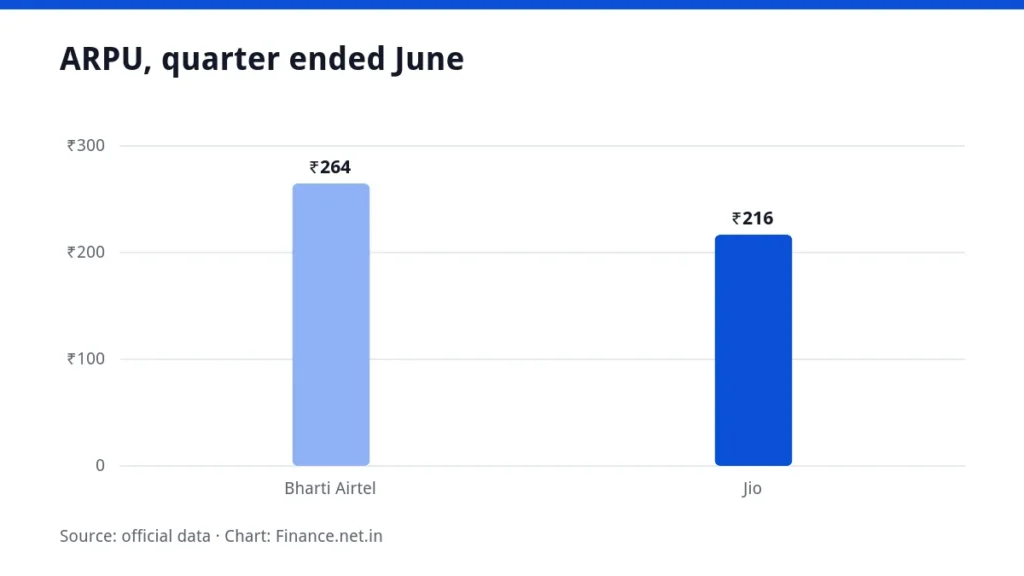
ARPU is average revenue per user: the revenue a company earns per customer in a period. Analysts watch it closely because it shows how much each customer is worth, not just how many there are.
EBITDA margin is earnings before interest, tax, depreciation and amortisation, as a share of revenue. It shows how much of each rupee of sales is left from day-to-day operations before those costs.
Here is how the two companies compared, as reported by Bloomberg in Mint and BusinessLine:
| Measure | Bharti Airtel | Jio Platforms |
|---|---|---|
| ARPU, quarter ended June | ₹264 | ₹216 |
| EBITDA margin | 57.4% | 53.3% |
| Trailing earnings multiple | nearly 37 times | 33.2 times |
The reports say Jio has more than 500 million subscribers and leads in wireless and fixed broadband, yet has lagged Bharti on ARPU for seven straight years. They link Bharti’s higher figure to a long-running strategy of shedding low-value customers in favour of higher-paying ones. The report says that shift began around the summer of 2019.
A trailing earnings multiple is the share value divided by the last 12 months of profit. A lower number means the market pays less per rupee of past earnings.
Why it is in the news
The immediate reason is the Jio Platforms IPO. An initial public offering (IPO) is a company’s first sale of shares to the public. Jio sought to raise as much as $3.1 billion, valuing it at $107 billion at the top of a price band of ₹1,065 to ₹1,119 per share.
According to the Bloomberg reports, bids for the full offer came in on the first day of bidding, and the subscription period was due to end on 23 October. That valuation is roughly 10% below Bharti’s, and the reports describe Bharti as Jio’s nearest sector rival.
Jio has since reported its second-quarter results. Its ARPU was reported at ₹218.8, with 542.4 million customers, according to the Times of India.
Analysts at Nomura wrote in a 10 October note that Bharti remained their top pick in the sector. They cited its higher share of premium subscribers, which they said should protect it if telecom services get costlier. That is an analyst view, not a recommendation from us.
What it means for you
If you are a mobile user, the reports mention an expected rise in mobile tariffs, which they say would lift telecom earnings. They do not give a date or size for any increase.
If you follow telecom shares, the comparison between the two companies shows that markets are weighing revenue per customer against sheer customer numbers. The reports say investors now prefer firms that earn more from each customer. Valuation views differ: Nomura and Motilal Oswal valued Jio at a premium to Bharti on enterprise value to EBITDA, per the same reports.
This is background, not a call to buy, sell or hold any share.