What happened
The initial public offering (IPO) of Jio Platforms was fully subscribed on its first day of bidding, Wednesday, 21 October 2026. According to reports in Mint and BusinessLine, citing BSE data, the issue was subscribed nearly three times by 4:35 pm in Mumbai. An IPO is the first sale of a company’s shares to the public.
Jio is seeking to raise as much as $3.1 billion. At the top of the price band of ₹1,065 to ₹1,119 a share, that values the company at $107 billion. ThePrint put the size of the sale at $3.2 billion, so reports differ slightly on the figure.
Mint reported that the issue was fully covered within 100 minutes, which it called rare for a mega offering in India. BusinessLine reported that, in the first two hours, total bids had already passed the 197.5 million shares being offered.
How each investor group bid
- Qualified institutional buyers: subscribed over seven times by the afternoon.
- Wealthy (non-institutional) investors: 1.51 times the shares reserved for them.
- Retail investors: about 68% of their allocation.
Anchor investors, which are large institutions that commit before the public issue opens, took stakes worth a combined $854 million at the top of the range. They included BlackRock, Fidelity Management & Research, Capital Group and Allianz. The subscription period ends on 23 October.
What it means for you
If you applied through the retail portion, note that it had not been fully covered by the end of day one, at about 68%. Subscription figures can change before the issue closes, so the day-one numbers are not a final tally.
The IPO also moved the currency market. Mint reported that foreign inflows into the offer pushed the rupee up as much as 0.5% to its highest level since 7 September, a six-week high.
Jio plans to use IPO proceeds to pre-pay a substantial part of its debt, according to the reports. That would strengthen its balance sheet as it looks to compete with Starlink in satellite communications. Indian regulators have yet to clear the applications of both companies.
Background
Jio launched in 2016 with free calls and cheap data, which set off a price war that led rivals to exit, merge or consider bankruptcy. The listing is Mukesh Ambani’s return to the IPO market after 20 years. He has said it will “unlock great value” for parent Reliance Industries.
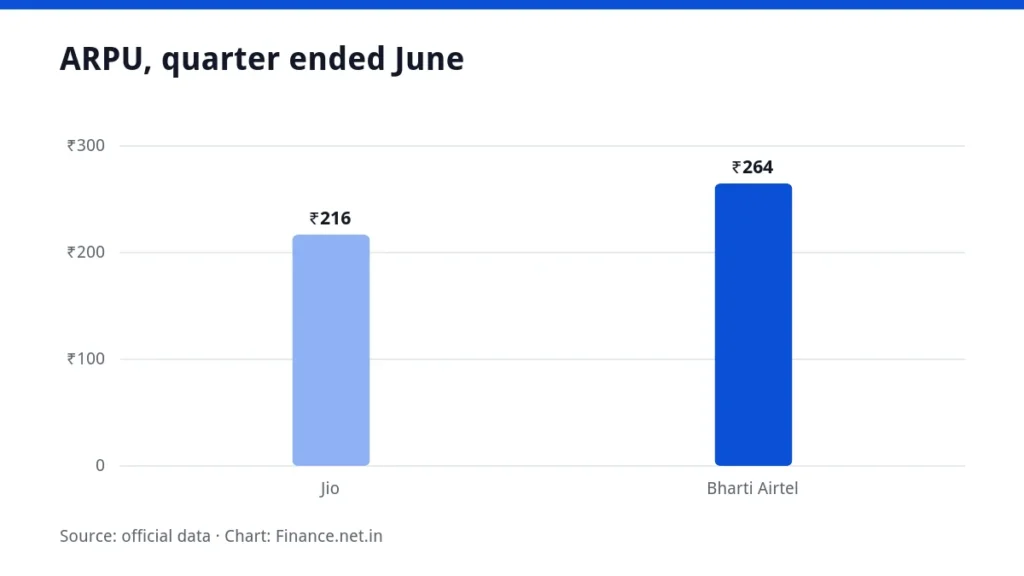
Jio is seeking a valuation roughly 10% below Bharti Airtel, which was valued at about $123 billion, according to BusinessLine. Jio has more than 500 million subscribers, but Bloomberg data show it has lagged Bharti on average revenue per user (ARPU, the monthly revenue earned from each customer) for seven straight years.
| Measure | Jio | Bharti Airtel |
|---|---|---|
| ARPU, quarter to June | ₹216 | ₹264 |
| EBITDA margin | 53.3% | 57.4% |
| Trailing earnings multiple | 33.2 times | nearly 37 times |
EBITDA is earnings before interest, tax, depreciation and amortisation. Nomura analysts wrote on 10 October that Jio will likely need to show growth to public shareholders after listing. Centrum Broking said Jio is well positioned for medium- to long-term growth. For background on the process, see our guide to the initial public offering (IPO).
What to watch next
The final subscription figures when bidding closes on 23 October are the next marker. Reports also point to a possible mobile tariff increase as a likely trigger for earnings. On the same theme, see the rupee’s early trade gains.